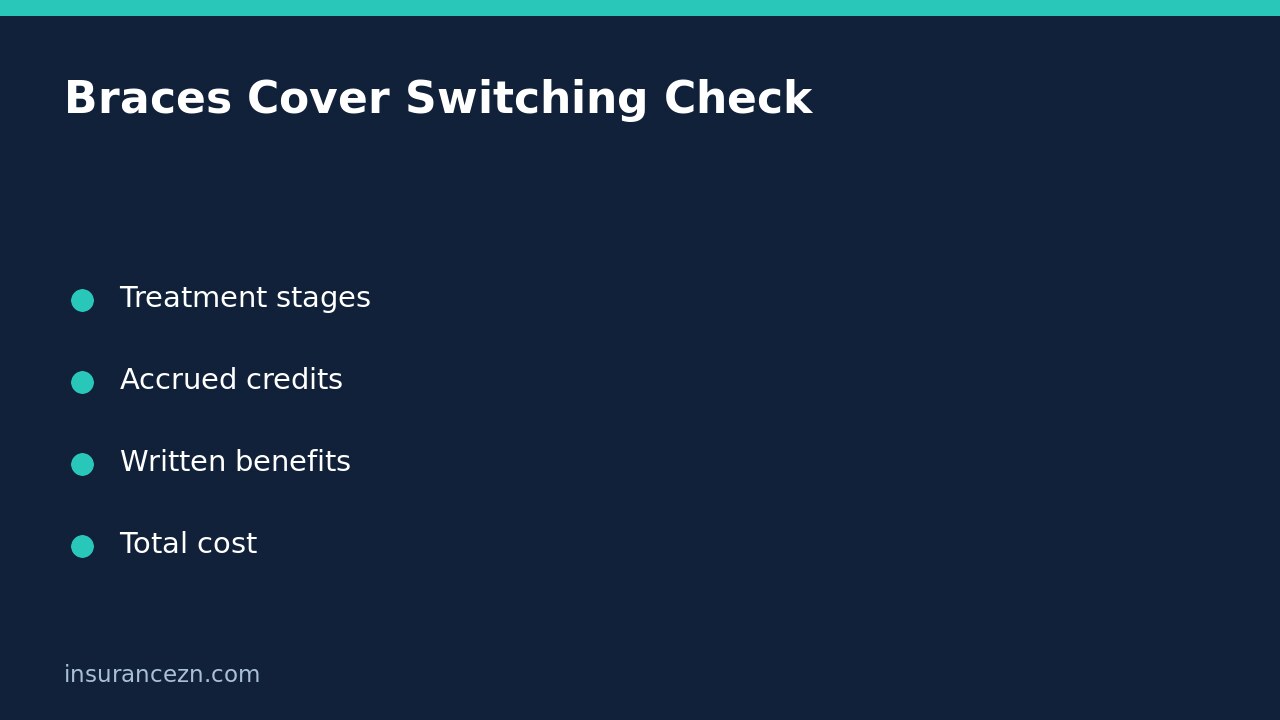

If braces are planned, compare more than the extras premium before changing Australian health funds. Ask whether any orthodontic benefits you have built up will survive the switch, and get a treatment-specific estimate from the proposed fund. Waiting-period continuity and the transfer of accrued credits are different questions.
This is general information for Australian readers, not personal financial advice. Benefits depend on the policy, fund rules and individual circumstances. Read the policy documents and any applicable PDS; obtain written confirmation before changing cover or committing to treatment.
Why a lower premium may not mean a lower treatment cost
PrivateHealth.gov.au’s policy-management guidance says to check whether accrued benefits, credits or bonus points can transfer to a new insurer. It notes that these usually cannot be transferred and gives accrued orthodontic benefits as an example. It also explains that benefits already paid by an old insurer may be considered when a new insurer determines annual limits.
That does not mean every person with braces should stay put. It means a premium comparison is incomplete until the funds explain what happens to your actual entitlement. A new policy’s advertised maximum is not proof that the whole amount is available for your next invoice.
Collect the treatment timetable before requesting quotes
Ask the orthodontist for an itemised plan showing the patient, proposed treatment, likely start date, payment stages and estimated fees. Ask whether the billing dates represent services already delivered, future appointments or an instalment arrangement. Do not change medically appropriate treatment dates merely to chase a possible benefit.
Then ask your current fund for a written snapshot of the orthodontic entitlement: benefits already paid, relevant remaining limits, any accrued amount and how future treatment stages would be assessed if you stayed. Keep the date of that snapshot because claims and policy changes can alter the answer.
Ask the new fund about the exact plan, not just braces cover
- Does this policy cover the proposed orthodontic services for this patient and provider?
- Which waiting periods are recognised, and which apply to new or higher benefits?
- Will prior orthodontic payments affect annual, lifetime or other applicable limits?
- Are any credits or accrued benefits recognised? If not, what entitlement would actually be available?
- How are the proposed treatment stages and payment dates assessed?
- What documents are needed before an estimate can become sufficiently specific to use in a comparison?
Do not treat a sales acknowledgement as confirmation that credits have transferred. Ask the fund to identify the policy and effective date in its response. An estimate remains subject to the actual services and claim conditions.
Compare two complete cost paths
Use the same treatment period for both options. In a worksheet, record the total payable premiums over that period, the same proposed treatment fees and each fund’s written estimated benefits. Compare premiums plus treatment fees minus estimated benefits. Keep uncertain amounts visibly marked rather than entering them as guaranteed payments.
For example, a proposed fund may quote a lower monthly premium while your current fund identifies accrued orthodontic benefits that the new fund will not recognise. The useful question is whether the confirmed premium saving outweighs the resulting increase in treatment costs over your chosen period. There is no universal answer, and a lifetime maximum cannot be substituted for a personal estimate.
Include other household extras services you genuinely expect to use. A braces-only calculation can miss a reduced dental or optical entitlement for another member. For a separate everyday dental comparison, use the dental premium and item-code worksheet; do not assume ordinary dental benefits describe orthodontic rules.
Check the processed change before relying on it
PrivateHealth.gov.au explains that a Private Health Information Statement is a summary and that example benefits are not personal guarantees. Use the official PHIS guide to compare broad features, then obtain the full product rules and a current quote.
If you proceed, confirm that the correct patient and extras product are active, the change date is recorded and outstanding transfer documents have been received. Ask the new insurer about continuity requirements before cancelling the old membership; do not invent a safe break between policies. Membership being active still does not establish that a particular orthodontic claim will be paid.
Quick questions before deciding
Does serving a waiting period transfer my credits? Not necessarily. Ask separately about waiting-period recognition and accrued entitlements.
Can I assume the advertised orthodontic maximum is available immediately? No. Obtain the rules and an estimate accounting for prior payments, treatment details and applicable limits.
What if the funds give conflicting answers? Send both the same treatment plan, identify the disputed entitlement and request clarification before relying on an unconfirmed saving.