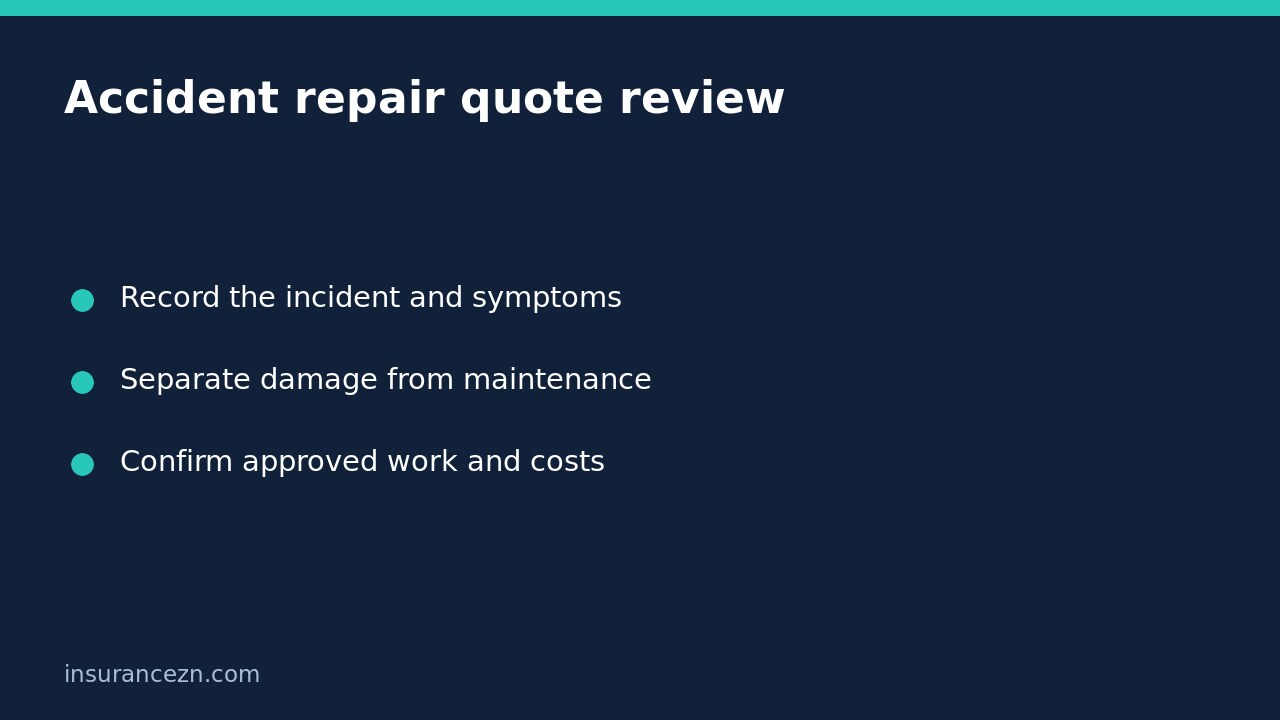

A workshop quote after a car accident is not necessarily a list of insured repairs. It may include collision damage, an unrelated mechanical problem and maintenance that was already due. Ask the repairer to explain each proposed item and ask the insurer which work it accepts under your claim. Do not assume that the timing of a symptom proves its cause, or that a comprehensive policy pays every cost needed to make the car roadworthy.
This is general information for Australian readers, not personal financial advice. Your policy, PDS, schedule and endorsements determine the available cover, subject to the circumstances and assessment. This article is an administrative checklist, not a mechanical diagnosis.
Start with the distinction in the policy
As a first-party example, AAMI’s comprehensive car insurance summary describes accidental damage cover but separately identifies wear, tear and gradual deterioration, and mechanical and electrical breakdown, under what is not covered. It also explains the owner’s responsibility to maintain a safe, roadworthy vehicle and notes that lack of maintenance can affect a claim.
Those are AAMI’s summary statements, not a universal ruling on another insurer’s contract or your particular incident. Read the wording that applies to your policy and ask how it applies to the proposed work. Roadside assistance is a separate service question; access to help or towing does not itself establish payment for replacement parts or accident repairs.
Give the repairer observations, not a guessed diagnosis
Write a short timeline before discussing the quote. Record the impact location, what you noticed immediately afterwards, any warning lights and whether the car was driven or transported. Include symptoms that existed before the incident and relevant servicing records. If you do not know when a symptom started, say so rather than inventing a date.
Do not drive an unsafe vehicle to collect evidence. Seek suitable professional help and follow safety advice. A road test should not be attempted simply to prove an insurance point.
Ask the repairer for an itemised estimate separating investigation, parts, labour and maintenance recommendations. Request a plain-language explanation of the evidence linking each disputed item to the incident. Useful evidence may include dated photographs and written inspection findings, but do not demand that the repairer guarantee the insurance outcome.
Work through a mixed quote line by line
Consider an illustrative quote after a front-corner collision. It includes a damaged bumper, a cooling-system investigation and replacement of worn tyres. These items being on one document does not establish one cause or one funding decision.
- Bumper: ask whether the insurer accepts this as incident damage and which repair scope it authorises.
- Cooling system: ask what the inspection found, what further testing is proposed and whether approval is required before that testing.
- Tyres: ask whether replacement is recommended for pre-existing wear or supported incident damage; do not relabel maintenance as accident damage.
This example does not decide the claim. The task is to make the supporting findings and the insurer’s decision visible for each item. An unclear line marked repairs is much harder to reconcile than a quote showing the precise part, work and reason.
Confirm who authorises work and who pays
Before approving non-urgent work, ask the insurer whether the repairer and quote require approval, whether investigation costs are accepted and how additional damage discovered during repairs should be submitted. Ask the workshop to distinguish insurer-authorised work from work you are personally being asked to purchase.
Get the expected excess and any separate customer-paid amount in writing. Check whether a quoted total already includes those amounts so you do not subtract or add them twice. An insurer receiving a quote is not the same as approving the scope. A repair booking is not proof that the insurer will pay every line.
If necessary safety work cannot wait, document the urgency and seek instructions as promptly as practical. Preserve invoices and inspection records. Avoid arranging optional improvements on the assumption they will be reimbursed.
Review a disputed exclusion without changing the evidence
If an item is declined as wear or breakdown, request the specific reason, relevant policy clause and findings relied upon. Compare that explanation with the workshop’s evidence. A factual disagreement about the cause should be identified precisely rather than answered by the broad statement that the problem happened after an accident.
For the written-decision process, see requesting a car insurance claim decision you can check. Use the existing claim reference and follow the insurer’s complaint pathway if the explanation remains unresolved.
Does an approved bumper repair mean the whole quote is accepted? No. Confirm the exact approved scope and any outstanding items.
Can the workshop decide coverage? It can explain its findings and proposed work, but obtain the insurer’s policy decision separately. Keep the final approved scope, customer authorisation and invoice together so any later discrepancy can be checked against the same records.