
If your Australian health fund’s remaining extras balance looks wrong, start with a dated record of the balance and the claims behind it. Do not immediately submit the same invoices again. The task is to reconcile the fund’s processed records with your actual services and ask it to explain any mismatch. An uploaded receipt, a pending claim and a paid benefit are different stages.
This is general information for Australian readers, not personal financial advice. Your entitlement depends on the policy, fund rules and service details. Read the policy documents, Private Health Information Statement and any applicable PDS; a balance review is not a guarantee of additional benefits.
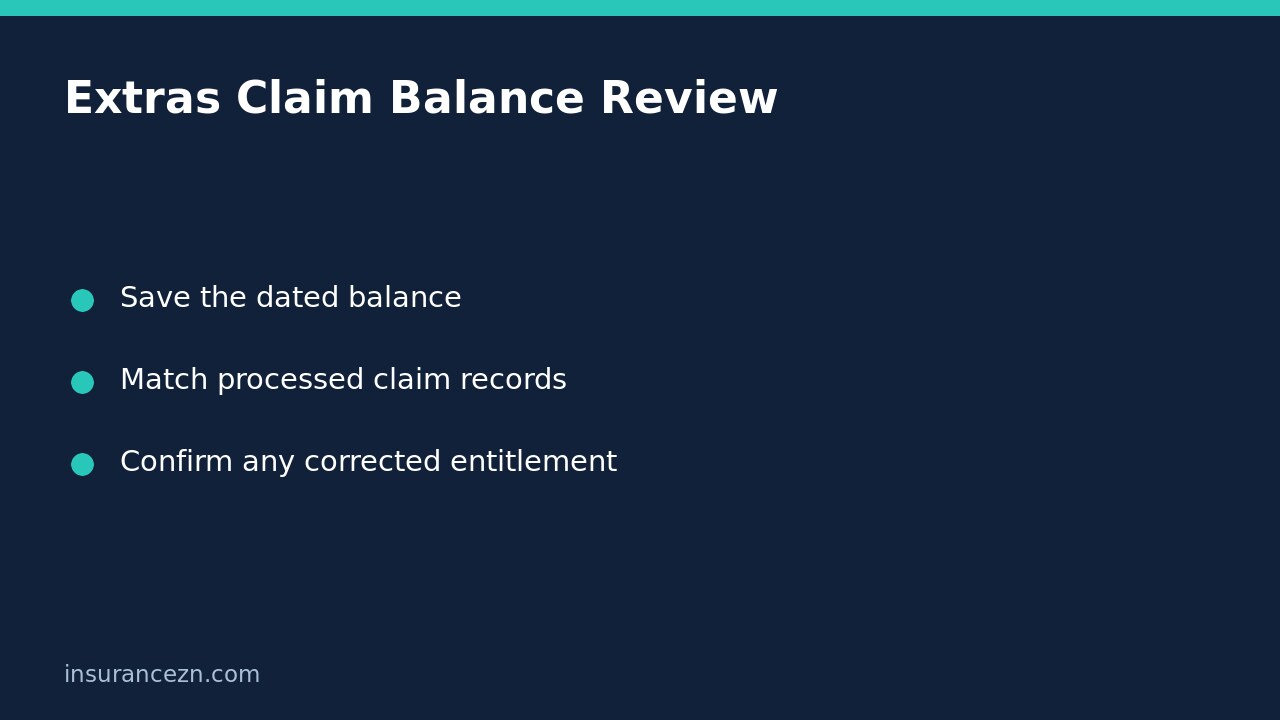
Save the balance you are questioning
Capture the displayed category name, member name, remaining amount and date of the screen or statement. Note which benefit period the display refers to. If a family membership shows several people, confirm whose balance you are viewing before drawing conclusions. Store screenshots securely because membership and treatment information is sensitive.
Ask the fund whether the displayed figure includes pending claims or other adjustments. An app label alone may not explain how the figure was calculated. Keep your enquiry tied to the particular category and period instead of asking only why your overall cover has changed.
Gather records that show actual claim outcomes
Create a folder containing itemised provider invoices, claim references, insurer assessments and payment records. A provider receipt shows what you paid; it does not, by itself, prove what the fund paid or which limit it used. Similarly, money arriving in your account may need matching to an assessment before you can identify the relevant service.
For each appointment, record the patient, service date, provider, invoice reference, service description or item number where supplied, claimed fee, assessed benefit and current claim status. Add the fund’s reference for any review or correction. Mark uncertain information as unknown rather than filling gaps from memory.
Make a claim-by-claim reconciliation table
Use separate columns for submitted, assessed and paid. Include a final column asking whether the claim is reflected in the displayed balance. For example, an appointment might have a receipt and submission acknowledgement but no assessment. Keep that row pending; do not treat it as both a completed deduction and a new claim to lodge again.
If you suspect the same appointment was recorded twice, compare patient, service date, provider and invoice details. Ask the fund to identify the underlying records. Two similar entries could reflect different services, an adjustment or a genuine duplicate; the appearance of a second line alone does not establish an error.
For an amended assessment, retain both versions and mark which one the fund says is current. Do not add the old and replacement benefit together. Ask whether any reversal, repayment or replacement payment has actually been processed and how it affects the remaining entitlement.
Check the rules behind the number
PrivateHealth.gov.au explains that general-treatment benefits are commonly limited, with possible per-service, yearly and lifetime limits. Some services are excluded altogether. Consequently, a remaining annual figure is not a promise that the same amount can be paid on your next appointment.
Ask which limit applied to each disputed assessment, whether another service uses the same pool and which benefit period was used. Confirm any person-specific or family limit rather than assuming the membership has one unrestricted shared allowance. If your cover changed, ask which rules applied on the relevant service date and how the fund treated the transition.
This review differs from deciding whether an advertised limit is generous. You are checking a specific membership ledger against real assessments. The fund may explain the balance without finding any error, or it may identify something requiring correction.
Send a precise review request
Use a concise message: ‘Please explain the remaining balance displayed on this date for this member and category. Attached are the relevant claim references and assessments. Please identify any pending items, reversals or shared-limit deductions, and confirm whether a correction is required.’
Ask for the explanation and any corrected assessment in writing through the fund’s approved channel. Record the enquiry reference and promised next step. Do not send passwords or unnecessary medical records. If the response does not address the identified mismatch, use the fund’s complaint process and include the earlier references rather than repeatedly resubmitting invoices.
Close the loop before relying on a higher balance
- Has the fund explained the disputed entries?
- Has any correction been processed, not merely requested?
- Does the updated balance match the confirmed outcome?
- Is any additional payment separately confirmed?
- Have you obtained a fresh estimate for the next appointment?
A corrected balance still does not establish treatment eligibility or guarantee the next benefit. If you are assembling documents across several insurance enquiries, the filing approach in our claim evidence register guide can help organise references, but car-claim rules do not determine health-fund entitlements. Keep each claim’s records and conditions distinct.