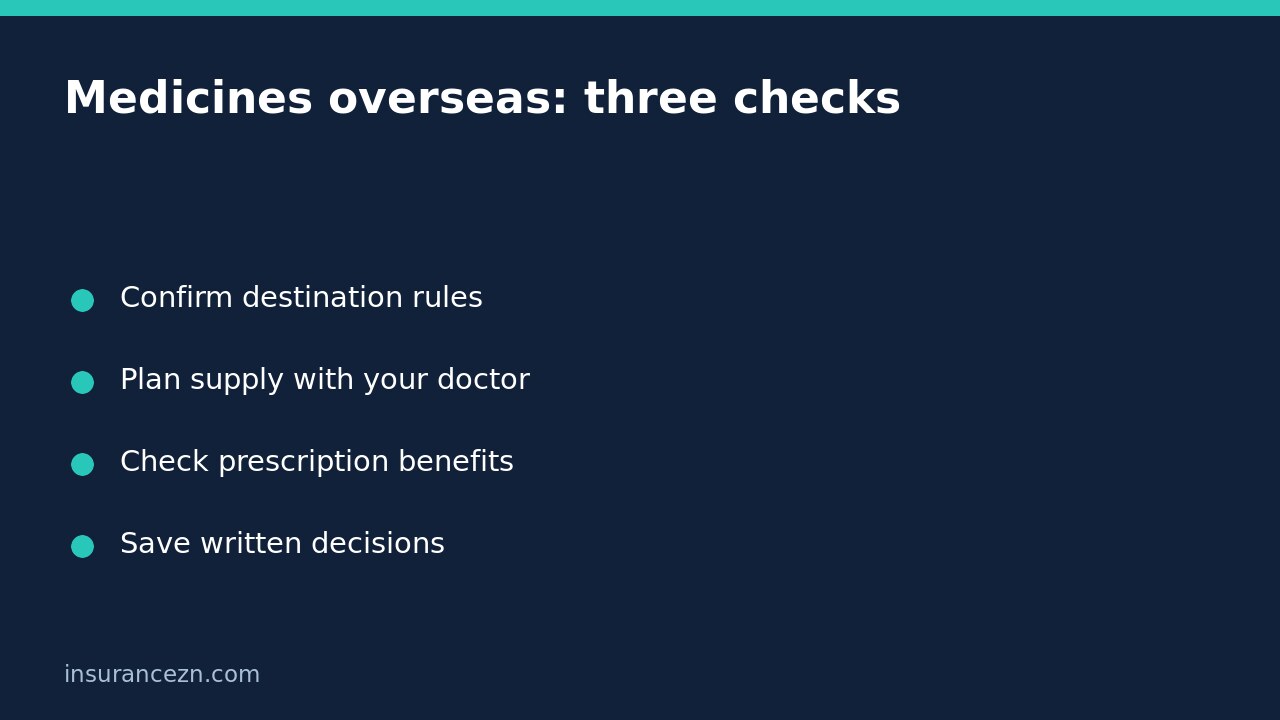

An Australian prescription and an accepted travel insurance policy do not establish that you can legally bring the medicine into another country. Before departure, make three separate checks: what the destination permits, what your clinician recommends for safe treatment, and what the insurer will pay under the exact policy.
This is general information for Australian readers, not personal financial advice or medical advice. Insurance benefits depend on the policy, Product Disclosure Statement (PDS), exclusions and any accepted conditions. Speak with your treating clinician about medication and use official destination authorities for import requirements. Never stop or change prescribed treatment solely to simplify travel paperwork.
Start with the medicine, quantity and actual route
Make a private list of each medicine’s name, active ingredient, strength, prescribed use and quantity you expect to carry. Include every destination and any transit arrangements that may require entry into another country. This is a checking document, not something to post publicly with your travel itinerary.
Smartraveller warns that medicines commonly used in Australia can be illegal or controlled overseas. Its examples include some ADHD medicines, opioid-based painkillers, sleeping pills and medications containing pseudoephedrine. Those examples are not a list of medicines prohibited everywhere: the rule must be checked for the actual substance and destination.
Contact the destination’s embassy or consulate, or follow its direction to the responsible authority. Ask whether your exact medicine and amount are allowed, whether a permit is needed, what documents are required and how the process works. Do not infer permission from another traveller’s experience or a medicine’s brand name.
Arrange clinical supply without overlooking legal limits
Smartraveller recommends seeing a doctor or travel clinic before departure and planning enough medication for the journey and unforeseen events. It also explains that limits apply when taking prescription medicines, including PBS medicines, out of Australia. A larger supply may solve a practical problem but still needs to fit the applicable legal rules.
Ask your doctor for documentation identifying the medicine, quantity and personal use. Discuss safe storage, treatment continuity and what to do if supplies are lost. Carry medication in its original packaging and keep appropriate prescription or doctor-letter evidence accessible.
If the destination restricts the medicine, take the official response to your clinician. A clinically suitable alternative is a medical decision; it is not something an insurer, booking agent or online article should prescribe. Do not change a dose or substitute a local product without professional advice.
Ask the insurer about prescriptions as a separate benefit
Medical emergency cover is not a promise that routine prescriptions or replacement medication will be reimbursed. Smartraveller’s medication guidance warns that most insurers will not cover prescription medication costs and that specialised cover may be needed. Treat that warning as a reason to inspect the particular policy, not as proof that every product makes the same decision.
Ask the insurer about at least three different situations: ongoing supplies for an existing condition, replacement after loss or theft, and medicines prescribed during a new illness or hospital episode. Request the relevant benefit, exclusion, limit, excess and evidence requirements for each situation. A baggage benefit or accepted medical screening does not automatically answer all of them.
Our medical-screening decision checklist explains how to match an insurer’s response with policy documents. Acceptance of a declared condition still needs to be distinguished from payment for every medicine associated with that condition.
Build a three-column evidence file
Consider a traveller carrying a prescribed medicine on a multi-country holiday. The doctor confirms the treatment plan, the first destination issues any necessary permission, and the insurer confirms acceptance of a declared condition. Those are three useful records, but none establishes the missing answers for the other destinations or the cost of replacing tablets after a lost bag.
- Legal record: destination authority response, applicable permit and approved quantity where required.
- Clinical record: prescription, doctor letter and practical supply or emergency plan.
- Insurance record: policy version, declared-condition outcome and written explanation of prescription benefits and exclusions.
Check names, travel dates and medicine details across the records. A submitted permit application is not an issued permit; an insurer’s enquiry acknowledgement is not an accepted amendment. Keep sensitive records secure and retain accessible copies for travel.
What if medicine is lost overseas?
Seek appropriate local clinical or pharmacy advice promptly, and use local emergency services if urgent care is needed. Do not delay necessary treatment while waiting for an insurance reimbursement decision. Be cautious about unfamiliar products: Smartraveller warns that overseas medicine can be counterfeit or differ in strength and ingredients.
Contact the insurer through its stated assistance channel, explain what happened and ask about the specific benefit and documents. Save relevant receipts and advice, but remember that assistance contact, claim lodgement and payment approval are different stages. If lawful replacement arrangements are unclear, consult the relevant local authority and medical professional rather than assuming an Australian prescription overrides local rules.
Sources: Taking medicine and medical devices overseas and Smartraveller’s travel insurance guidance.