
Before buying travel insurance for an overseas volunteer placement, compare what you will actually do with the policy’s activity and work conditions. An unpaid role, an ethical organisation and a placement acceptance letter do not establish that your insurer accepts every task. Get the duty description first, then ask each shortlisted insurer to assess that same description.
This is general information for Australian readers, not personal financial advice. Cover depends on the applicable policy, Product Disclosure Statement (PDS), exclusions and any accepted amendments; an enquiry response is not a guarantee that a later claim will be paid.
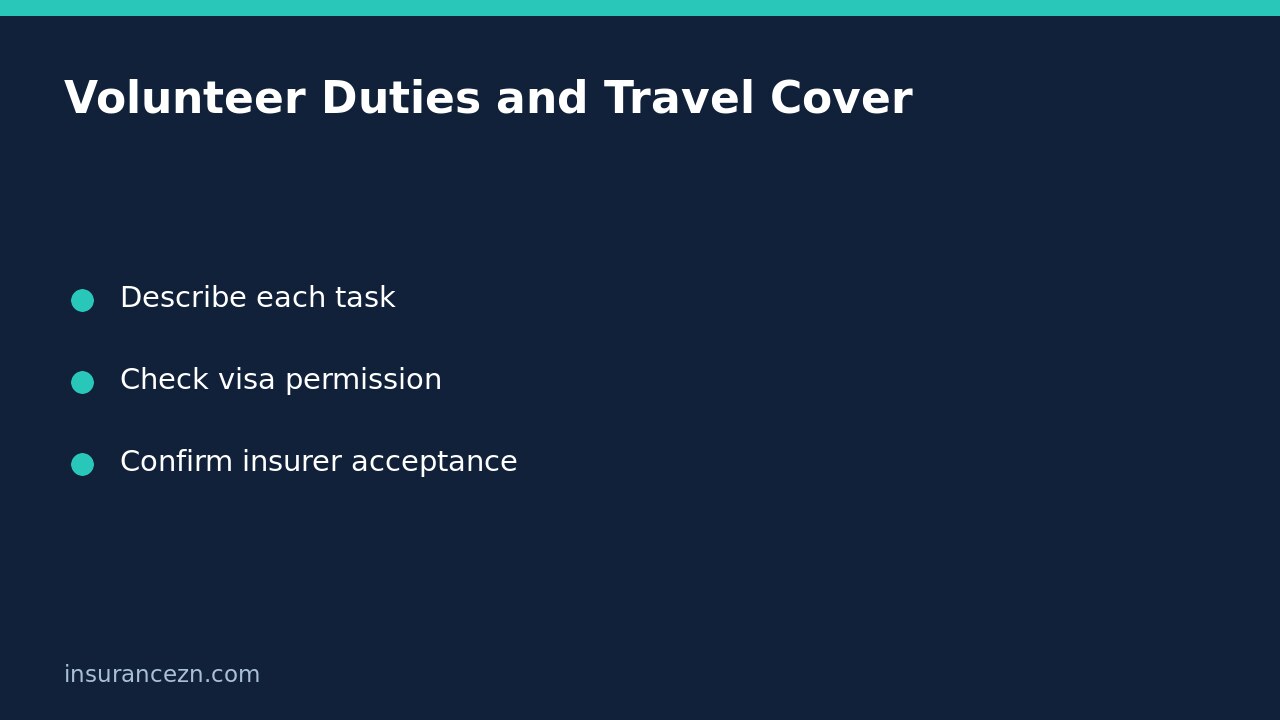
Turn the placement description into a task list
A programme called community support can involve office administration, lifting supplies, driving between sites or helping with building maintenance. Those are different activities even when they share the same programme name. Ask the organiser for a written description rather than inferring the duties from photos or marketing language.
- Record the countries, locations, placement dates and any travel before or after it.
- List routine duties, occasional duties, equipment, supervision and expected working conditions.
- Identify driving, manual work, work at height, animal handling or remote travel if proposed.
- Explain whether accommodation, meals or an allowance are provided instead of assuming unpaid means irrelevant to the policy’s work definition.
In its overseas volunteering guidance, Smartraveller recommends researching the organisation, matching your skills to the placement and checking whether the organisation requires specific insurance. That is a reason to obtain details, not evidence that a particular policy covers the work.
Separate permission to volunteer from insurance acceptance
Smartraveller warns that tourist visas can restrict paid and unpaid work, including volunteering. Confirm the destination’s requirements through its embassy or consulate and obtain the appropriate permission. The organiser’s willingness to host you does not establish that your visa is suitable.
Keep that legal-permission question separate from insurance. A valid visa does not remove an activity exclusion. Conversely, an insurer’s explanation of a benefit does not grant permission to work overseas. Resolve both before committing money that you cannot recover.
Compare quotes against the same written scenario
For example, imagine a traveller considering an unpaid community placement described as reception work, with occasional transport of supplies. These are illustrative duties, not a coverage example. Ask whether the transport means driving, riding as a passenger or carrying loads, then give both insurers the clarified description.
For each quote, record the response to these questions:
- Does this product accept the exact placement duties and locations?
- Which work or activity definitions, restrictions and exclusions apply?
- Is an optional section or a different product needed, and what does that change?
- What medical assistance and evacuation arrangements apply to the placement location?
- Are any liability or organisation-required benefits included, excluded or outside the product altogether?
Do not treat medical cover as proof of liability cover, or assume the organiser’s insurance protects your personal expenses. If the organiser says insurance is included, ask for the insurer, insured persons, policy wording and applicable limits before deciding what separate protection you need.
Reconcile the accepted cover before buying
Smartraveller’s travel insurance overview explains that policies differ and activities can require extra cover or be excluded. Read the PDS alongside the insurer’s written response. If a response merely acknowledges your email, keep the assessment open: received is not the same as accepted.
Where an amendment is offered, confirm the accepted duties, additional premium, conditions and effective dates, and check the issued documents match. Do not assume paying an extra amount fixes every exclusion. A later change from administrative work to construction or another task needs a fresh check rather than reliance on the original description.
Also check the ordinary trip boundaries. Our annual travel insurance trip-limit checklist helps you check whether the whole journey fits the selected product; acceptance of the volunteer duties does not itself extend the permitted trip length.
Quick questions before departure
Is unpaid work automatically accepted? Do not assume so. Ask about the actual duties and the product’s definitions.
Does the placement’s confirmation prove cover? No. Keep the organiser’s requirements, visa permission and insurer acceptance as separate records.
What should I save? Keep the duty description, insurer response, current policy documents and assistance access details. If duties change, resolve the change before undertaking them; do not wait for a claim to discover what the original acceptance meant.