
If an existing hearing aid needs repair, do not assume the extras benefit for buying a hearing aid also pays for repairing one. Obtain an itemised quote and ask your health fund to assess the exact proposed charges under your current product. A hearing-related allowance, a recognised provider or an unspent balance does not establish that every charge is eligible.
This is general information for Australian readers, not personal financial advice. Benefits depend on your policy, applicable fund rules and any relevant policy or Product Disclosure Statement (PDS) limitations. The questions below are a practical checking method, not a statement that all funds offer hearing-aid repair benefits.
Separate the device problem from the bill
Ask the clinic or repairer what work is proposed and whether it is a repair, replacement part, consumable, adjustment, consultation or complete device replacement. Obtain the device details and enough information to identify which aid is being repaired. You do not need to publish sensitive health information to make this enquiry.
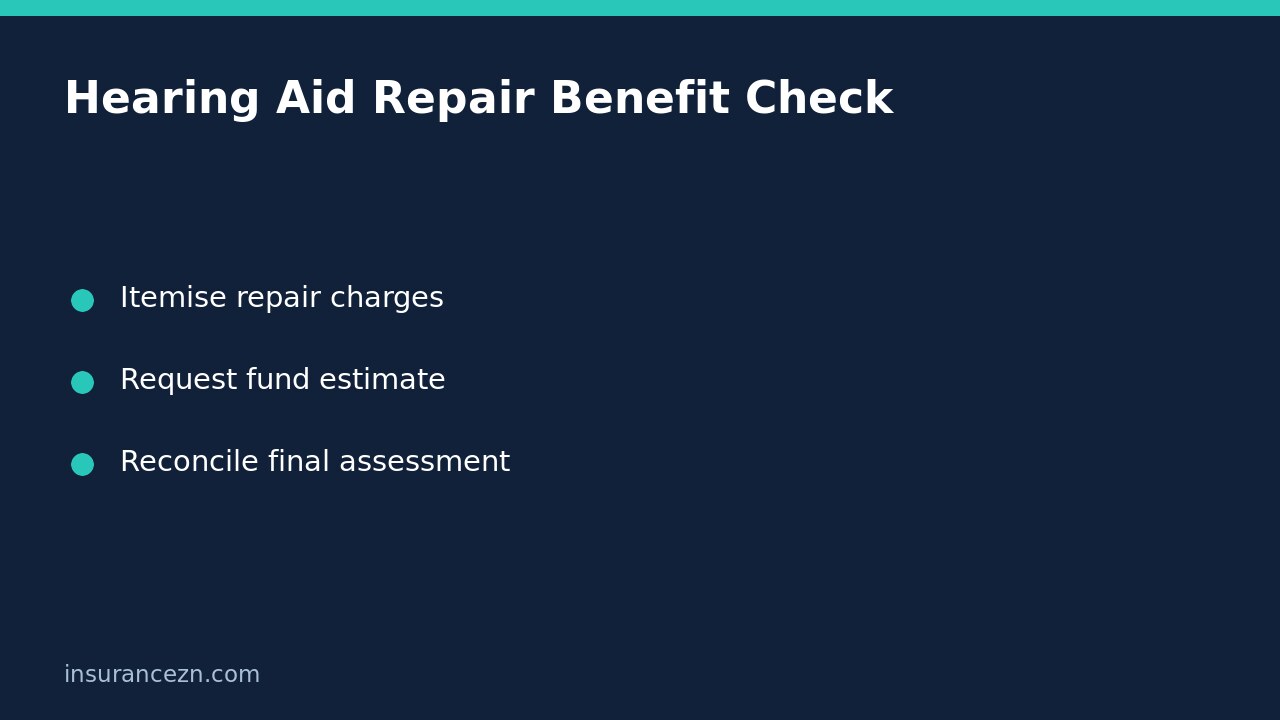
Request a quote that separates charges rather than showing only one hearing-care package price. Useful entries include the assessment fee, repair labour, parts, freight and any follow-up appointment. Ask whether the quote can change after inspection, whether a fee is payable if you decline the repair and who must authorise additional work.
If a warranty or service arrangement may apply, ask the supplier to explain it separately. A warranty decision and a health-insurance assessment are different processes. Do not assume an insurer will pay a charge simply because a supplier says it falls outside warranty.
Use government guidance for the boundary, not a promised benefit
The PrivateHealth.gov.au health-system overview lists hearing aids and other appliances among items for which Medicare does not provide benefits in its general comparison. It also explains that private insurance can cover many general-treatment services, with insurer limits. That overview does not establish a repair entitlement under your membership or determine eligibility for another assistance programme.
The government’s explanation of how health insurance works distinguishes hospital cover from general treatment, also called extras, and warns that policies limit what and when you can claim. Use that framework to ask your fund about the actual repair, rather than treating hospital cover or a generic extras heading as the answer.
Ask for a line-by-line estimate before authorising work
Send the quote through the fund’s ordinary secure channel and ask it to identify each eligible and ineligible line. Include the proposed service date, provider details and any service or item descriptions the fund requests. Ask:
- Does my exact product provide a benefit for this repair, or only for other hearing services or devices?
- Is this repairer or billing provider recognised for the proposed service?
- Are parts, labour, adjustments and consultations assessed separately?
- Which waiting periods, limits or prior claims affect the estimate?
- What evidence and final invoice wording will be required?
A useful response states the assumptions, estimated benefit and remaining uncertainty. If the fund only acknowledges receipt, request the substantive assessment before calling the amount confirmed. Recognition for one service is not proof of eligibility for every service a clinic provides.
Compare the repair option without counting benefits twice
Build a simple worksheet with one row per quoted charge: cost, estimated fund benefit, any separately confirmed supplier adjustment and expected personal payment. Label unresolved entries as unknown rather than entering the whole advertised allowance as a benefit.
If you also request a replacement-device quote, have it assessed as a separate alternative. Do not add the repair estimate and replacement estimate together as if both can automatically be claimed. Ask the clinician about suitability and timing, and ask the fund how choosing one option would affect the other. Insurance administration should not replace clinical advice or delay necessary care.
For a broader comparison of separately billed services, see our assessment-versus-therapy quote checklist. The shared lesson is to obtain service-specific estimates; speech-pathology benefits do not establish hearing-aid repair eligibility.
Reconcile the completed repair and final claim
After the work, compare the final itemised invoice with what you authorised. Save proof of payment and any revised description, then compare the fund’s assessment with its earlier estimate. An uploaded receipt is not a processed benefit, and a processed claim is not evidence that every invoiced item was paid.
What if the benefit differs? Ask which line, rule or assumption changed and request a written explanation. If a description is wrong, seek an evidence-backed correction from the provider rather than asking for a different label solely to obtain payment.
Does an annual balance prove another repair will be covered? No. Check the next service on its own terms, including the relevant limits and prior claims. Keep the final assessment so your next enquiry starts from the actual processed record.