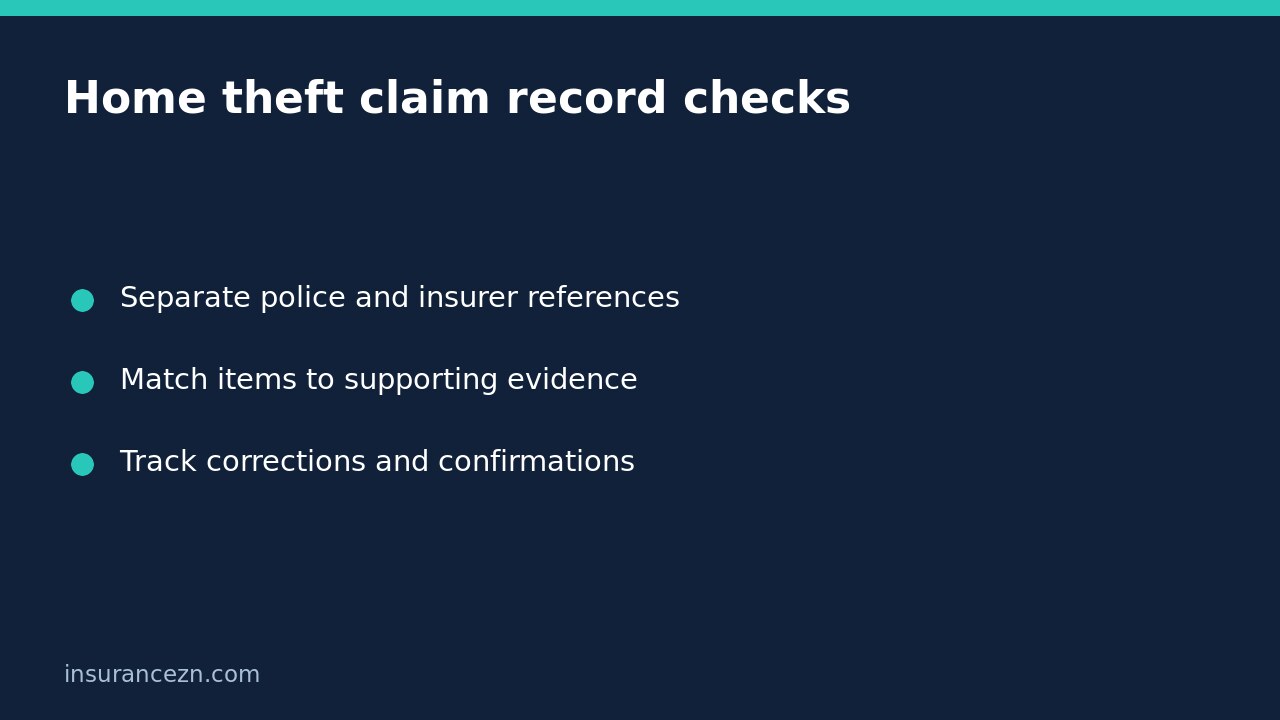

After a home theft, keep the police report and insurance claim connected without treating them as the same record. Save each reference separately, identify which missing items appear in each version, and ask how to submit evidence-backed updates. A police report records a reported incident; it does not establish insurance coverage, ownership of every item or payment approval.
This is general information for Australian readers, not personal financial advice. Cover depends on your policy, Product Disclosure Statement (PDS), schedule, exclusions and claim assessment. The checklist below is an organisational aid, not a universal insurer or police reporting procedure.
Start with safety and the correct reporting channels
Do not confront an intruder or enter an unsafe property to collect paperwork. Seek emergency help when necessary. Once safe, use official police and insurer channels rather than links in unexpected messages. Ask each organisation what information it requires and retain the resulting instructions.
As a provider-specific example, Suncorp’s home claims instructions say that a theft loss needs to be notified to police and a report obtained. They also say customers can lodge a home claim before every detail is ready and add details later. Other insurers’ processes and policy duties may differ; do not assume one provider’s workflow changes your reporting obligations.
Create a reference sheet before sorting the evidence
Use a single private reference sheet with separate fields for the police report number and insurer claim number. Add the insured address, policy number, date discovered, known incident period and the contact channel used. If the incident time is uncertain, record the last time the property was known secure and the discovery time rather than inventing an exact time.
- Label each reference by organisation and purpose.
- Record when each report was submitted and any outstanding requests.
- Keep copies of the original descriptions and item lists.
- Distinguish an acknowledgement from confirmation that a correction was processed.
A police reference entered into an insurer form is not an insurer claim number. Likewise, an insurer’s acknowledgement is not confirmation that police have received an amended list.
Reconcile missing items without manufacturing certainty
Build an item register with a stable label for each item, its description, identifying features, ownership evidence, police-list status, insurer-list status and next action. Separate known details from estimates. A serial number copied from a genuine device record is different from a number guessed from a similar model online.
For example, suppose a laptop appears on the first police report but a camera is only noticed missing the next morning. Mark the camera as a later discovery, preserve any photographs or purchase records, and ask both organisations how the additional information should be recorded. Do not silently rewrite the original report date or describe the camera as already included.
Keep original purchase price, advertised replacement price and any insurer valuation in separate fields. An advertisement for a newer camera is not proof of the stolen camera’s specification or an agreed settlement value. For a more detailed register, see tracking an incomplete contents claim list without guessing.
Send targeted updates and confirm their allocation
Use the recipient’s approved channel and identify the existing reference prominently. Explain whether you are adding an item, correcting a description or supplying evidence for an existing entry. Keep the previous version and label the replacement clearly so the recipient can follow the change.
Suncorp’s instructions describe uploading supporting documents through its account or app, or emailing them with the claim number in the subject. That is a Suncorp example, not a direction to send another insurer’s records there. Ask your own insurer which channel and file format it accepts.
After sending, check which documents were attached to the correct claim and whether the item list was updated. Evidence receipt, item recording, review, coverage acceptance and payment approval are separate stages. Do not open another insurance claim merely because an attachment confirmation is unclear; reconcile the existing reference first.
Final checks before the next claim conversation
- Can you distinguish the police reference from the insurance claim reference?
- Are later discoveries dated and uncertainties explicitly labelled?
- Does each item point to evidence rather than an assumed value?
- Have outstanding requests and processed corrections been recorded?
- Are sensitive records stored privately and shared only through verified channels?
Does a police report guarantee the insurer will pay? No. It supports the incident record, but the insurer still assesses the policy and evidence. Must every item be known before lodgement? Follow your insurer’s instructions and notification duties; Suncorp’s cited process allows later details, but that does not promise that every added item will be accepted.