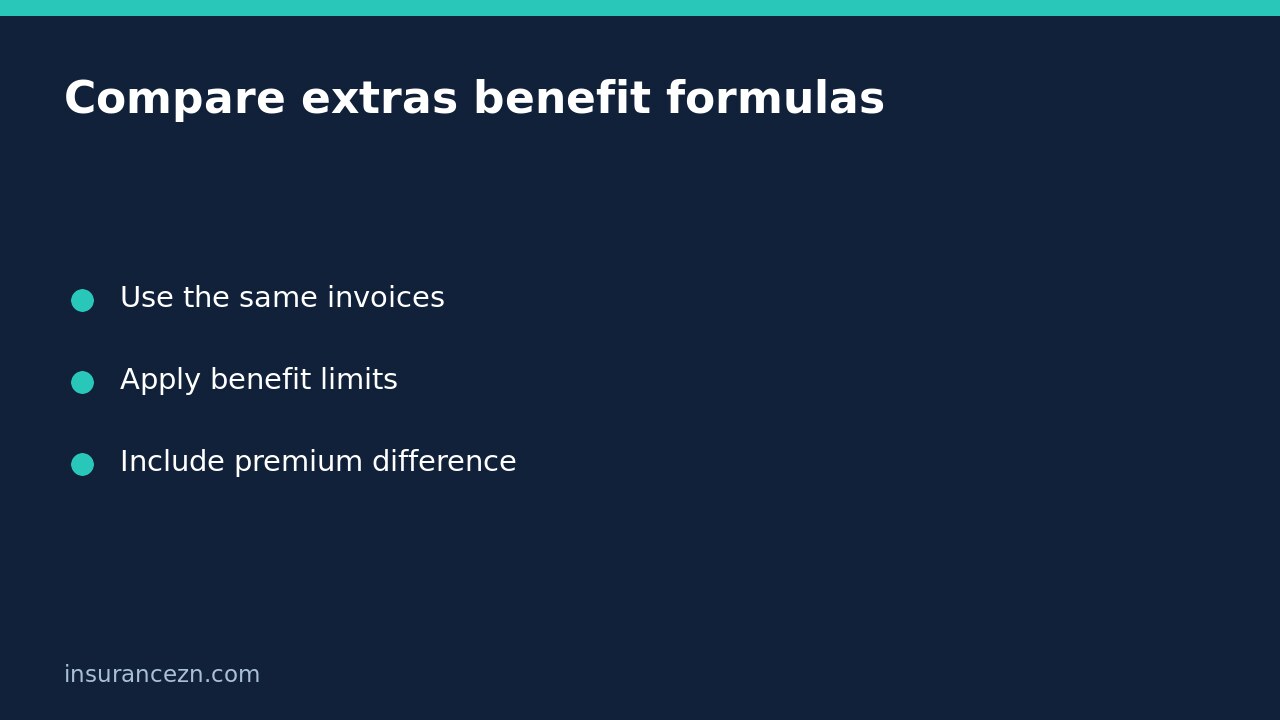

A percentage-back headline is not enough to establish that one extras policy is cheaper than a policy quoting a dollar benefit. Compare the amount each would actually pay on the same services, then include the premium difference. The useful result is your estimated total cost, not the largest advertised percentage or annual limit.
This worksheet is for Australian readers comparing benefit formulas supplied in their own quotes. The numbers below are invented to explain the calculation; they are not current insurer offers or promised rebates.
Get matching service-specific estimates first
Ask your provider for the service description, item code if used, fee, practitioner details and expected appointment dates. Submit those same details to both funds. Ask each fund for a written estimate under the exact product you are considering.
PrivateHealth.gov.au explains that general treatment benefits depend on the policy and may be limited per service, per year or over a lifetime. Some services are not covered at all. Its overview supports checking actual limitations; it does not establish a particular fund’s dollar schedule or percentage formula.
For a percentage quote, ask what amount the percentage applies to: the actual eligible charge, a recognised fee, or another contractual base. Ask whether a maximum benefit also applies. For a dollar quote, check whether the figure differs between initial and subsequent appointments, service codes or providers. Do not substitute a comparison site’s sample benefit for a personal estimate.
Work through one invoice before a whole year
Consider a hypothetical eligible appointment costing $180. Assume all required waiting periods have been served and the practitioner and service qualify under both products. Suppose Product A confirms a $60 benefit, while Product B confirms 50% of that full invoice, with no further cap affecting this appointment.
- Product A: $180 fee minus $60 benefit leaves $120 to pay.
- Product B: 50% of $180 is $90, leaving $90 to pay.
- For this appointment only, Product B reduces the gap by $30.
Those assumptions matter. If the percentage applies to a smaller recognised amount, or a service cap reduces the payment, the result changes. A provider price increase also need not increase a fixed-dollar benefit. Replace every invented input with the fund’s estimate rather than assuming the headline describes the full calculation.
Apply remaining limits across the appointment sequence
Now assume four identical eligible appointments in the same benefit year. The combined fees are $720. Without a binding annual or shared limit, Product A would contribute $240 and Product B $360, leaving treatment gaps of $480 and $360 respectively.
Next introduce an invented restriction: Product B has only $250 remaining in the relevant allowance. Even though the per-appointment calculation initially suggests $360, that remaining allowance would cap the total at $250 under this simplified scenario. The treatment gap becomes $470, only $10 below Product A’s $480 gap. Confirm how the actual fund applies limits and rounds payments; this illustration is not a universal processing rule.
Build one row for every planned visit. Record the benefit before limits, the applicable remaining balance and the estimated payment after limits. Where several services share a pool, deduct each payment from that same pool rather than giving every service a fresh allowance. Do not count appointments you do not actually expect to attend merely to make cover appear valuable.
Add premiums over the same comparison period
If the percentage product costs more, its extra benefits must be considered alongside that additional premium. Using the uncapped four-appointment example, its extra benefits are $120. An additional premium greater than $120 over the same period would outweigh that particular treatment saving, before considering any other genuine differences.
That is not a recommendation to choose either product. Include other services you reasonably expect to use, while avoiding double-counting shared balances. Keep hospital cover equivalent if comparing combined products. If considering separate products, read how to compare the combined cost of separate hospital and extras policies.
The government’s private health insurance basics also highlights waiting periods and policy limitations. A better-looking calculation is not useful if the proposed treatment is ineligible during the period being compared.
Questions before changing cover
Is a percentage always better on expensive visits? No. The eligible calculation base, per-service cap and remaining allowance can change that result. Obtain the actual estimate.
Does an annual limit tell me what I will receive? No. It is a limit, not a promised payment or a balance automatically refunded to you.
What confirms a switch? Keep the accepted product, commencement date, premium and any waiting-period or transfer assessment. A submitted application is not proof that the intended membership change has been processed. An estimate remains separate from the final claim assessment.
This is general information for Australian readers, not personal financial advice. Benefits and eligibility depend on the applicable policy terms, fund rules, PDS where applicable and service-date circumstances. Confirm your own estimates with the insurer before relying on this comparison.