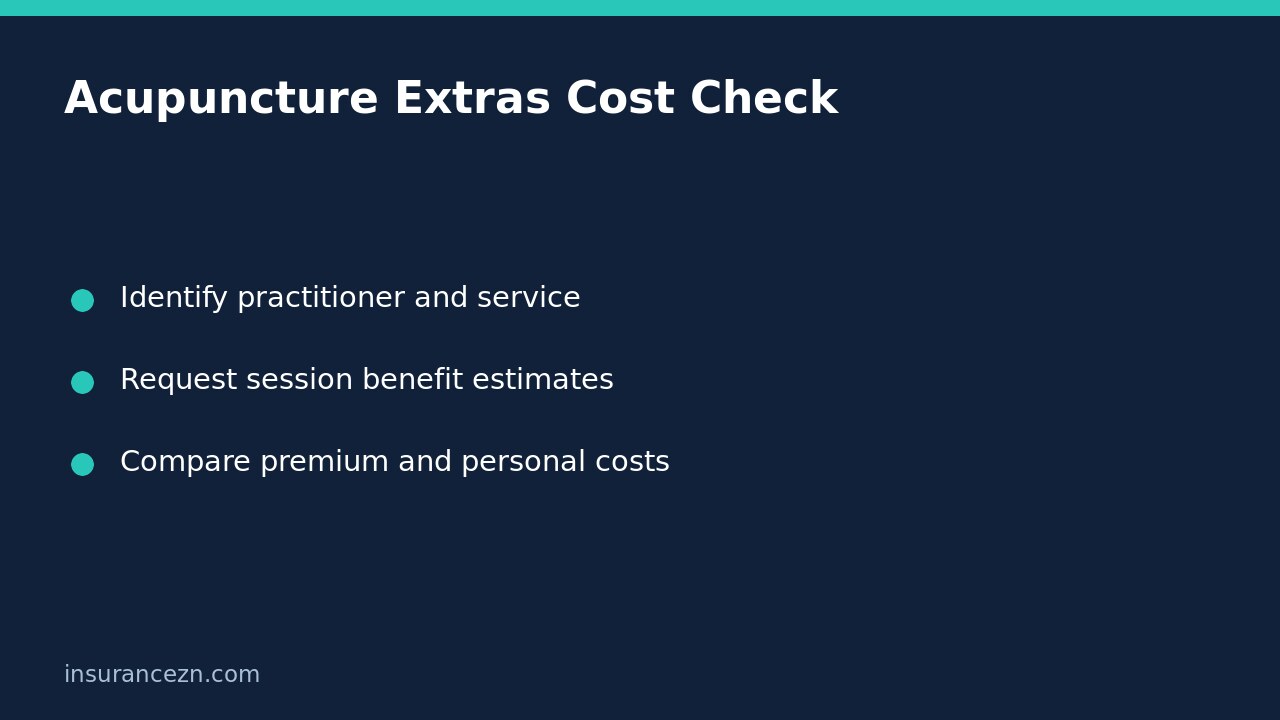

Do not buy or upgrade extras cover for acupuncture solely because the service appears in a product’s list. First identify the actual practitioner and appointment, obtain a personal benefit estimate, and compare the additional premium against the benefits you could realistically use. A large advertised annual limit is not the same as the rebate for your appointment.
This is a cost-comparison worksheet, not a recommendation to undergo acupuncture or change clinically appropriate care. Ask a qualified treating practitioner about suitability and timing; insurance administration should not determine urgent treatment decisions.
Start with the exact service, not the clinic’s label
The Australian Government’s PrivateHealth.gov.au health-system overview identifies acupuncture among services Medicare generally does not pay for, with a qualification where it forms part of a doctor’s consultation. It also explains that private insurance can cover many general-treatment services, usually with per-service and annual limits.
That overview does not establish that your particular fund pays for a particular appointment. Nor does the reference to a doctor’s consultation mean every acupuncture visit qualifies for Medicare. Ask the clinic how the service will be described and billed, then check the relevant eligibility with the fund or Medicare as appropriate. Do not count two payments for the same expense without confirming the applicable rules.
Record the practitioner’s name, provider details, clinic location, proposed service description, appointment length and quoted fee. If a clinic offers several therapies, ask which service will actually appear on your account. Recognition of one practitioner or service is not evidence that every item sold by that clinic is eligible.
Obtain a session-level estimate from each fund
Give the insurer the same appointment details used in the clinic quote. Ask whether the proposed practitioner and service are recognised under the exact product you are considering. Where there is a billing code or other service identifier, include it rather than guessing from a marketing heading.
- What benefit is estimated for the initial appointment?
- Does a follow-up appointment have a different eligible benefit?
- Is there a session limit, annual cap or shared limit with other treatments?
- What waiting period or other eligibility condition would apply personally?
- Would any part of the quoted account be ineligible?
Ask for the estimate and its assumptions in writing. A benefit estimate is still not the final claim assessment. The actual service, invoice, membership eligibility and available limits at the time of treatment can affect payment.
Build two matched appointment budgets
Use the same planned appointment sequence for both options. For each visit, write down the clinic fee, estimated eligible benefit and the amount you would pay yourself. Keep the initial appointment separate from follow-ups if their fees or benefits differ. Do not multiply the largest advertised rebate by every visit.
Then compare a realistic treatment period with the premium payable over that same period. One column might show your current cover and the other an upgrade. If you are considering adding extras to hospital-only cover, compare that actual additional premium rather than the price of an unrelated package.
Count other extras benefits only if you reasonably expect to use them and they are eligible. Avoid treating unused annual limits as cash savings. Include shared-limit effects: using a benefit for another therapy may leave less available for the planned acupuncture sessions if the product groups them together. Ask the fund for the exact grouping rather than assuming one.
Handle timing and treatment changes explicitly
A short course starting soon may not fit a new product’s waiting-period rules. Check the proposed commencement date, when eligible benefits become available, and how the product’s benefit year affects your planned visits. Do not assume switching or upgrading removes every waiting requirement or restarts every balance.
If the practitioner changes the treatment plan, update the budget instead of relying on the original session count. Clinical needs can change, and a quoted course is not an insurance entitlement. Do not book unnecessary appointments merely to use an allowance before its reset date.
Before accepting a change, request the final premium and product details. Afterward, check the processed membership record and effective date. An online application acknowledgement does not establish that the requested cover is already active or that tomorrow’s appointment qualifies.
Questions that expose a misleading comparison
Can the clinic guarantee my fund rebate? Treat a clinic’s indicative figure as a starting point. Confirm your own membership, provider recognition and service details with the fund.
Is an annual limit the amount I will save? No. Your benefit depends on eligible services and product rules; your overall cost also includes premiums and unreimbursed charges.
What should I retain? Keep the clinic quote, fund estimate, product documents, processed membership confirmation and final itemised accounts. Use them to reconcile what was proposed against what was assessed.
For a different treatment with similar session-level budgeting needs, see our psychology extras session and premium comparison. Do not transfer its service eligibility or benefits to acupuncture.
This is general information for Australian readers, not personal financial advice. Read the applicable policy, PDS or health-fund product rules, exclusions, limits and waiting periods. Neither a comparison worksheet nor a benefit estimate guarantees claim payment.