
If more damage appears while a home claim is open, do not automatically add it to the first incident or automatically lodge a duplicate claim. The important question is whether you have discovered more damage from the original event, experienced a later event, or cannot yet tell. Preserve the timeline and ask your insurer how to record the facts without guessing the cause.
This is general information for Australian readers, not personal financial advice. Your policy, Product Disclosure Statement (PDS), schedule, exclusions and the insurer’s assessment determine cover and any excess. An open claim does not establish protection for every subsequent loss.
Separate discovery time from event time
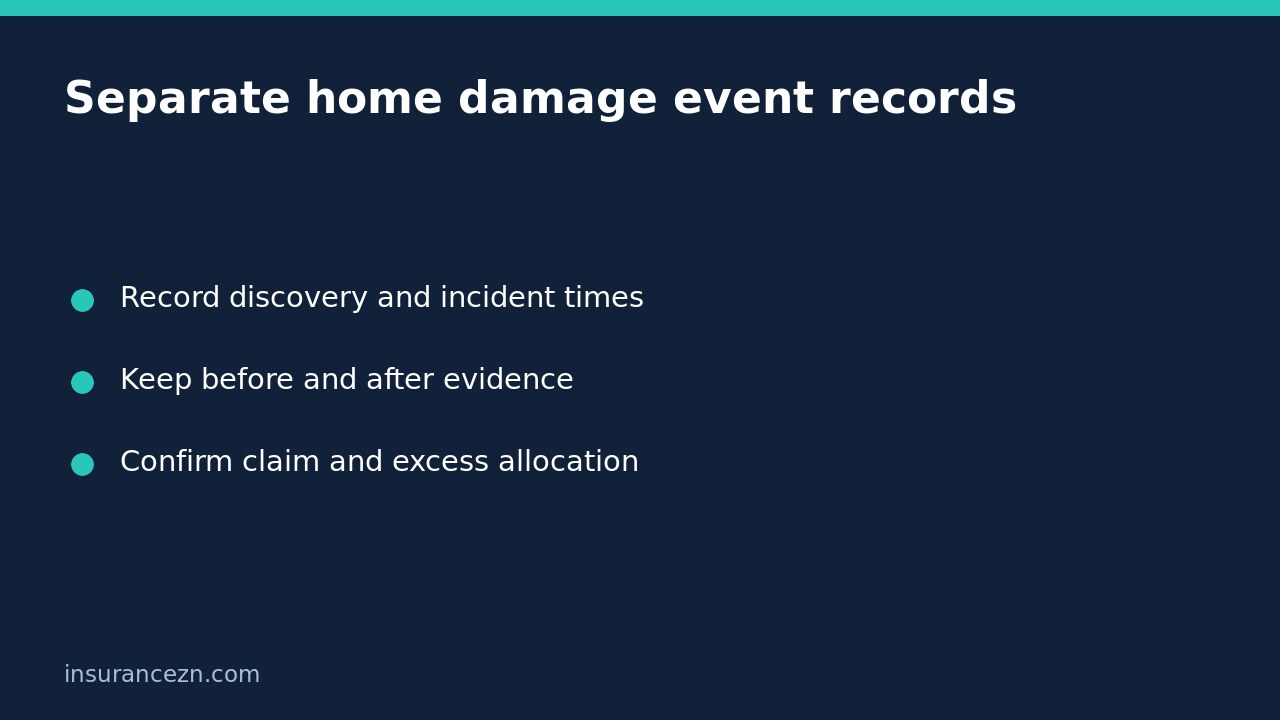
A stain found on Thursday might have resulted from Monday’s storm, a new Thursday leak, or something else. The date you noticed it is not necessarily the date it began. Write down the discovery time, the last relevant observation and any later weather or plumbing incident you actually witnessed. Keep unknowns explicit.
The distinction appears in Suncorp’s home claims instructions. For more damage or stolen items discovered after a claim, Suncorp says to make a note, take photographs and tell it when next in contact. Separately, it directs customers to make a new claim if a different part of the home is damaged by another insured event. These are that provider’s instructions, not a universal rule that every new mark requires another claim.
Preserve two timelines rather than rewriting one
Keep the original incident description and evidence unchanged. Create a later-discovery note or a separate possible-event record, with links back to the first claim. Include the location, visible condition, date observed, photographs, known temporary repairs and any change since the last inspection.
For a hypothetical example, a storm damages the roof and the insurer arranges temporary protection. Several days later, a washing-machine hose bursts in a different room. Record the burst hose and resulting damage separately rather than describing it as more storm damage. Whether either loss is insured, and how claims or excesses apply, still requires assessment.
By contrast, discovering wet insulation during an assessment does not itself prove a second event. Ask the assessor to identify what they observed and what remains uncertain. Avoid labelling all later findings as a new incident simply because they were not visible on the first day.
Keep safety work and evidence connected
Do not postpone necessary safety action to obtain better photographs. Avoid unsafe rooms, electrical hazards and entry into damaged roof spaces. Contact the insurer promptly about urgent assistance and follow emergency advice where needed. Preserve photographs and itemised work records when it is safe to do so.
Suncorp’s cited instructions generally require consent before repairs, with stated exceptions where contact is not possible and emergency work is needed to protect property, or for health and safety. They also discuss damage photographs and itemised invoices for assessment. Do not generalise this into permission for unrestricted permanent repairs under every policy.
Tell the insurer what temporary work occurred before the later damage, who performed it and what the contractor actually reported. Temporary protection, a contractor’s attendance and a paid invoice are not proof that all subsequent damage is covered or that reimbursement has been approved.
Ask how the insurer will allocate the records
Use the existing claim reference to explain the new facts and ask whether the insurer needs an update, a separate claim, or further investigation before deciding. If a second claim is required, keep both references and ask which event, damaged area, documents and expenses belong to each. Do not submit the same repair expense twice as though it were two separate costs.
- Which incident description is currently recorded for each reference?
- Which damage is accepted, disputed or still being investigated?
- Which invoice lines relate to each assessed repair scope?
- What excess is proposed for each claim, and why?
- What confirmation shows that any requested allocation correction was processed?
A reference number or uploaded photograph establishes neither accepted causation nor a final excess decision. If an invoice contains work affecting both areas, ask for clear line items rather than inventing a percentage split. Obtain the insurer’s recorded position before treating an expense as allocated.
Check the outcome, not just the submission
After contact, save the insurer’s explanation and compare it with your timeline. Correct factual errors using the underlying evidence, retaining the earlier version. If the cause remains uncertain, say so. For related risks during self-managed repairs, see checking insurance during cash-settlement repairs; this is a separate issue from deciding how a later incident should be recorded.
Does a second claim always mean a second excess? Do not assume either outcome: ask for the policy basis and assessed event allocation. Can an upload into the original claim settle the classification? No. Receipt is not confirmation that the insurer has reviewed the cause, corrected the record or accepted payment responsibility.