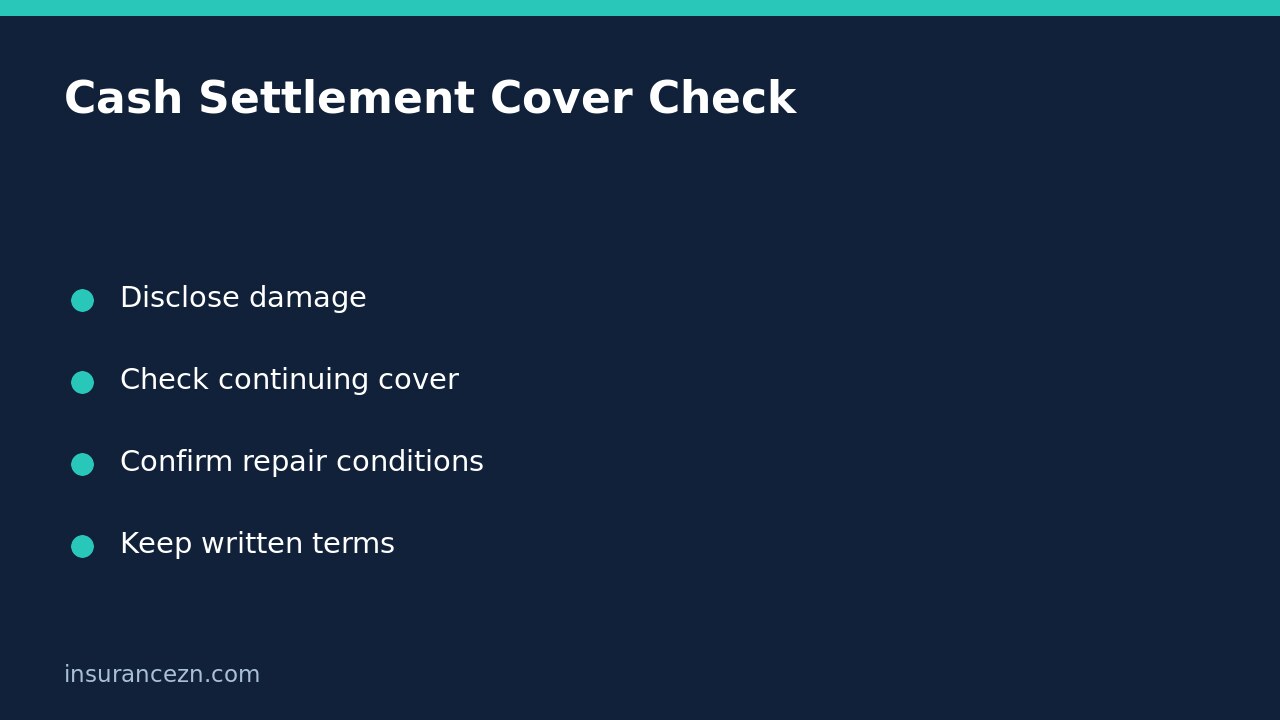

A home insurance cash settlement can leave you managing repairs while the building is still damaged. Before accepting, check whether your current insurer will continue cover, what that cover excludes and what another insurer would require if you need to move. Receiving money for one loss does not answer how the property will be insured against the next one.
This is general information for Australian readers, not personal financial advice or legal advice. Your policy, Product Disclosure Statement (PDS), settlement wording and individual circumstances determine the available cover. No worksheet or insurer enquiry guarantees acceptance, renewal or payment of a future claim.
Separate the settlement decision from the next-loss question
The first question is whether the proposed settlement fairly resolves the existing claim. The second is what insurance remains available while the home is awaiting or undergoing repairs. Both matter, but they require different evidence. A satisfactory repair quote does not prove that the damaged property remains acceptable to an insurer.
Legal Aid NSW’s October 2023 disaster-claims brochure specifically advises checking whether a property can be insured before accepting a cash settlement. It notes that many insurers will not insure damaged property and suggests enquiries with other insurers or asking the existing insurer to address continued insurance in the settlement agreement. Treat that as a practical warning, not a universal refusal rule.
Describe the actual condition, not the intended finished home
Prepare a concise condition summary using information you can support: rooms affected, whether the home is occupied, known structural concerns, temporary protection, proposed repair work and the expected sequence. If a completion date is only an estimate, say so. Do not describe damage as repaired because settlement money is available or a builder has been booked.
- Identify outstanding damage separately from improvements you plan to fund yourself.
- Record whether anyone is living in the home and any expected vacancy.
- Explain what temporary protection has been installed, without asserting it makes the building safe.
- Keep relevant assessments and the proposed scope ready for insurer questions.
- Correct inaccurate answers in an application before relying on the quotation.
Do not enter an unsafe building to complete this list. Use existing reports and ask appropriately qualified people for condition or safety information where needed.
Ask the existing insurer precise continuity questions
Ask for written answers linked to your policy reference and the disclosed condition. Will the policy continue after settlement? Is that answer about the present policy period only, or does it also address renewal? Are any exclusions, higher excesses, occupancy conditions or repair milestones proposed? What changes must be reported as work proceeds?
Check what the answer means for each insured interest. Building, contents and liability questions should not be collapsed into a vague assurance that you are “still insured”. Ask about the events and property you are concerned about rather than assuming every section continues unchanged.
If the insurer proposes a settlement clause about ongoing cover, request an explanation of its limits and how it relates to the policy. Obtain independent legal advice if you do not understand a release, undertaking or condition. An email expressing willingness to consider renewal is not necessarily an unconditional commitment to provide it.
Test alternatives before cancelling existing cover
If you enquire elsewhere, describe the same damage and repair circumstances to each provider. An online price based on an undamaged, occupied home is not a like-for-like alternative if your property is damaged and vacant. Ask whether the insurer has assessed the actual facts and whether further underwriting information is needed.
Do not cancel the existing policy merely because a quotation appears cheaper. Confirm acceptance, start time, applicable conditions and any gap between policies first. Where suitable cover cannot be found or the decision is unclear, a licensed insurance broker or qualified adviser may help investigate options without guaranteeing availability.
A worked handover check
Consider a fictional homeowner offered cash for storm damage. Repairs cannot start immediately, and the house will be empty during roof work. The useful comparison is not simply settlement amount versus builder price. The homeowner also needs written answers about cover before work starts, while the home is empty and while the roof is being repaired.
They record each answer beside the relevant date or milestone and identify who must notify the insurer of changes. Builder insurance is checked separately; the builder holding insurance does not by itself answer whether the homeowner’s building, belongings or personal liability exposures are covered. For the separate cost comparison, see our guide to comparing repair quotes with different scopes.
Final checks and source
Does settling the claim automatically end the policy? Do not assume either outcome. Ask what the settlement and policy actually provide.
Does keeping the policy mean all damage is covered? No. Existing unrepaired damage, new events and repair-related risks need to be distinguished through the actual wording and insurer confirmation.
What should be saved? Keep the disclosed condition summary, accepted policy terms, endorsements, settlement documents and insurer responses together.
Source: Legal Aid NSW, Insurance claims after a disaster, October 2023. Its practical warning about insurance after settlement supports this checklist; historical legal deadlines and contact details are not presented here as current Australian-wide rules.