
If you are comparing health insurance because you have regular outpatient psychiatrist appointments, start by identifying who pays for those consultations. Do not treat a hospital mental-health benefit or an extras allowance as a promised rebate for every mental-health bill. A consultation outside an admission needs its own billing and Medicare eligibility check.
This is a comparison task, not a recommendation to change treatment. Keep necessary care moving and discuss affordability with your treating practitioner rather than postponing care while shopping for insurance.
Identify the appointment you actually need to fund
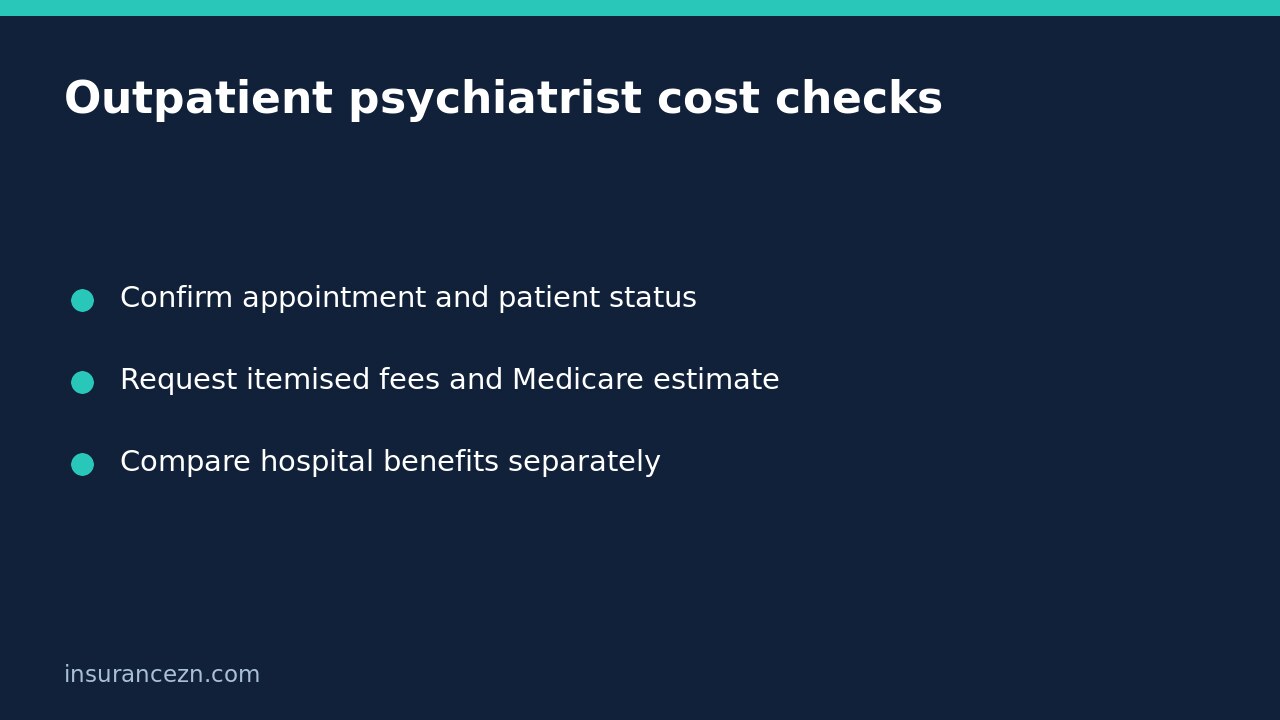
Ask the psychiatrist’s practice to describe the proposed service, expected fee, relevant Medicare Benefits Schedule item number if applicable, and whether you will be an admitted patient. Record whether it is an initial appointment or follow-up and whether the quote covers all intended services. Do not assume a clinic inside a private hospital makes the visit an insured admission.
The Australian Government’s out-of-pocket costs explanation says that if you are not an admitted hospital patient, medical fees may only be claimable through Medicare. It describes insurers’ medical gap arrangements in the context of inpatient hospital treatment. A practice saying it works with your insurer does not establish a gap arrangement for an outpatient consultation.
Keep three different budgets separate
- Outpatient medical consultations: obtain the psychiatrist’s fee and ask about the expected Medicare benefit for your circumstances. Confirm referral and other eligibility requirements with the practice and Medicare.
- Possible hospital treatment: compare the relevant admitted-treatment benefits, exclusions, restrictions and waiting periods separately. Do not assume these benefits pay for your ongoing outpatient appointments.
- Other services: if you also attend a psychologist or another allied-health provider, obtain a separate service-specific estimate. A similarly named mental-health benefit is not proof that two different provider services are interchangeable.
The government’s health-system overview distinguishes outside-hospital doctor consultations from general treatment such as psychology. Use that distinction to organise your questions, not to predict your personal rebate from a headline percentage.
Compare policies without inserting an imaginary consultation benefit
Make a worksheet with one row for each planned appointment and columns for provider fee, confirmed expected Medicare benefit, any separately confirmed applicable benefit, and remaining personal cost. Label uncertain amounts as unknown. Do not enter an extras annual maximum as though it were money available for psychiatrist consultations.
For a hypothetical reader with an initial outpatient visit and several follow-ups, the practical question is what each appointment will cost after applicable benefits. That question is different from whether a more expensive hospital policy offers broader admitted mental-health treatment. Both can matter, but they solve different funding problems.
Compare actual payable premiums over the same period and equivalent membership circumstances. If a quotation changes hospital and extras together, ask for the components to be identified. A higher premium is not evidence of a higher rebate for the consultation you want to fund.
Ask for a service-specific written answer
Send the insurer the proposed appointment details and ask whether any benefit applies to that exact service in its stated outpatient setting. If the response refers to an inpatient benefit, ask it to distinguish that from the consultation. Keep the answer with the provider estimate and the policy documents.
If future hospital treatment becomes relevant, obtain new estimates for that admission rather than reusing the outpatient answer. Our guide to checking whether your specialist will use the gap scheme explains why an individual episode needs confirmation.
Quick checks before deciding
Does a referral guarantee a rebate? Do not infer payment from the referral alone. Confirm the service and eligibility conditions, then retain the assessment once the service is claimed.
Does an estimate settle the final account? No. After the visit, compare the invoice, service details and processed benefit assessment. Query discrepancies with the relevant practice or payer; an enquiry receipt is not a corrected account.
Should insurance choose my treatment? Discuss clinical options with your practitioner. This worksheet is for understanding costs, not replacing clinical advice.
This is general information for Australian readers, not personal financial advice. Benefits depend on actual services, eligibility, policy wording, exclusions, restrictions and waiting periods. Read the policy documents and any applicable PDS, and obtain confirmation for your circumstances.