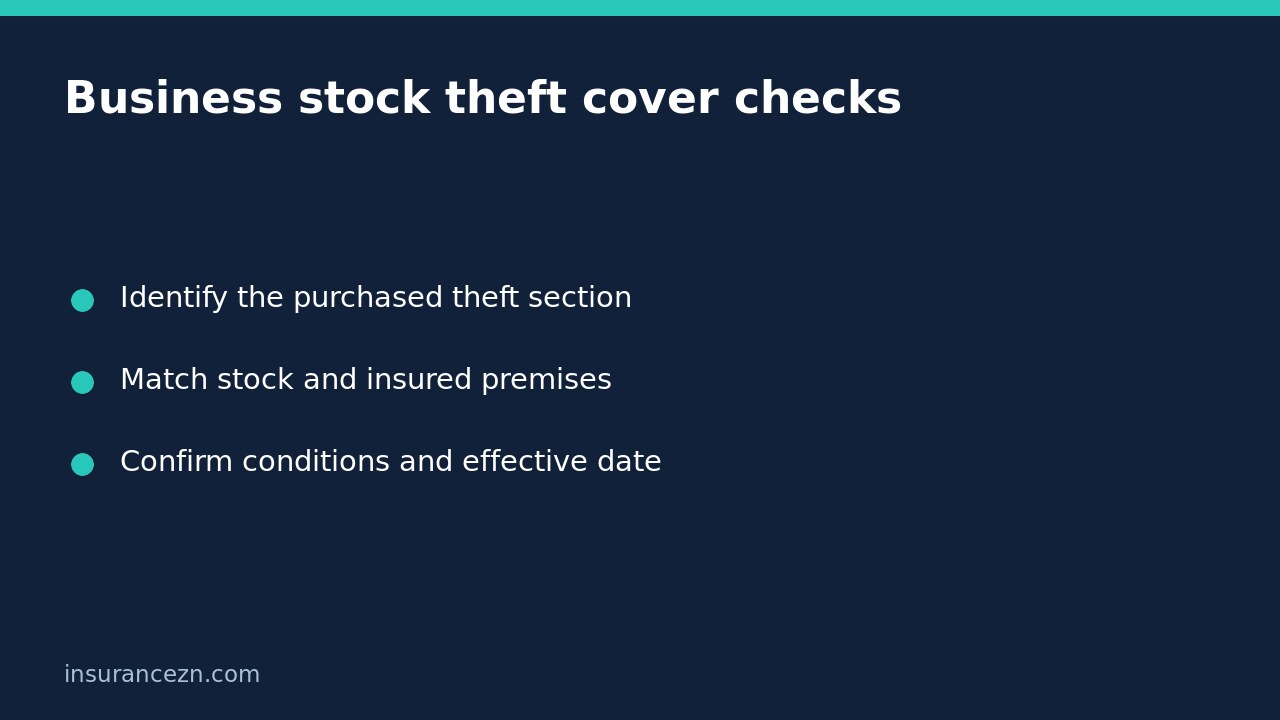

A business policy can show a contents and stock sum insured without establishing that every theft loss is covered. Before relying on protection for stolen merchandise, identify the theft section actually purchased, the property and premises it applies to, and the conditions in your policy documents. A quote showing an available option is not evidence that the option became part of your insurance.
This is a different question from whether your stock value is high enough. First establish the relevant cover; then review its limits and excesses.
Why the stock figure alone is not the answer
Insurers can organise business packages into different sections. For example, AAMI’s small business overview describes contents and stock cover for fixed premises under its base covers, with loss or damage resulting from an insured event. It separately lists Theft among the extra covers, describing loss of or damage to contents, specified items and stock caused by theft.
That is a provider-specific product summary, not an Australian-wide rule that every insurer uses the same structure. It does show why reading only the words ‘contents and stock’ can be misleading. The same overview warns readers to consult the PDS and policy wording for terms, limits, conditions and exclusions.
Read the schedule alongside the theft wording
Collect the current schedule or certificate, applicable Product Disclosure Statement, policy wording and any endorsements. Check the business name, period of insurance and premises before interpreting the section list. An old renewal offer may describe a different arrangement from the policy currently in force.
- Find the section that responds to theft rather than assuming property cover is enough.
- Check whether that section is shown as insured, and identify its limit and excess.
- Match the merchandise to the wording’s property definitions and any specified-item requirements.
- Read location, storage, security and event conditions, including relevant exclusions.
- Ask the insurer to explain anything inconsistent or unclear in writing.
Do not infer a universal forced-entry requirement, or universal cover for shoplifting, employee dishonesty or unexplained shortages. Ask how your exact wording treats the loss you are concerned about. Different causes and evidence can lead to different assessment questions.
Describe the actual storage arrangement
A useful enquiry explains where goods are kept, who owns them and how the business operates. Identify stock on shelves, stock in a locked storeroom, goods at another address and goods being transported separately. Do not assume that acceptance at one premises extends to an overflow warehouse or delivery vehicle.
For example, imagine a retailer whose schedule lists stock at its shop. The owner plans to keep additional cartons in a separate rented storage unit. This is a hypothetical checking exercise, not a claim outcome: the owner should ask whether the theft section accepts that second location, what security information is required, and whether an amendment is needed before the cartons arrive.
For equipment carried between jobs, our business tools away from the premises checklist addresses the separate location and journey questions. Portable equipment and retail stock should not automatically be treated as the same insured property.
Confirm the amendment, not just the request
If theft cover is missing or the arrangement has changed, request a quotation and written explanation of the proposed section. Compare the premium, excess, insured locations, item definitions and conditions. Ask when accepted cover would begin and whether any requirements remain outstanding.
Keep the accepted amendment and updated schedule. A submitted form, acknowledgement or premium enquiry is not by itself confirmation that the risk has been accepted. Adding cover now should not be described as protection for a loss that already happened; report existing circumstances accurately and ask which policy terms apply.
Questions before you close the file
- Which purchased section would assess theft of these particular goods?
- Are the actual premises and storage arrangements recorded correctly?
- What limits, excesses and event-specific conditions apply?
- What evidence would help establish ownership, quantity and loss?
- Has any requested amendment been accepted with a clear effective date?
Does an invoice prove the theft is covered? No. It can help establish purchase and value, but it does not establish the insured event or satisfaction of policy conditions.
Does a larger stock sum insured fix a missing theft section? Not necessarily. A higher amount does not itself change the events or locations insured. Resolve both questions separately.
This is general information for Australian readers, not personal financial advice. Your policy, PDS, schedule and endorsements determine cover, including exclusions and claims requirements. The cited insurer summary is an illustration, not a recommendation or a promise of claim acceptance.