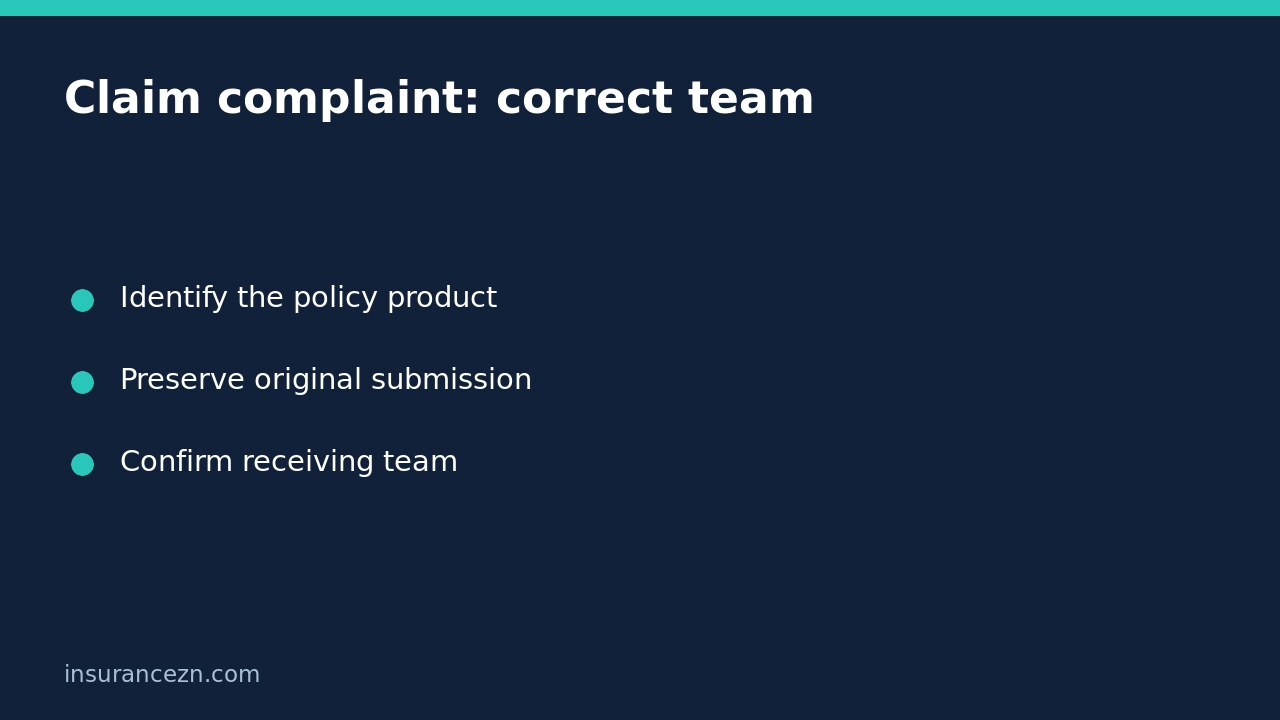

If an insurance claim complaint reaches the wrong product team, preserve your original submission and ask who now owns the complaint. A message saying it has been forwarded is not confirmation that the receiving team has registered it, obtained the attachments or agreed to the response timing you expected.
This is general information for Australian readers, not personal financial advice. Your policy, PDS, applicable complaint rules and circumstances matter. This administrative checklist is not legal advice and does not establish claim entitlement or extend a deadline.
Identify the product before choosing a contact pathway
Start with the policy schedule and the claim correspondence, not just the logo on an email. Record the product name, insurer identified in your documents, policy number and existing claim reference. A motor property-damage complaint and a compulsory third-party injury complaint may need different handling even when both relate to one collision.
For a concrete provider example, Suncorp’s complaints overview asks which product the complaint concerns. It links separately to general insurance, Queensland CTP, life and income protection, and health pathways. That is evidence of this provider’s routing structure, not a universal map for every insurer.
The same overview identifies different issuing entities for general, health and life products. Do not infer that a complaint sent to one branded contact automatically reached the organisation responsible for another product. Check the documents relevant to your own policy, including any older product arrangements.
Keep the original submission intact
Save the message you actually sent, its date, the destination address or form, the acknowledgement and the attachments. If you only have a screenshot, retain it alongside any downloadable receipt. Write down telephone advice as your recollection unless a written record confirms it.
Make a small routing log with four fields: original destination, date sent, forwarding advice and confirmed receiving contact. Keep the claim reference separate from any complaint reference. Do not silently replace the original submission with a rewritten version that makes the chronology difficult to establish.
If important evidence was omitted, identify the additional document and explain that it supplements the original complaint. Avoid sending your entire medical, banking or identity file to several teams while trying to find the right destination. Verify the official channel before supplying sensitive material.
Ask for a confirmed handover, not just forwarding
A useful request is: ‘I submitted a complaint about claim [reference] on [date] through [channel]. I have been told this belongs with another product team. Please confirm the correct receiving team, whether my original message and attachments have been transferred, the complaint reference and the date recorded for receipt. Please explain the response timeframe you are applying.’
This asks the insurer to reconcile its records without asserting a legal conclusion about when a particular deadline began. If the date is disputed, preserve the original evidence and seek prompt advice rather than assuming that a transfer resets or pauses time.
Consider a hypothetical household that mistakenly selects a health-insurance pathway for a home claim complaint. The useful next step is a confirmed transfer to the home/general-insurance complaints contact with the original home claim number. It is not lodging a second home insurance claim. A complaint-routing problem does not create a second insured event.
Use the product-specific review information
Suncorp’s general insurance complaints page describes its Internal Dispute Resolution team and says that team will provide progress and response-timeframe information. It also describes possible external review through AFCA, subject to AFCA’s authority to hear the complaint. Use the current instructions for the relevant product rather than transplanting another product’s contacts or review route.
If a handover remains unconfirmed, follow up with the original submission evidence and the precise missing confirmation. Explain any urgent practical consequence, such as an approaching response deadline. Obtain qualified help promptly where rights or time limits are uncertain; do not assume repeated forwarding protects them.
Where the substantive dispute involves competing assessments, our guide to identifying which report findings support a claim decision can help organise the issue for the receiving reviewer.
Before treating the routing issue as resolved
- The receiving team has confirmed the correct policy and claim.
- The complaint reference and recorded receipt date are clear.
- Relevant attachments are accounted for, not merely promised for transfer.
- You know the follow-up contact and stated response timeframe.
- Any conflicting dates or missing evidence remain documented.
Does registration mean the claim is approved? No. Correct routing and complaint registration are process checks. Coverage, repair authority and payment remain separate decisions.