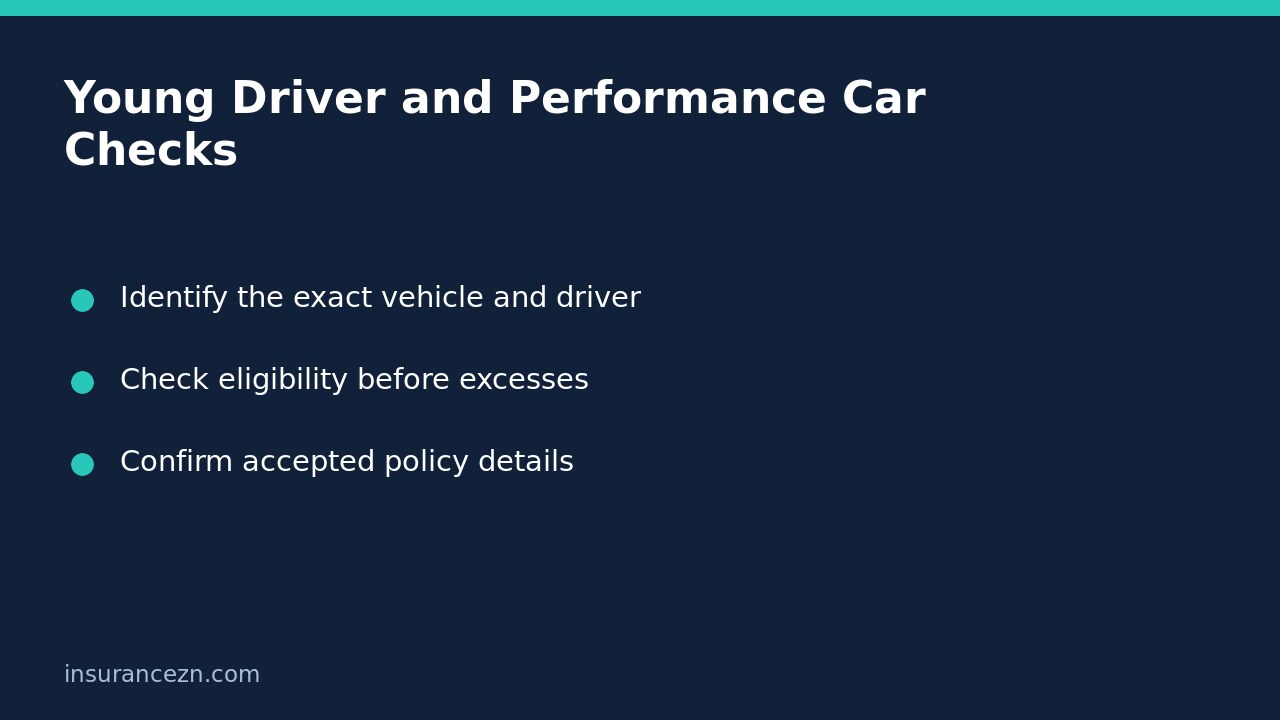

When comparing insurance for a high-performance car that someone under 25 will drive, check eligibility before comparing the premium or young-driver excess. An age-related excess does not necessarily mean that every young driver can drive every vehicle under that policy.
This is general information for Australian readers, not personal financial advice. Your Product Disclosure Statement (PDS), policy schedule, definitions, exclusions and accepted details determine cover. Driving-licence restrictions are a separate issue from insurance eligibility; satisfying one does not establish the other.
Start with the driver-and-vehicle combination
Write down the exact vehicle make, model, year and variant, together with relevant modifications. Record each intended driver’s age, licence status and proposed use. ‘My parent’s car’ or ‘a sporty hatchback’ is too vague to support a useful comparison. A different engine variant or a driver with a different licence history may change the questions the insurer needs to consider.
Use these same details for each quote. Do not omit a regular younger driver merely to see a cheaper price. Ask how the insurer defines repeated or regular driving and what information must be disclosed. If an online question does not let you accurately describe the arrangement, obtain clarification through an official enquiry channel before buying.
Read restrictions before calculating the excess
Suncorp’s car insurance driver FAQ provides a specific example of why this ordering matters. It describes applicable standard and additional excesses, but also states that it does not cover a driver under 25 while driving a High-Performance vehicle. That is a provider-specific restriction, not a statement that all Australian insurers apply the same rule.
Check the applicable PDS for the definition and ask how the insurer classifies your exact vehicle. Do not decide eligibility from a badge, engine size, an online enthusiast description or a salesperson’s informal opinion. Equally, do not assume adding the driver to the policy overrides an exclusion. Ask the insurer to identify the relevant wording and whether the quoted arrangement is acceptable.
Use a comparison worksheet with a clear stopping point
For every insurer, create a short record with five fields: the vehicle identified, the intended driver, the eligibility answer, any applicable excesses and the document or written response supporting the answer. Mark an unresolved eligibility question as unresolved rather than entering a guessed excess.
Only after the combination is confirmed as eligible should you compare otherwise equivalent premiums, insured values, uses, excesses and benefits. A lower premium is not a meaningful saving if the intended driving arrangement is excluded. Conversely, an eligibility restriction from one insurer does not prove that another insurer accepts or rejects the same arrangement.
If you are comparing value options at the same time, keep that as a separate row. Our guide to comparing car insurance quotes without losing agreed value explains why the insured-value basis also needs to remain consistent.
A household example without a coverage assumption
Consider a parent comparing policies for a performance-model vehicle that their adult child, aged 23, expects to drive on weekends. The parent finds a young-driver excess in a product summary and assumes paying it would resolve the issue. Instead, they should first ask whether that particular driver can be covered while driving that particular vehicle.
If the answer is no, the household needs another lawful, appropriately insured arrangement rather than treating the excess as a buy-in price. If another insurer says yes, the next checks are the precise conditions, listed-driver details, vehicle description, use and applicable excesses. This hypothetical example illustrates a comparison method, not a recommendation or a prediction of any insurer’s decision.
Final questions before relying on the policy
- Does the applicable wording restrict this driver’s age or licence status for this vehicle class?
- How is the exact vehicle classified, including relevant modifications?
- Have all required driver details been accepted and recorded?
- What excesses apply only after eligibility is established?
- Do the issued documents match the arrangement and commencement date you requested?
Does an online quote prove every driver is accepted? Do not treat a price alone as confirmation of an arrangement that the quote did not accurately capture. Resolve missing details and check the issued documents.
Can I simply wait until a birthday? Ask how the applicable restriction operates and what policy details need updating. Do not assume a birthday processes a policy amendment, removes every other restriction or establishes entitlement for an earlier incident.