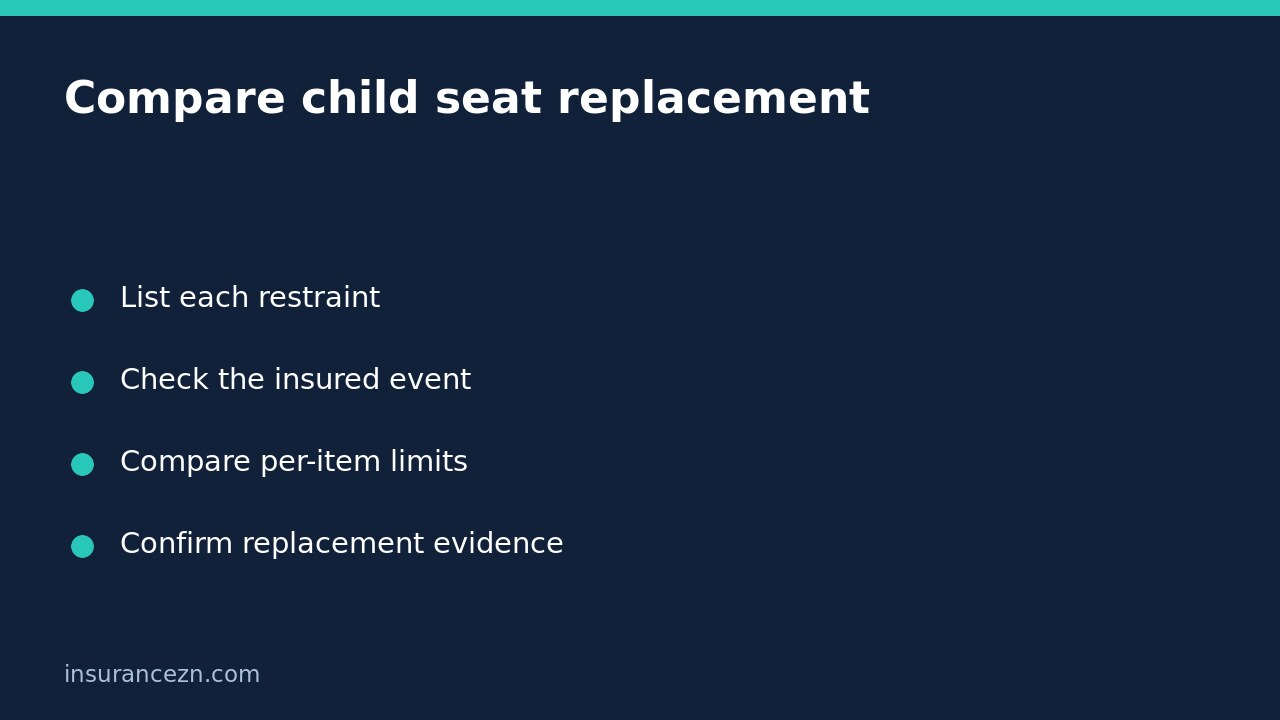

When comparing car insurance for a household with child restraints, check the limit for each seat or capsule rather than assuming one large family allowance. Match each actual replacement cost to the policy’s insured event, item definition and settlement conditions. A useful benefit for one inexpensive restraint may leave a gap for a more expensive one.
This is general information for Australian readers, not personal financial advice. Read the applicable PDS, certificate and policy wording. Product summaries illustrate questions to ask; they do not establish your personal entitlement or replace a claim assessment.
Start with the exact restraints you use
Create a short inventory before collecting quotes. Record each restraint’s make, model, ownership and purchase evidence, where available. Note whether it is normally installed in the vehicle being quoted. If you regularly transfer seats between cars, ask how the wording applies rather than assuming either car’s policy will respond.
Obtain a current replacement price for each item. Keep this separate from its original purchase price and from the amount you hope the insurer will pay. A price listing supports a comparison, not a promise that a particular replacement will be approved. Do not put children’s names or unnecessary personal details in a quote-comparison spreadsheet.
Read the limit’s unit before comparing the number
Suncorp’s comprehensive car insurance overview describes replacement of baby capsules and child seats stolen or damaged in an incident, up to $750 per item. This is a provider-specific example, not an Australian-wide minimum. Its wording makes the item basis important: the number is not a guarantee of that payment for every seat and is not simply one unrestricted household fund.
For each competing quote, record whether the stated limit applies per item, per incident or across the insurance period. Also ask whether another combined limit applies and how excesses interact. If a summary does not answer these points, mark them as unresolved until you have the relevant clause or written clarification.
Use a seat-by-seat comparison worksheet
Consider this hypothetical comparison exercise, not a claim estimate. One restraint has a replacement quote of $620 and another has a quote of $910. Under a hypothetical $750 per-item cap, the first price is below the cap while the second exceeds it by $160. Do not describe the unused $130 below the first seat’s cap as money that can automatically be transferred to the second seat.
That exercise isolates the cap only. Whether either item qualifies, how its assessed replacement is determined, and whether an excess or other condition changes payment still require the actual policy. A higher advertised limit does not compensate for an event that is outside cover.
- Item: identify the individual seat or capsule.
- Price: record a dated, like-for-like replacement quote.
- Trigger: record the covered event and relevant conditions.
- Limit: copy the unit and amount, including any combined ceiling.
- Unresolved costs: ask about installation, accessories or other charges rather than assuming inclusion.
Compare the event and evidence requirements
Ask what must happen for replacement cover to apply. A theft benefit, incident-damage benefit and general replacement recommendation are not interchangeable. Do not infer that ordinary wear, a child outgrowing a seat, or buying a preferred newer model is covered merely because the policy includes child restraints.
Ask what evidence is needed after an incident: photographs, item identification, receipts or other ownership records, and any requested inspection information. If receipts are missing, ask which alternative evidence the insurer will consider. Do not promise that a photograph alone will be accepted. Before disposal, request instructions about preserving evidence without continuing to use a potentially unsafe restraint.
Insurance administration is separate from child safety. Follow appropriate manufacturer and road-safety guidance for safe restraint use and replacement; do not keep using a suspect restraint while waiting for a financial decision. Conversely, buying a replacement for safety does not itself establish insurer reimbursement.
Check the whole quote before deciding
Compare premiums and the wider vehicle protection on equivalent details, not the child-seat line alone. Note the exact product level and benefit wording saved with each quote. For the vehicle’s repair arrangements, see comparing repairer choice by quote approval rules; restraint replacement and vehicle repair authorisation are separate decisions.
Does “per item” mean every item will be paid at the maximum? No. It describes a ceiling, subject to eligibility and assessment.
Can two seats share unused limits? Do not assume so. Ask about the exact pooling and combined-limit wording.
What should be saved? Keep the quote, relevant PDS version, item inventory and any written clarification. After an incident, distinguish evidence submitted from a processed replacement decision.