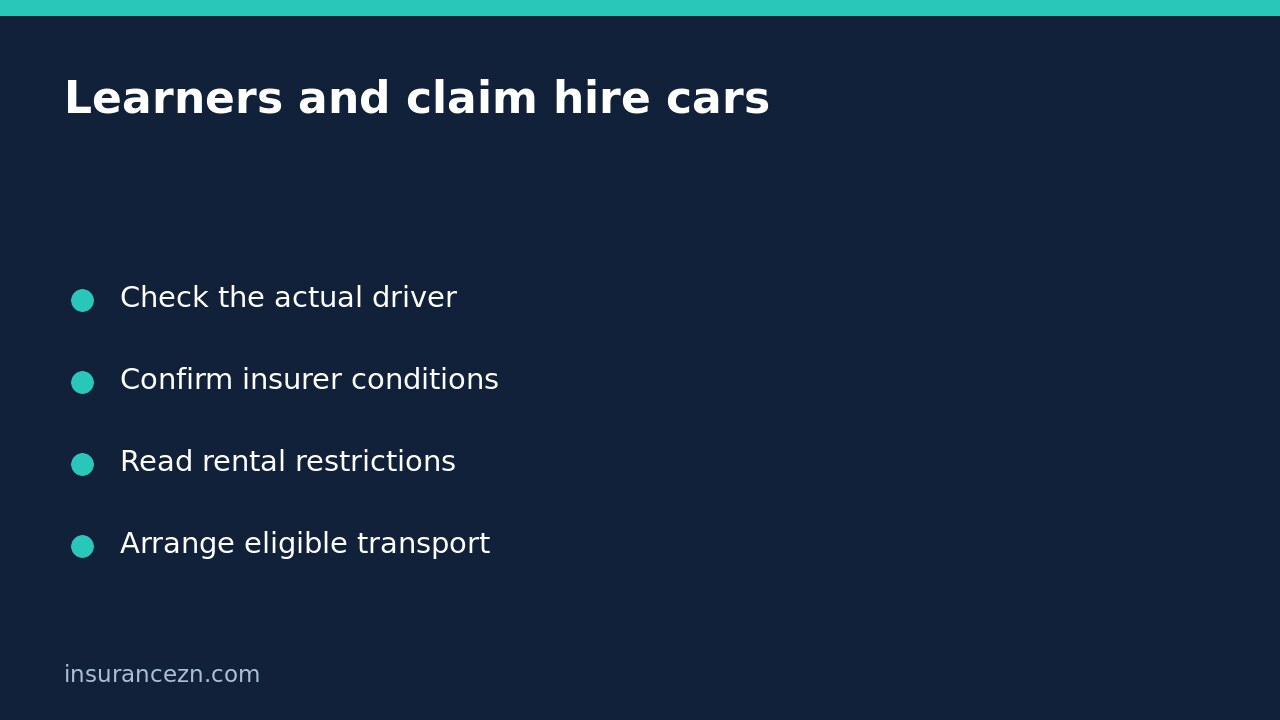

A hire car arranged after an insurance claim is not automatically available for every person who could drive the insured family car. If a learner needs transport, check the replacement vehicle’s driver restrictions before collection. A valid learner permit, supervising adult and an accepted car claim do not by themselves establish that the learner can drive the hire car.
This is general information for Australian readers, not personal financial advice. Cover depends on the applicable policy, PDS, certificate and rental agreement. The provider example below is not a rule for every Australian insurer.
Separate the insured car from the replacement vehicle
The practical mistake is transferring permission from one vehicle to another. The insured car and a rental vehicle can involve different conditions. Your policy may address learners driving your own car while separately restricting who may use a claim-related hire car. The rental company also needs to accept the intended driver under its agreement.
For example, Suncorp’s comprehensive car insurance overview says learners do not need to be listed until they obtain their licence, while relevant PDS conditions and applicable excesses still apply. The same overview explicitly says learner drivers are not covered to drive a hire car obtained under the insurance policy. That contrast is why a general answer about learner cover is insufficient.
Identify who actually needs to drive
Before asking for a booking, list the intended drivers and their current licence status. Distinguish a supervising adult driving the hire car from the learner driving it with supervision. These are different proposed uses. Do not simply say that the vehicle is for the family and assume everyone is accepted.
- State whether the learner would drive or only travel as a passenger.
- Identify the adult who would collect and drive the vehicle.
- Ask whether any other household driver must be approved separately.
- Describe the necessary journeys without suggesting that transport needs override restrictions.
Provide sensitive licence information only through the insurer’s or rental provider’s verified channels. There is no need to send a family-wide document pack to an unsolicited caller.
Ask two different organisations two different questions
Ask the insurer whether the claim qualifies for a hire-car benefit and which drivers the policy permits. Then ask the rental provider which drivers its agreement accepts. Obtain the relevant written conditions, rather than relying on a booking screen that only displays the collection time and vehicle class.
A useful message is: “Our household includes a learner. An adult can collect the car, but we need to know whether the learner may drive it under supervision. Please confirm the policy restriction and the rental agreement requirements separately.” If the answer is no, do not treat adding the learner’s name at the counter as an insurance solution.
For the earlier question of whether a benefit exists at all, see comparing hire-car benefits by the accident trigger. Benefit eligibility, booking authority and permission for a particular driver remain separate checks.
Plan around an excluded driver before collection
Consider a hypothetical household whose insured car is being repaired. The parent is eligible to drive the arranged hire car, but the learner’s usual practice sessions cannot continue in that vehicle under the applicable conditions. The parent’s collection signature does not remove the learner restriction.
The household can ask about an eligible adult using the hire car for essential trips and make separate lawful arrangements for driving practice. It should not book another vehicle expecting reimbursement unless the insurer has accepted that expense. Record who authorised any alternative, the agreed cost scope and any conditions. An enquiry or quotation is not payment approval.
Collection checklist and short answers
- Confirm the claim’s hire-car entitlement and authorised booking.
- Read the policy’s driver restrictions and the actual rental agreement.
- Have each intended driver accepted where required.
- Resolve conflicting answers before driving, not after an incident.
- Keep the booking, conditions and written clarification together.
Does supervision make an excluded learner eligible? Do not assume so. Lawful supervised driving and contractual eligibility are separate matters.
Does a confirmed reservation prove insurance cover? No. It establishes a booking, not acceptance of every intended driver or use.
What if the learner passes the test during the hire? Ask both organisations to review the changed licence status before that person drives. Passing the test does not itself process a booking or policy amendment.