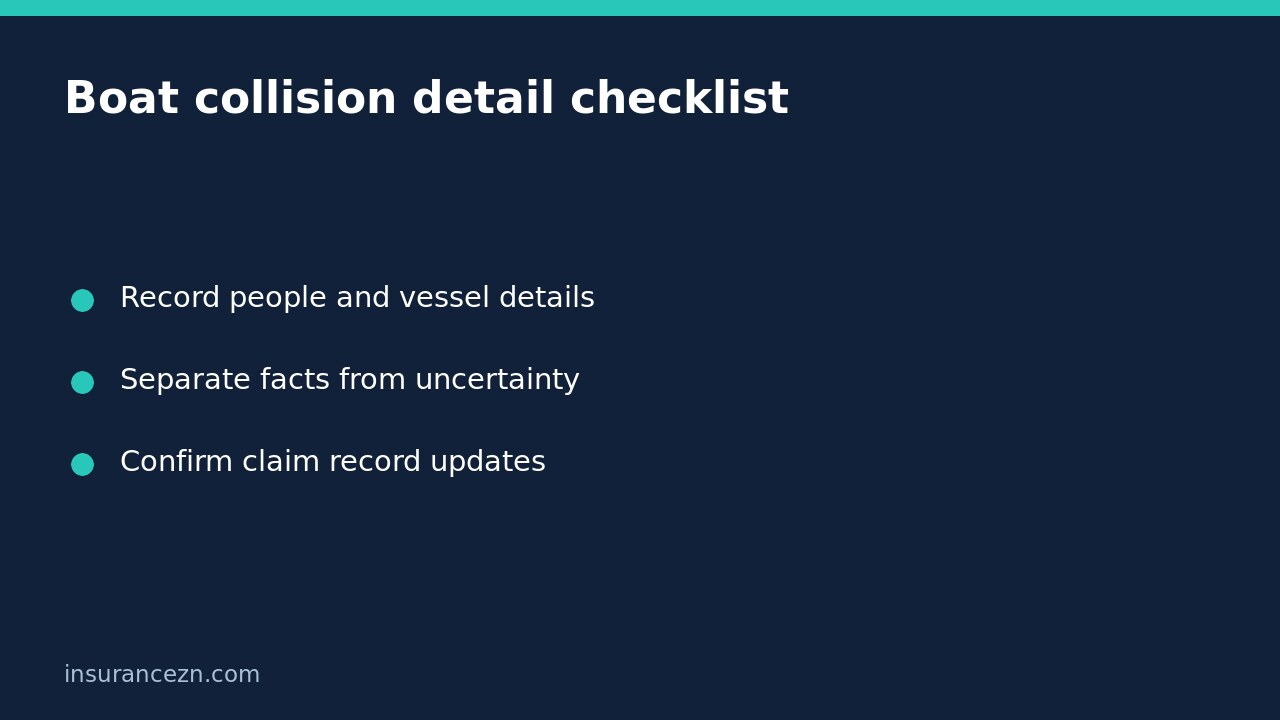

After a boat collision, create a factual record of the other people and vessels involved, without guessing fault or filling gaps from memory. Give your insurer what you can safely establish, mark unresolved details clearly and ask how to add verified information to the existing claim. A name, registration or claim number does not establish liability or an approved payment.
This is general information for Australian readers, not personal financial advice or legal advice. Cover depends on your policy, PDS, circumstances and insurer assessment. Follow emergency and maritime safety directions first; do not delay help, enter unsafe water or remain near a hazard to collect insurance evidence.
Understand what the insurer is asking for
In its boat insurance claim instructions, Suncorp asks for details of when the event occurred and what happened. It says details of other people or vehicles involved, including names and addresses, are handy to have. It also says customers can lodge without having everything ready and add details later.
That is a provider-specific description of its process, not a universal rule about boating incidents or other insurers. Check your own insurer’s requirements and any separate reporting obligations relevant to the location. Do not assume that giving details to a marina, police officer or another boat owner has lodged your insurance claim.
Build a people-and-vessels record
Once safe, keep a simple record with separate sections for people, vessels and observations. Record the source of each detail so that a later correction can be explained. You can ask for contact information without making admissions or agreeing to pay a repair bill.
- People: the person’s name, contact details and stated role, such as operator, owner or witness.
- Vessel: visible name, registration or other identifier, description and any safely obtained photographs.
- Event: location, approximate time and the sequence you personally observed.
- Evidence source: your photograph, the person’s written message, a witness statement or an official reference.
Do not assume the person steering owns the vessel or has authority to settle an insurance matter. If ownership or an address is unknown, say so. Preserve original messages and photographs instead of editing them to make an uncertain identifier appear more definite.
Separate observation from someone else’s account
A useful note might read: “I photographed the registration at the berth after the collision. The operator gave a name by text. I have not confirmed the owner’s address.” This is an illustrative record, not a report of an actual incident.
Keep statements such as “the other operator said their insurer would pay” in a separate attributed section. That statement is not confirmation from the insurer, acceptance of liability or repair authority. Similarly, describe visible damage without claiming you know whether every mark was caused by this collision.
If accounts differ, preserve both rather than silently choosing whichever is more favourable. Note what you saw directly, what someone told you and what remains uncertain. Do not contact a witness repeatedly to obtain a particular version of events.
Use the existing claim to supply later details
Suncorp says it provides a claim number and confirmation by email after lodgement. Keep that reference with your incident notes. When supplying later information to your own insurer, identify the existing claim and specify the fields you want added or corrected.
For example, explain that an earlier vessel identifier was provisional and attach the photograph supporting the replacement entry. Ask the claims team to confirm that the correct claim record was amended. An upload acknowledgement shows that a file was received; it does not establish that a handler reviewed it or processed the correction.
Our claim registration correction checklist illustrates this evidence-preserving approach in a car-claim context. Boat identifiers and insurer processes may differ, so use the recordkeeping principle rather than copying vehicle-specific requirements.
Keep repair and payment decisions separate
Exchanging details does not authorise a repairer, approve a tow or settle responsibility for either vessel. Before agreeing to non-emergency work in reliance on insurance, ask your insurer what it has authorised, for which vessel and scope, and who is responsible for any charges. Necessary safety action and insurance reimbursement remain different questions.
If the other party sends a demand or quotation, preserve it and forward it through your insurer’s nominated channel. Ask what response is needed and by when rather than assuming silence means the matter has been resolved. Seek appropriate advice where legal documents or disputed obligations are involved.
What if details are still missing?
Tell the insurer exactly what is missing and what attempts you have already made. Ask whether the existing information is enough to proceed and what evidence would be useful next. Do not invent an address, insurer name or ownership relationship to complete a form. A clear unresolved field is more reliable than a confident guess that later contaminates the claim record.