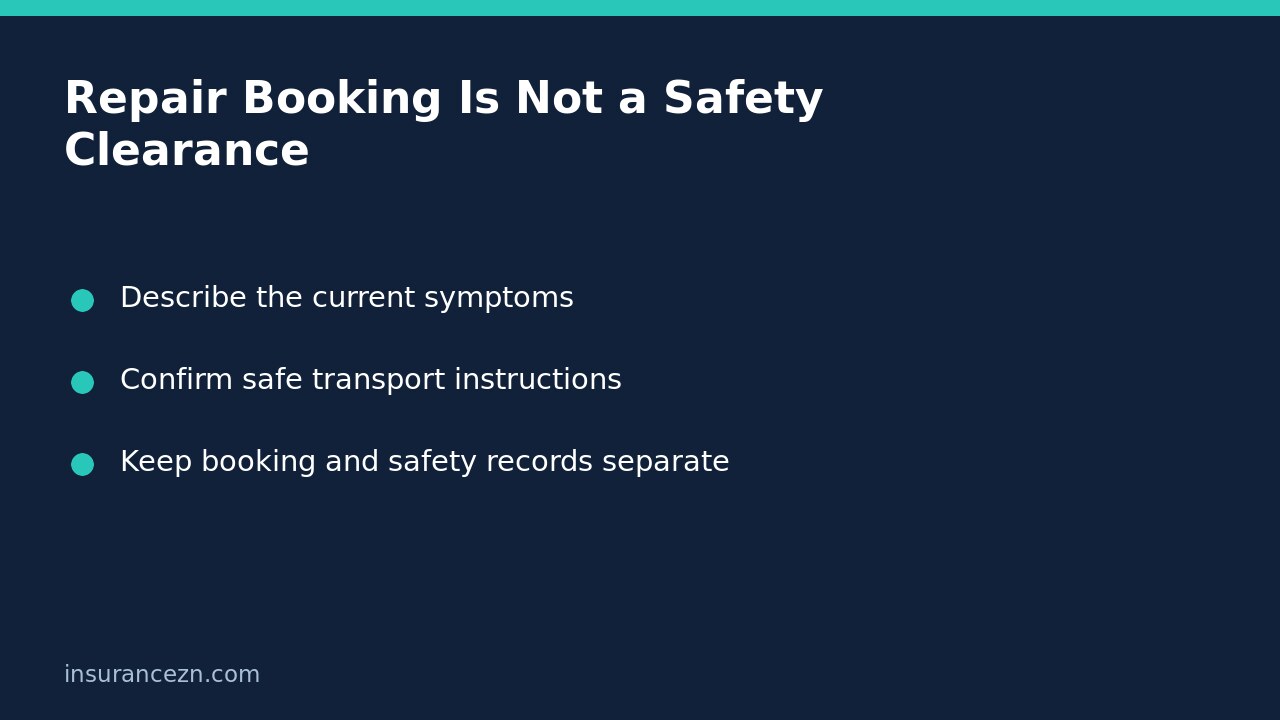

A confirmed repair appointment tells you when a workshop expects your vehicle. It does not, by itself, establish that your accident-damaged car is safe to drive there. Before setting off, separate the booking from the vehicle’s current condition and obtain appropriate professional guidance where safety is uncertain.
This is general information for Australian readers, not personal financial advice. Cover depends on your policy, Product Disclosure Statement (PDS), schedule, exclusions and the circumstances. This is not a mechanical inspection or legal roadworthiness assessment.
Why a booking message can create the wrong impression
A message saying ‘bring the car on Tuesday’ may have been generated from the claims workflow without anyone inspecting the vehicle. The workshop may know a bumper needs repair but not know it has started rubbing against a tyre. An appointment arranged days earlier may also predate a new warning light or worsening symptom.
In its minor car accident guidance, Suncorp warns customers to consider unstable parts and bumper damage before driving. It also warns that further damage may not be covered. These are reasons to resolve uncertainty, not a universal rule that any later damage will automatically be rejected by every insurer.
Describe observations without diagnosing the car
Give the repairer and insurer a factual update before the appointment. Describe what you can observe safely: a loose panel, a new scraping sound, visible fluid, a warning message or a tyre touching damaged bodywork. Say when the change appeared and whether the vehicle has moved since the incident. Do not crawl under an unstable vehicle, touch hot components or take a test drive merely to collect more evidence.
Keep earlier photographs and add clearly dated new ones where this can be done safely. A photograph can show visible damage, but it cannot rule out hidden mechanical or structural problems. Equally, the engine starting or the car having completed one short journey does not establish that another journey is safe.
Ask a transport question, not just an appointment question
Contact the workshop through its verified number and explain that you are checking how the car should arrive. Ask whether it has actually been assessed for driving, whether a suitable professional needs to inspect it, and how transport should be arranged if driving is not appropriate. A receptionist confirming an available timeslot is not the same as a vehicle-specific safety assessment.
Then contact the insurer about the proposed transport arrangements and costs. Ask who should organise collection, the agreed destination and what authorisation is needed. Do not interpret a general claims acceptance as approval of every towing expense. If you need help understanding the appointment itself, see what a car repair booking actually authorises.
A practical example before the workshop visit
Imagine a driver who books a bumper repair after a parking collision. The next morning, the displaced bumper appears to touch the front tyre when the steering turns. The useful next step is to report that observation and ask for safe transport instructions, rather than assuming the booking means the vehicle can be driven.
The driver records the booking reference, the new photograph, the time of the call and the instructions received. If transport changes, they confirm whether the original appointment remains available and where collection should occur. These records explain the sequence; they do not prove causation, guarantee reimbursement or replace a professional inspection.
Questions to settle before departure
- Has anyone appropriately assessed the current condition, rather than simply accepted the booking?
- Have new symptoms been reported without guessing their cause?
- Is the arrival method confirmed with the repairer and any insurer-authorised transport provider?
- Are collection details, destination, possible charges and appointment changes recorded?
Can I drive slowly because the workshop is close? Distance and speed are not substitutes for resolving a safety concern. Do not drive a vehicle whose safety is uncertain simply to keep an appointment.
Does requesting transport delay claim approval? A transport query and a claim assessment are different steps. Ask what remains outstanding rather than assuming either approval or refusal. In an emergency, prioritise immediate assistance and follow emergency-service directions instead of waiting for insurance administration.