
If illness or injury interrupts work again after an income protection claim, do not assume you must serve a fresh waiting period—or that payments automatically restart. A recurrent claim provision may change the waiting-period treatment, but only when its conditions are met. The practical task is to reconcile the earlier claim, the new period of incapacity and the applicable contract before relying on another payment.
This is general information for Australian readers, not personal financial advice. Your policy, PDS, schedule, exclusions and claims requirements determine eligibility. The insurer example here illustrates a particular provision, not a universal Australian entitlement.
What a recurrent claim provision can change
A waiting period concerns when relevant benefits can begin under the contract. A recurrence provision may allow a qualifying return of the same or a related cause to be handled without another waiting period. That is different from having a fresh benefit period, receiving an immediate deposit or being excused from providing evidence.
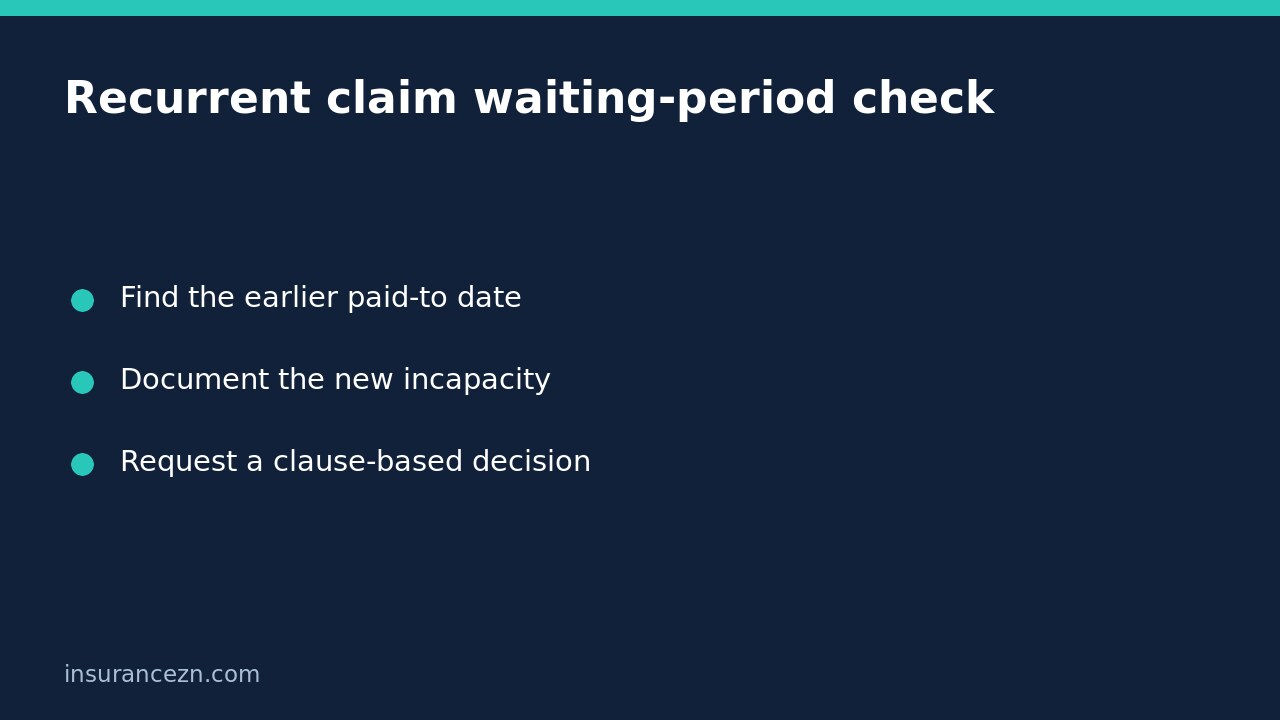
For a concrete example, TAL’s income protection overview describes a Recurrent Claim Benefit. It says that if the insured becomes Totally Unable to Work or Partially Unable to Work because of the same or a related cause within 12 months from the date the claim was last paid to, payments recommence without a further waiting period. Those defined terms and that timing rule belong to the product description on TAL’s page. Do not apply them to another contract without checking its wording.
Notice the reference to the date the earlier claim was last paid to. That is not necessarily the date the last bank deposit arrived. A deposit might relate to an earlier covered period, so preserve the payment statement rather than reconstructing the timeline from banking dates alone.
Build a chronology before asking for reassessment
Find the earlier claim reference, decision letters and final payment statement. Then assemble a short chronology that separates the following:
- The earlier illness or injury and the dates the insurer assessed benefits for.
- The last paid-to date shown on the insurer’s statement.
- Your return-to-work dates, hours, duties and any reduced-capacity arrangement.
- When the new incapacity started and what your treating practitioner has documented.
- When you notified the insurer and which evidence it requested.
Describe uncertainty honestly. If the treating practitioner has not determined whether the new symptoms are related to the earlier condition, say that. Do not relabel a different event as a recurrence simply to avoid a waiting period, or assume a familiar symptom proves the contractual relationship.
Contact the insurer promptly using the existing claim reference. Ask whether it needs to reopen the earlier record, create a linked claim or use another process. Avoid making duplicate submissions merely because the first enquiry has not produced a decision.
Ask for the classification and its consequences separately
A useful request is: “Please confirm whether you are assessing this under the recurrent claim provision, the date you are using as the previous paid-to date, whether another waiting period applies, and any outstanding evidence.” Include the chronology and retain proof of submission.
For example, imagine a worker whose earlier benefits stopped after returning to work and whose capacity later deteriorates again. The worker has a medical report and their old payment statement. Those records help the insurer assess the relationship and timing; neither document independently guarantees that the recurrence clause applies. This is a hypothetical process example, not a claim outcome.
Ask separately how the decision affects the remaining benefit period, any cumulative limits, the amount payable and the payment cycle. A clause removing another waiting period should not be read as replenishing exhausted benefits or overriding exclusions. TAL’s overview also describes benefit-period limits elsewhere, reinforcing the need to read linked provisions together rather than treating the recurrence heading as complete cover.
Check the processed outcome before budgeting
Request written confirmation of the classification, the relevant clause, assessed dates and whether payment has actually been authorised. An acknowledgement that the recurrence request arrived is not an acceptance decision. If the insurer applies a fresh waiting period, ask for the contractual reason and the evidence or dates used before deciding whether to request a review.
Our separate guide to income protection waiting periods and bank-payment timing explains why entitlement timing and cash arrival must be kept separate. Even without another waiting period, assessment requirements and the applicable payment cycle still matter.
Quick questions about recurrence wording
Does returning to work reset all cover? Do not assume that. Ask about remaining entitlement and the exact recurrence conditions.
Is the latest bank-deposit date the deadline anchor? Use the date specified in your contract and have the insurer confirm it. TAL’s example refers to the previous paid-to date.
Should treatment wait for a claim decision? No. Continue appropriate clinical care and provide accurate updates; insurance administration is separate from medical decisions.