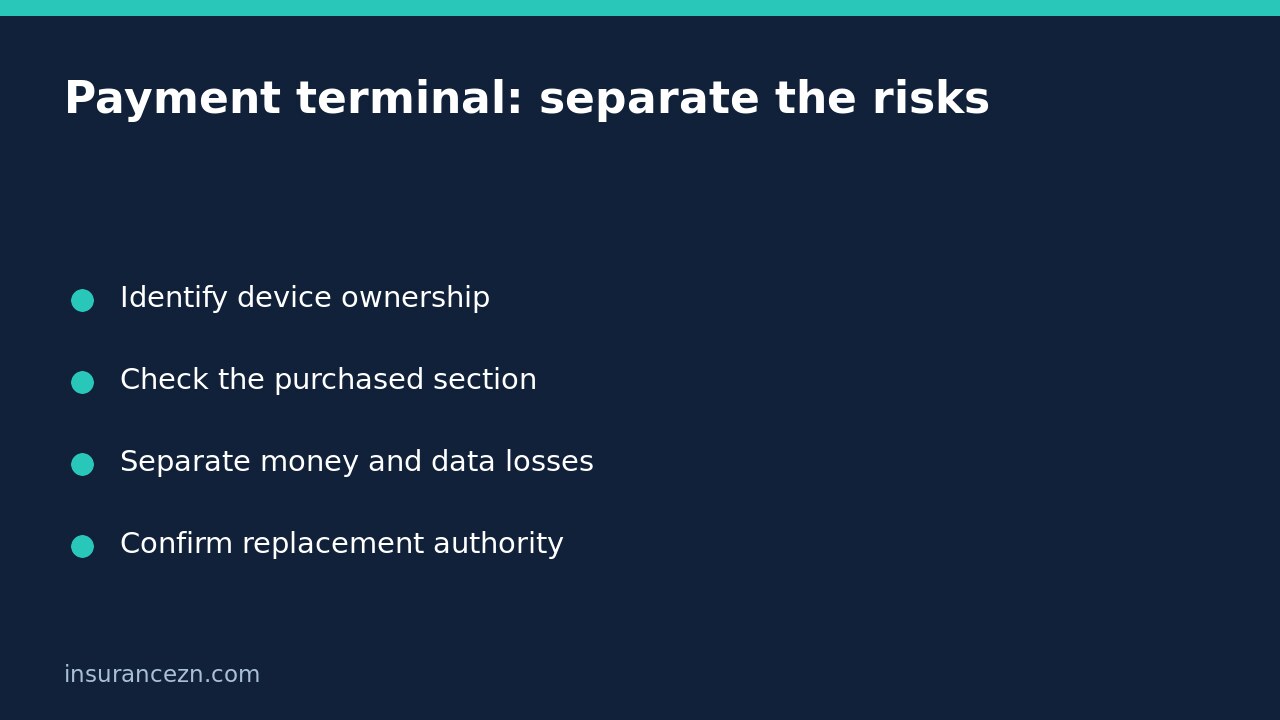

A broken or stolen payment terminal can create several problems, but they are not automatically one insured loss. Identify the physical device, who owns it and the section of your business insurance that might cover it. Then ask separately about money, disputed transactions, data incidents and interrupted trading. A policy that includes the terminal does not necessarily pay every consequence of losing it.
This is general information for Australian readers, not personal financial advice. Cover depends on your policy wording, schedule, endorsements and applicable PDS, including limits, exclusions and conditions. A payment-service agreement is a separate document and may create obligations insurance does not meet.
Start with the actual terminal and its owner
Record the model, serial number, normal location and how you use the device. Distinguish a terminal kept at a fixed counter from one taken to markets or customers. Establish whether your business bought it, leases it, borrows it or receives it under a payment-provider agreement. Keep the agreement and acquisition records together.
Ownership matters when explaining what has been lost and who can authorise replacement. Do not assume a replacement charge from the payment provider proves an insurance entitlement. Ask the provider what its agreement requires, and ask the insurer how that ownership arrangement is treated under the purchased cover.
Locate device cover rather than relying on the package name
AAMI’s small business insurance summary lists point of sale terminals among examples of portable and valuable items under its optional Portable & Valuable Items cover. It separately describes contents and stock cover at fixed premises, and Money as another extra cover. These are AAMI-specific product descriptions, not a promise that your terminal qualifies under every policy.
The useful lesson is to ask which section addresses this particular device. Give the insurer the ownership details, location and actual working pattern. Request the relevant wording and confirmation that the section appears on your schedule. An optional cover being available on a website does not mean you bought it.
- Is this terminal accepted as insured property under the purchased section?
- Does the answer differ between counter use and off-site use?
- Which events, such as theft or accidental damage, are included?
- How are mechanical faults, wear and maintenance handled?
- What item limits, total limits, excess and security conditions apply?
For equipment that travels, use the location-by-location approach in our business tools away from the premises checklist. A device described as portable still needs its actual movements and storage checked.
Put money and transaction problems in separate rows
AAMI’s summary describes Money cover in terms of business money at premises, in transit or in custody at a private home. That description should not be extended into a promise to pay disputed electronic transactions, merchant settlement shortfalls or chargebacks. Ask the payment provider to explain the transaction record and the insurer to identify whether any purchased section responds.
Build a short loss worksheet with separate rows for the terminal, physical cash, unsettled transactions, disputed transactions, and any suspected information-security incident. Record what is known and what remains uncertain. Do not describe an unreceived electronic settlement as stolen cash simply because both affect your bank balance.
If there may be unauthorised access or compromised payment information, contact the payment provider through verified channels promptly and follow its security instructions. Do not include passwords, card details or unnecessary customer information in an ordinary insurance email. Technical containment, contractual reporting and insurance assessment are different tasks.
Work through a terminal failure without merging approvals
Imagine a fictional cafe whose portable terminal is damaged during a delivery. The payment provider offers a replacement, the owner hires a temporary device, and some sales cannot be completed. The original device cost, replacement charge, temporary hire and lost revenue are separate amounts to investigate. An accepted physical-damage claim would not itself establish payment for the other rows.
Before committing to non-urgent costs, ask who must approve replacement or temporary hire and what evidence is required. AAMI lists business interruption cover separately and describes it by reference to interruption caused by loss or damage from an insured event. Do not infer that every outage, network fault or unsuccessful transaction satisfies your own policy’s trigger.
Retain photographs, provider correspondence, itemised invoices, incident notes and the insurer’s instructions. Avoid discarding the damaged terminal until the relevant parties confirm how it should be handled, including any secure return requirements.
Final checks before relying on a replacement
Does receiving a new terminal mean the insurer approved it? No. A provider’s replacement decision and an insurer’s payment decision are separate.
Does a claim reference establish all losses are covered? No. Ask which items and costs have actually been accepted, which remain under assessment and which require further evidence.
What closes the loop? Reconcile the final provider bill, insurer assessment and any payment against the same itemised worksheet. Keep explanations for unpaid amounts and confirm any replacement device details that need updating on the policy.