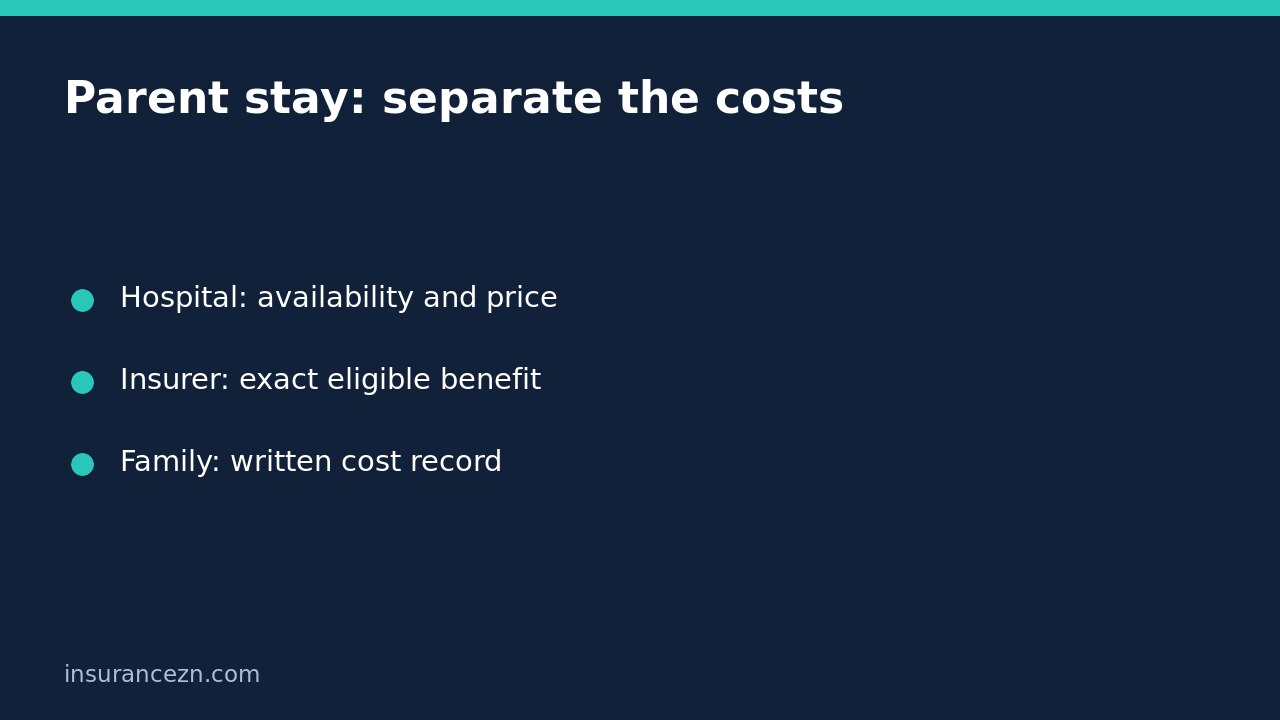

If you plan to stay overnight while your child is in hospital, check your own accommodation arrangements separately from your child’s hospital cover. A confirmation that the child’s treatment is included does not tell you whether a parent can stay, what the hospital will charge, or whether an insurer will contribute towards that particular charge.
This is a practical pre-admission checking task, not a statement that every hospital offers parent accommodation or that every policy includes a parent-stay benefit. Do not delay urgent treatment while sorting out insurance or overnight arrangements.
Identify exactly what the hospital is offering
Ask the hospital admissions or ward team about the proposed arrangement before treating it as part of the child’s accommodation. Is it a chair or fold-out bed beside the child, a separate room, or accommodation elsewhere? Ask whether availability is confirmed or remains subject to the ward’s capacity and clinical requirements.
Get the name of the person allowed to stay and clarify whether another carer can take over. Permission to accompany a child is an access arrangement; it is not confirmation that the accommodation is free or insured. Ask about any clinical, visitor or supervision requirements directly rather than assuming insurance determines them.
Request an itemised estimate showing any parent accommodation charge, meals, parking and other separately charged services. Ask which items are optional, when payment is required and what happens financially if the admission is cancelled, shortened or extended. These are questions for the specific hospital, not universal refund rights asserted here.
Ask the insurer about the parent’s charge, not just the admission
The government explanation of private health insurance cover stresses that policies differ and not all services are included. It describes hospital cover, extras and ambulance cover separately. That general overview does not establish an entitlement to a parent’s overnight stay.
Send the insurer the hospital’s actual description of the parent accommodation. Ask whether any benefit exists under your exact product and, if so, which conditions, waiting periods, age requirements, approved settings, limits and documentation apply. Ask whether the benefit concerns accommodation only or any separately quoted items. Do not assume meals or parking are included merely because a bed is available.
Confirm whether payment goes directly to the hospital or requires a later reimbursement claim. If prior approval is required, distinguish submitting that request from receiving the decision. Keep the answer with the membership details, admission dates and hospital estimate, and ask what changes would require another review.
Keep the child’s patient costs on a separate line
PrivateHealth.gov.au explains that hospital charges and doctors’ medical fees are different, and that hospital benefits depend on the policy and relevant hospital arrangements. An excess or co-payment can still apply at an agreement hospital. Those patient expenses should not be mixed into an estimate labelled parent accommodation.
Use separate headings for the child’s hospital estimate, treating doctors’ estimates and the parent’s stay. This helps prevent a broad statement such as ‘the admission is covered’ being mistaken for a promise that the family will have no bill. For other advance payments, our guide to separating surgery deposits from insurance approval explains why paying a requested amount is not a benefit decision.
Build a simple written record before you agree
For a hypothetical family, the hospital might confirm that a parent can remain at the bedside but send a separate accommodation estimate. The family should record that estimate as a possible personal expense while the insurer checks the exact charge. A general membership balance or a verbal statement about the child’s treatment is not a substitute for the parent-benefit answer.
- Hospital arrangement: location, named carer, dates and whether availability is confirmed.
- Charges: accommodation and each separately priced item, including cancellation or extension terms.
- Insurance response: exact product, eligible service, applicable conditions and any approval reference.
- Payment route: direct billing or reimbursement, required documents and expected personal contribution.
- Changes: who to contact if the child stays longer or a different carer attends.
If you have already paid, retain the original invoice and receipt. A payment receipt establishes payment, not insurer acceptance. If the invoice description is inaccurate, request a supplier-issued correction rather than relabelling it yourself to resemble an eligible benefit.
Two common questions
Does a family policy automatically pay for a parent to stay? Do not infer that from the membership label. Ask about the specific parent accommodation charge under the actual product.
Does an agreement hospital mean all family expenses are included? No such conclusion follows from the government overview. Confirm the child’s hospital costs and the parent’s separate arrangements individually, using written estimates wherever practicable.
Sources: PrivateHealth.gov.au: Out of pocket costs and the linked government cover overview support the checking framework; they do not promise a parent accommodation benefit.
This is general information for Australian readers, not personal financial advice. Cover and claims depend on the applicable policy, fund rules, any relevant PDS or other product documents, exclusions, waiting periods, limits and assessment. Confirm your own arrangements with the hospital and insurer.