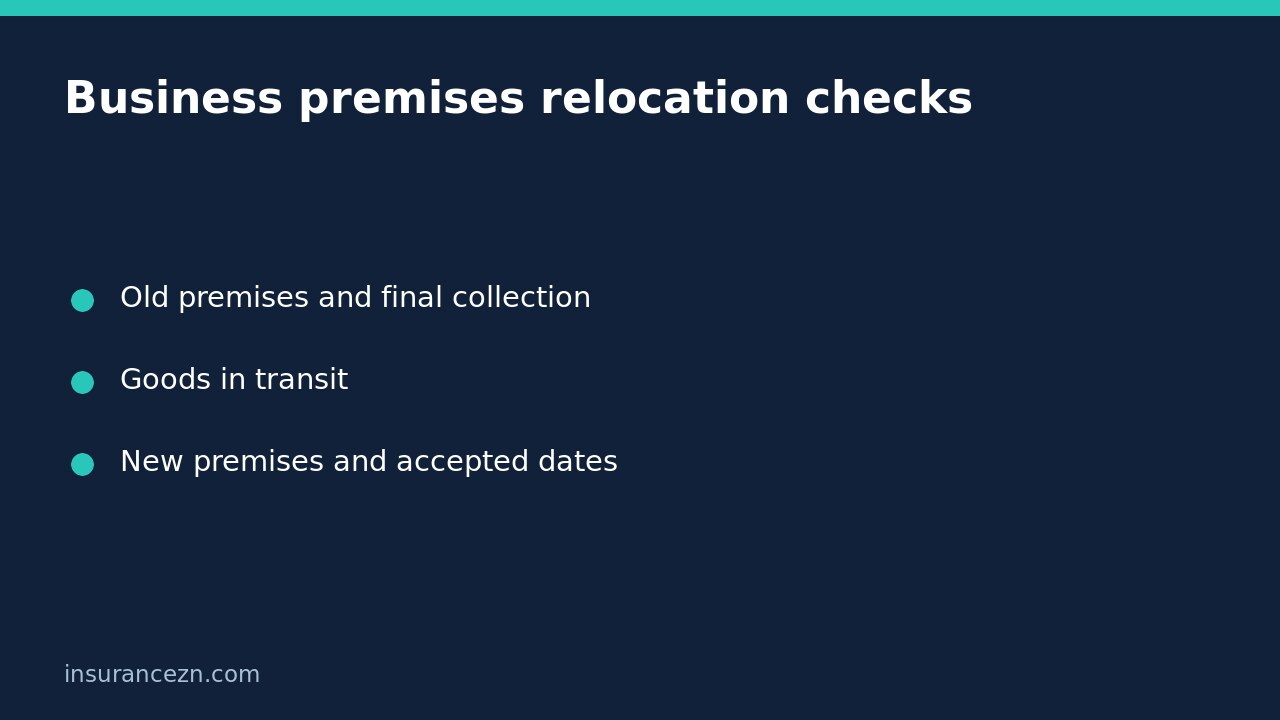

Before relocating your business, ask your insurer or broker to confirm cover for the old premises, the new premises and the journey between them. Updating a mailing address is not the same as getting the new insured location accepted. A removalist booking also does not establish insurance for your stock or equipment while it is being moved.
The practical task is to build a location-and-date map before anything leaves. Avoid assuming one address change automatically protects two occupied sites, temporary storage and every moving vehicle.
Map where property will actually be kept
List the last day stock will remain at the old address, the first delivery to the new one, any overnight storage and the planned opening date. Include a second trip for equipment you cannot disconnect immediately. If dates are uncertain, label them as proposed and ask what to do if the move slips.
For example, a retailer might collect keys on Monday, move boxed stock on Wednesday and transfer its display cabinets on Friday. This is a hypothetical planning example, not a statement that any insurer covers that overlap. During those days, property may sit at two premises while other items are on the road. A single effective date without a location breakdown could leave the business unsure which arrangement was accepted.
Separate fixed-premises cover from portable items
AAMI’s small business insurance overview describes contents and stock cover for fixed premises and separately describes optional Portable & Valuable Items cover for items usually carried in the course of business. It also lists theft and other optional sections. These are product-specific summaries, not proof that a particular relocation or removal load is covered.
Use that distinction to ask precise questions. Which section would respond to stock damaged while loading? What about a machine in temporary storage, or a cabinet damaged inside the new shop before opening? Ask for the relevant wording, exclusions and any accepted amendment. Do not assume a portable-equipment option covers every business asset simply because it can be lifted.
Our checklist for business tools away from the premises explains why the journey and circumstances matter alongside the item itself.
Give the insurer the new risk details, not just a postcode
Prepare the new street address and unit number, occupancy dates, business activities, property values and planned security arrangements. Describe any change in customer access, storage layout or shared occupancy. Tell the insurer if the old building remains occupied or if the new space will initially be used only for storage.
Ask which further details it needs to assess the change. A leased premises agreement, building description or security information may help the discussion, but providing documents is not acceptance. Keep permissions to operate, lease responsibilities and insurance terms as separate checks.
Reconcile the processed amendment before moving
- Record the existing policy number and send the proposed move timeline through an official channel.
- Ask whether both premises can be insured during the overlap and what transit or storage arrangements require separate cover.
- Request confirmation of accepted addresses, property, sections, conditions and effective dates.
- Compare the issued schedule or endorsement with your request, including sums insured, excesses and any premium adjustment.
- If anything differs, resolve it before relying on that part of the arrangement.
Paying an additional premium or receiving an acknowledgement does not by itself establish acceptance of every requested moving stage. Ask what protection is actually in force and retain the written answer. Do not cancel the old-location arrangement merely because the new lease has started if insured property is still there.
Questions before the removal vehicle arrives
Does the removalist’s insurance replace mine? Do not assume so. Ask the removalist what liability or goods cover it provides, who may claim, and what conditions apply; then compare that with your own insurer’s answer.
What if moving day changes? Notify the insurer promptly and seek confirmation of revised dates. A request to extend the overlap is not a processed extension.
Is reopening approval the same as insurance acceptance? No. Operational permission and insurer acceptance are different records. Keep both where relevant.
This is general information for Australian readers, not personal financial advice. Cover depends on the applicable policy, PDS or policy wording, schedule, endorsements, limits, exclusions and insurer assessment. Obtain advice appropriate to your business before relying on a relocation arrangement.