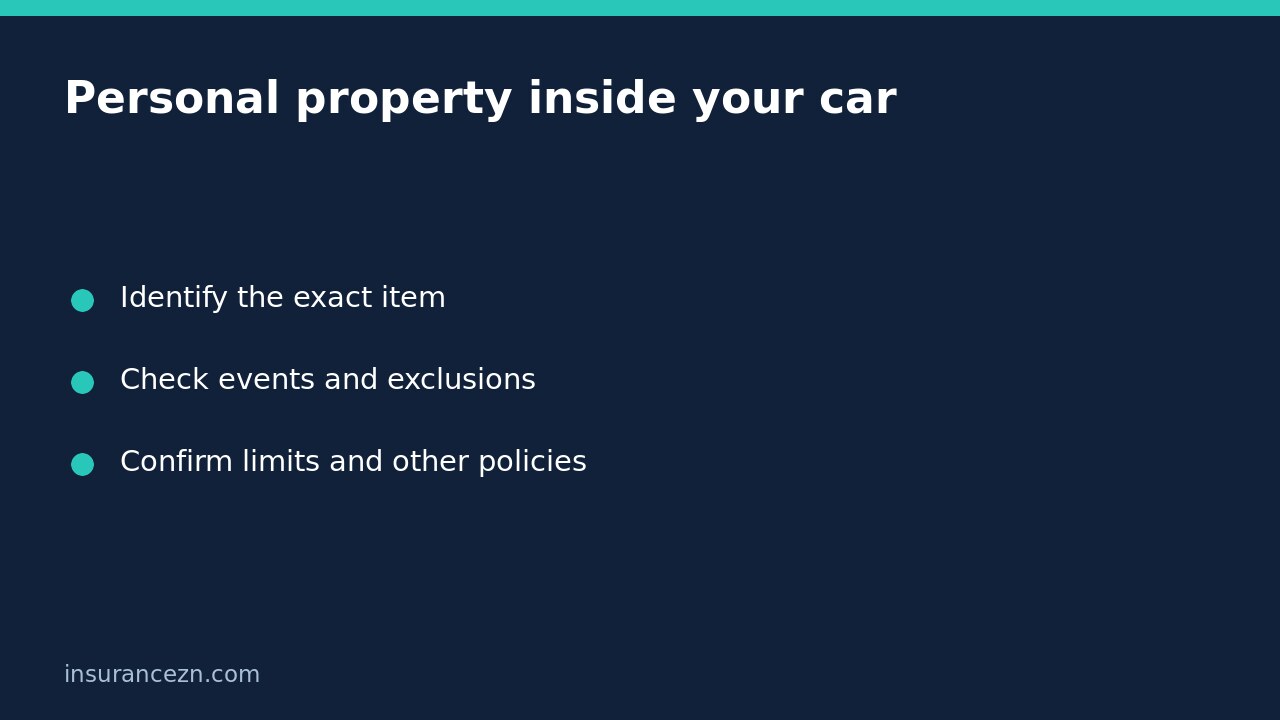

Comprehensive car insurance does not mean every object left in the vehicle is automatically covered for every loss. Check the exact personal-property benefit, the item definition, the insured event and the applicable limits. A tick beside a benefit in a comparison table is a starting point for checking, not a personal claim decision.
This matters before leaving luggage, clothing or other belongings in a car, and when comparing replacement policies. Build a short item-by-item check rather than treating the car’s insured value as a budget for everything carried inside it.
Read the personal-property benefit separately from vehicle cover
AAMI’s car insurance comparison lists cover for personal property in the car separately from accidental loss or damage to the vehicle. Its table shows that benefit under comprehensive cover and indicates a different position for third party property damage unless upgraded to the named fire-and-theft product. The page expressly says it is a summary and directs readers to the relevant PDS for terms, limits, conditions and exclusions.
That provider-specific table does not establish which possessions qualify, the payable amount for an individual item or whether a particular theft scenario is accepted. Read the actual benefit in the PDS applying to your policy, alongside the schedule and endorsements. Do not borrow a competing insurer’s definition to fill a gap in your own wording.
Describe the object precisely before asking about cover
Make a simple list of possessions you regularly carry. Separate an ordinary personal bag from a business tool, and a loose object from equipment permanently fitted to the vehicle. Those distinctions are questions for the insurer, not universal classifications you should guess.
For each object, record its description, ownership, approximate replacement cost and purpose. If another person owns it, say so. If it is used for work, disclose that too. Ask whether the exact object is eligible under the personal-property benefit, covered under another section or excluded. An answer about clothing does not establish cover for a laptop placed in the same bag.
For installed equipment, the separate checklist on reconciling added car accessories with existing cover may be more relevant. Do not count the same item as both an accessory and a personal possession without checking the policy’s treatment.
Match the loss scenario to the insured events
Ask about the circumstances you actually need covered: damage during an insured collision, property taken from a parked car, or belongings lost without damage to the vehicle. Do not assume those scenarios receive the same treatment. Request the relevant event requirements and any security, location or reporting conditions.
Consider a hypothetical weekend trip carrying two bags and a camera. Instead of asking only whether the car is comprehensively insured, ask whether each possession qualifies, which events apply and whether one benefit limit is shared across the incident. This example illustrates a checking method; it does not state that any of those items or events are covered by AAMI or another insurer.
Compare the likely assessment, not the headline limit
Ask whether there is an overall incident limit, an item limit, an excess, depreciation or another settlement basis. Confirm whether claiming for personal property affects the same excess as the vehicle claim or requires a separate assessment. Avoid assuming the full advertised maximum would be paid.
If home contents or another policy might also apply, disclose the other insurance and ask how the insurers want the matter handled. Do not submit inconsistent accounts or seek payment twice for the same loss. Keep the same incident facts and item descriptions across enquiries, while recording each insurer’s separate claim reference if claims are lodged.
Keep a practical pre-loss checklist
- Locate the current personal-property clause and any exclusions.
- Ask about the actual possessions and intended use, not just the word ‘belongings’.
- Check incident and item limits, conditions, excesses and settlement method.
- Retain purchase evidence, photographs and identifying details where available, without leaving sensitive records in the vehicle.
- Keep valuables secure and avoid leaving unnecessary possessions in the car; insurance is not a substitute for prevention.
Does a policy upgrade cover an earlier loss? Do not assume retrospective protection. AAMI’s comparison expressly says optional covers cannot be added after an incident to cover that same incident. Ask about incident-time cover rather than trying to change the policy to match a loss that has already happened.
This is general information for Australian readers, not personal financial advice. Benefits depend on your policy, PDS, schedule, endorsements, exclusions, limits and claim assessment. An enquiry, quote or submitted claim does not guarantee acceptance or payment.