
A lower annual quote does not establish how much you will save by replacing a car insurance policy today. Part of your current premium has already paid for cover you have used. There may also be instalments due, a delay before money returns to your account, or different cancellation rules for your particular contract.
The useful question is narrower than which insurer has the lowest headline price: what will it cost, from the proposed switch date onward, to retain the current arrangement or replace it? Obtain the actual cancellation calculation before treating an unused premium as available cash.
Start with the document that applies to your current policy
Find your certificate, schedule, PDS and any supplementary documents. Record the insurer, product, policy period and payment frequency. A current website can contain several document versions; ask which one governs your existing policy rather than automatically using the first download.
For a specific example, the NRMA Car Insurance PDS and Policy Booklet available at the linked document address when researched carries the identifier NRMAMOTPDS REV2 09/2023. Its cancellation section says a premium refund accounts for the period already insured, and discusses unpaid instalments that are due. This is an example of one document’s wording, not a universal Australian cancellation formula.
Do not confuse ordinary cancellation with cooling-off rights. That NRMA booklet describes separate cooling-off conditions, including a claim condition. Whether those provisions apply to your own policy depends on the correct documents and circumstances. A mid-term comparison should not assume a full cooling-off refund.
Ask for a refund quote using an exact cancellation time
Request a written calculation for the date and time you are considering, without instructing the insurer to cancel yet. Make the distinction explicit: you want information for a comparison, not an immediate change to cover.
Ask the insurer to identify the gross premium paid, the amount retained for elapsed cover, any applicable charges or adjustments, and the final amount refunded or still payable. Also ask when the calculation expires and how it will change if cancellation occurs later.
A useful message is: Please calculate the amount refundable or owing if this policy ends at my proposed date and time. Please explain each deduction, the applicable policy wording and the expected refund method and timing. Do not cancel the policy on the basis of this enquiry.
If a claim is open or a total-loss settlement has occurred, raise that fact. Do not assume a cancellation illustration for a claim-free policy describes the outcome after a settlement.
Handle monthly payments as a contract question
Paying monthly can make a policy feel like a sequence of independent monthly purchases. Do not rely on that impression. Check the contract and ask what instalments remain due under the specific cancellation circumstances.
The NRMA booklet’s cancellation wording discusses collecting unpaid instalments that are due from the previously nominated payment method. That is different from assuming that every future instalment always becomes payable, or that cancelling a bank debit automatically cancels insurance. Neither assumption is a sound comparison method.
NRMA’s renewals and payments page separately describes managing payment frequency and requesting an extension, and directs customers who want to cancel to contact the insurer. If affordability is the problem, asking about payment support before making a cancellation decision may help clarify the available choices. It does not promise a discount or that every requested arrangement will be approved.
Compare equivalent cover over a matching period
Put the proposed replacement beside the existing policy with the same drivers, vehicle details, use, insured-value basis, excess and optional benefits where possible. Record any differences rather than hiding them in a price comparison. A cheaper replacement with materially less protection is not simply the same purchase at a lower price.
Then make two columns in your own worksheet. In the retain column, enter the actual future payments required to keep the current cover through a chosen comparison date. In the replace column, enter the replacement payments required through that same date, any confirmed cancellation amount owing, and the confirmed refund as a separate offset.
An annual replacement policy and the remaining portion of an existing policy do not necessarily end together. If the dates differ, show the difference plainly. Avoid calling the gap a saving unless the comparison accounts for the extra or missing period of cover.
Our provider-switching checklist can help organise the wider handover; this article focuses on the cancellation money that belongs in that decision.
Test whether the cash arrives when you need it
A refund can reduce the eventual net cost without funding an upfront replacement payment. Ask when the insurer expects to issue it, which account or card receives it, and whether the quoted amount is final. Keep a record if the original payment card has closed or your account details have changed.
For example, someone who can afford ongoing instalments but cannot fund an annual premium upfront should not treat an unreceived refund as spendable. The comparison needs both a cost view and a cash-timing view. Write down the order of payments and the lowest account balance you would be comfortable with.
Do not borrow money or cancel necessary cover merely because a spreadsheet shows a theoretical saving. If the timing or terms are unclear, get clarification before authorising anything.
Verify the handover and reconcile the final amount
Before ending existing cover, confirm the replacement has been accepted and record its exact commencement date and time. Do not rely on an unfinished quote as proof that protection exists. Ask both insurers how the proposed handover should be documented so you do not create an unintended gap.
After a deliberate cancellation, retain the confirmation, final transaction and refund calculation. Compare the amount received with the written estimate. If they differ, ask for the reason and the policy clause supporting the adjustment. A remaining scheduled debit is a reason to query the account, not an invitation to assume that cancellation failed or to cancel payment instructions without checking.
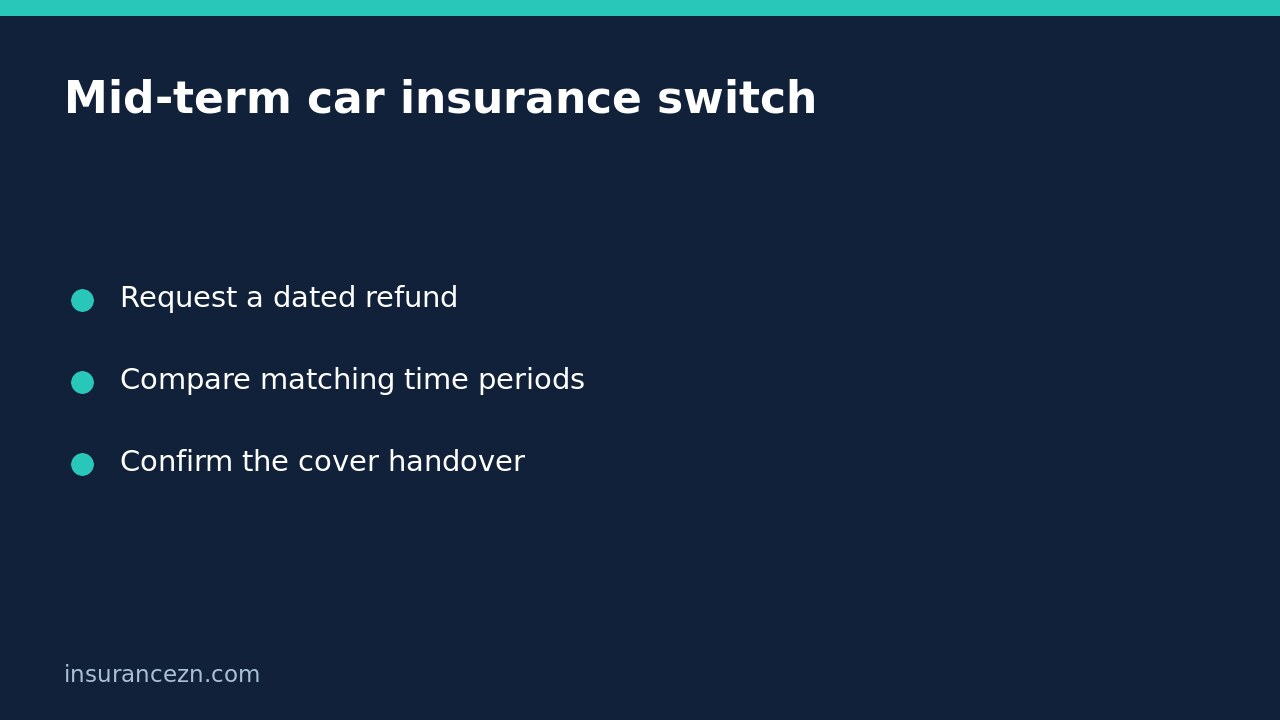
The decision checklist is: correct policy version, dated refund quote, matched coverage, matched comparison period, affordable payment timing and confirmed handover. Only then does the lower advertised premium become a meaningful input.
Sources and general-information notice
Primary references: NRMA Car Insurance PDS and Policy Booklet, especially cancellation and cooling-off wording, and NRMA car insurance renewals and payments. Product versions and processes can change.
This is general information for Australian readers, not personal financial advice. Check the current PDS, supplementary documents and your policy, and contact your insurer for individual cover, cancellation conditions and refund amounts.