
Before buying roadside assistance with Australian car insurance, check whether you already pay for an active service elsewhere. Two memberships do not necessarily provide twice the useful protection. However, similar benefit names do not prove the services are interchangeable, and cancelling one without checking eligibility can leave a gap.
This is general information for Australian readers, not personal financial advice. Insurance benefits depend on the policy, Product Disclosure Statement (PDS), certificate and exclusions; roadside assistance also has separate service terms, eligibility and limits. No comparison here guarantees attendance, refunds or claim payment.
Find the memberships you actually hold
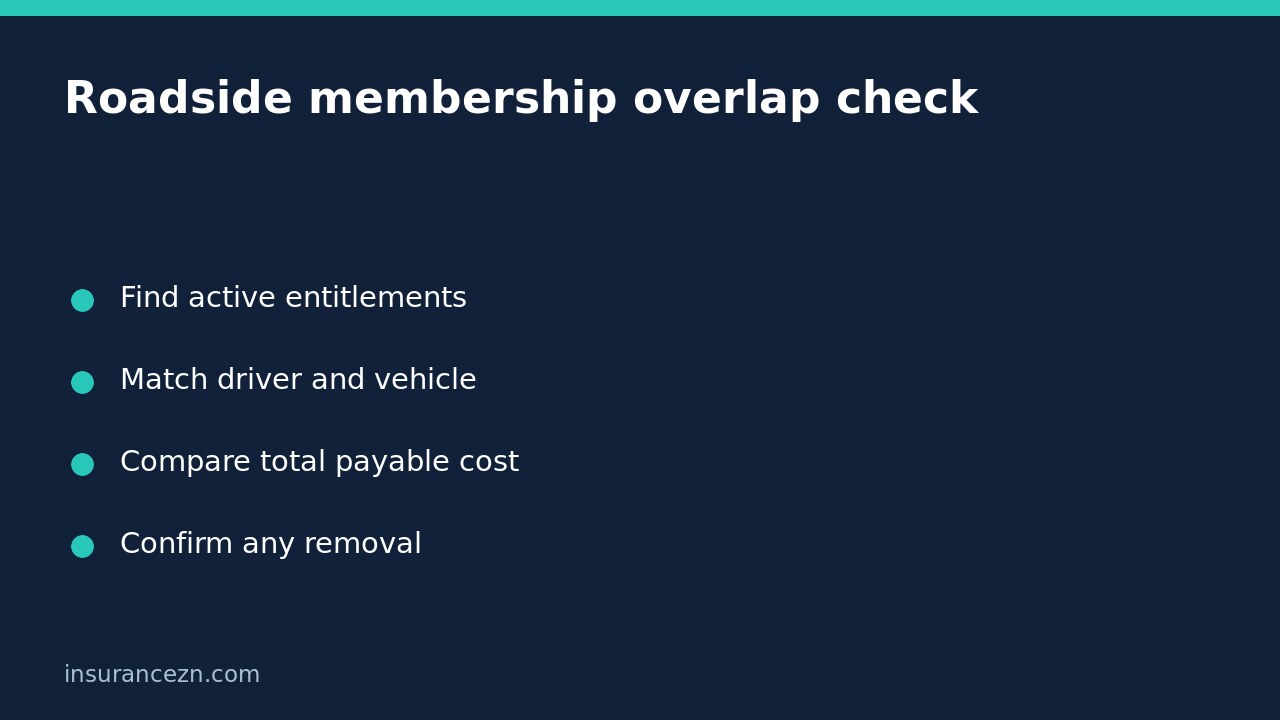
Start with documents rather than memory. Look at the current car insurance certificate, separate motoring-club renewal, vehicle purchase paperwork and any manufacturer service programme. Treat these as places to investigate, not evidence that every purchase includes assistance. An old welcome email does not establish that the entitlement remains active.
For each possible service, record the provider, membership reference, start and end dates, charge and the official contact route. Ask the provider to confirm whether your particular vehicle is eligible today. If eligibility depends on servicing or another continuing condition, establish whether that condition is satisfied rather than assuming the original purchase still protects you.
Compare the person, vehicle and situation
A service attached to one vehicle might not match a membership attached to a person. Ask which registration, driver and use are accepted under the actual terms. Do not infer that a partner driving the car, a borrowed car or a work journey is included merely because the household pays a membership fee.
- Which vehicle or member is covered, and how is that recorded?
- Where is assistance available, including the places you regularly travel?
- What happens for a flat battery, puncture, lost key or breakdown?
- What towing destination and distance rules apply?
- Which parts, fuel or additional services remain payable?
- Are there waiting periods, exclusions or maintenance requirements?
Use the same plausible breakdown when asking both providers. For example, ask what each would arrange if your usual car would not restart away from home, with your partner driving. The answer must address that combination, not just repeat a generic list of benefits.
Do not equate callouts with every cost being covered
Suncorp’s car insurance overview describes Roadside Assist as an optional addition for an additional premium. Its qualifications distinguish service availability from costs: they refer to an initial waiting period, fuel, towing and key-assistance limits, and an additional replacement-battery cost. These are provider-specific examples of why an advertised assistance feature is not an unlimited repair budget.
The same page separates optional roadside assistance from the car insurance cover itself. Removing an assistance option should therefore be considered alongside, but not confused with, changing comprehensive damage cover. Ask exactly which component a requested amendment would remove and what other policy fields would remain unchanged.
Compare the money you would really save
Request the actual payable insurance premium with and without the optional service, keeping the remaining quote inputs the same. Compare that difference with the separate membership charge over an equivalent period. If a service is already included in another purchase, find out whether dropping it would produce any saving at all.
For a hypothetical household, the car policy includes paid optional assistance while another active membership provides a similar service. The useful question is not simply whether there are two logos on the paperwork. It is whether one service meets the household’s needs, and whether removing the other changes the payable cost without losing a needed entitlement. Do not invent a refund or assume the standalone renewal can be cancelled without consequences.
For a closer look at one common overlap, see checking who pays for a replacement battery. Two services might both arrange battery help while leaving the battery purchase payable, so a second membership should not be valued as an extra free battery.
Confirm the amendment before relying on it
Ask the provider for the effective date, revised charge and any refund or remaining payment obligation before instructing a cancellation. Keep the confirmation and inspect the replacement certificate or membership record. A submitted request is not proof that the change was processed. Avoid arranging duplicate dispatches for the same breakdown; first reconcile any existing booking with the relevant provider.
Should you automatically remove the insurance add-on? No. First confirm the other service is active, eligible and suitable. Does overlap mean a refund is owed? Not by itself; check the contract and processed decision. What if you are already stranded? Prioritise immediate safety and use the appropriate assistance channel instead of delaying help to complete a saving exercise.