
If a repair invoice for your home insurance claim contains an apparent arithmetic error, duplicated line or incorrect payment balance, ask the supplier to reconcile it. Do not silently edit the invoice yourself or submit the larger figure simply because it appears on official-looking paperwork. An accurate supplier account and the insurer’s assessment are separate records that both need checking.
This is general information for Australian readers, not personal financial advice. Your policy, Product Disclosure Statement (PDS), schedule, exclusions and claim assessment determine any benefit. A corrected invoice does not establish coverage, repair authority or entitlement to reimbursement.
Identify the exact discrepancy before contacting anyone
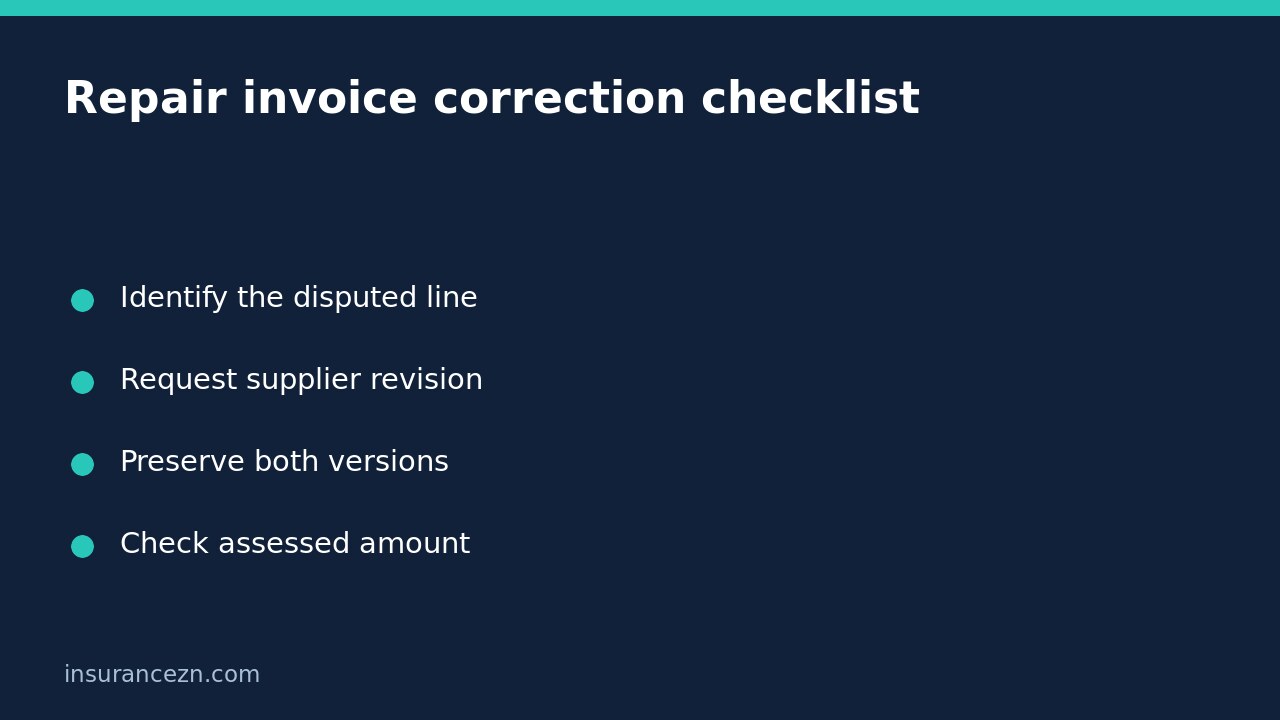
Compare the invoice with the accepted quote, work description, any variations and your payment records. Keep the documents as received. Mark your questions in a separate note rather than changing the supplier’s original PDF. You are looking for an explainable difference, not assuming that every unfamiliar amount is an error.
- Does a quantity or line description appear twice?
- Does the total agree with the listed charges and adjustments?
- Was a deposit shown as paid, credited separately or omitted?
- Is a previous invoice being replaced, or is this an additional account?
- Does the invoice describe work that was actually completed?
If a charge relates to additional work, ask when and by whom that work was authorised. A billing correction should not be used to disguise an unapproved variation as part of the original scope. Equally, do not relabel an unrelated maintenance job as insured damage to make the account easier to submit.
Ask the supplier for a documented explanation
Use the supplier’s established contact details and identify the invoice number, property, date and specific disputed line. A useful message is: ‘Please explain whether the deposit is included in the balance shown and confirm whether this document replaces the earlier invoice.’ Attach relevant payment evidence securely, limiting it to what is needed.
For a hypothetical example, a contractor’s invoice repeats the same temporary-protection line. Ask whether the second entry represents a separate attendance or an accidental duplication. If it is a duplication, request a supplier-issued revised invoice or other appropriate correction showing how the earlier account is adjusted. Do not decide on the contractor’s behalf that one line should be deleted.
Keep the supplier’s explanation even if no new invoice is issued. If the disagreement remains unresolved, describe the disputed amount as disputed when contacting the insurer. Do not present your own preferred total as though the supplier has accepted it.
Preserve the original and connect the replacement
Save both versions with their actual receipt dates. Maintain a short note explaining which invoice replaces or adjusts which earlier document. Keep receipts, deposit acknowledgements and any credit documentation separately so that a reviewer can distinguish charges from payments.
A revised invoice is not automatically a refund. Ask whether the supplier has changed the amount still payable, recognised an existing payment, or agreed to return money already collected. If a refund is promised, track its actual completion rather than treating the promise as money received. Avoid paying a replacement invoice as an additional account before reconciling any earlier payment.
Update the existing insurance claim transparently
Suncorp’s home claims guidance says an itemised invoice for emergency work should be supplied for assessment. It also identifies document-submission routes for invoices and receipts, including the account, app and an email process using the claim reference. These are that insurer’s instructions; use your own insurer’s confirmed channel and requirements.
Send a concise correction note against the existing claim reference. Identify the earlier invoice, what the supplier changed and the replacement document. Explain whether you previously paid it or whether the insurer has already assessed or paid any amount. Ask the claims team to identify which version it now holds and which amount remains under consideration. Do not lodge a second claim merely to replace an invoice.
For the broader supporting records needed before uploading emergency repair costs, see the emergency home repair invoice pack checklist. Correcting a supplier’s billing error is an additional step, not a substitute for showing the work, consent and payment evidence.
Check the processed outcome
Compare the insurer’s next written assessment with the supplier’s final account and your actual payments. Ask about any remaining discrepancy before treating the claim ledger as resolved. A successful upload means neither that the earlier figure was removed nor that the revised cost was accepted.
Can I correct a total myself? Explain your calculation separately and seek the supplier’s documented correction. Does the insurer have to pay the revised invoice? No; coverage and reasonable insured costs still require assessment. What if urgent safety work is needed? Prioritise safety and contact the insurer about assistance; resolving a paperwork error should not delay emergency help or be mistaken for permission to begin permanent repairs.