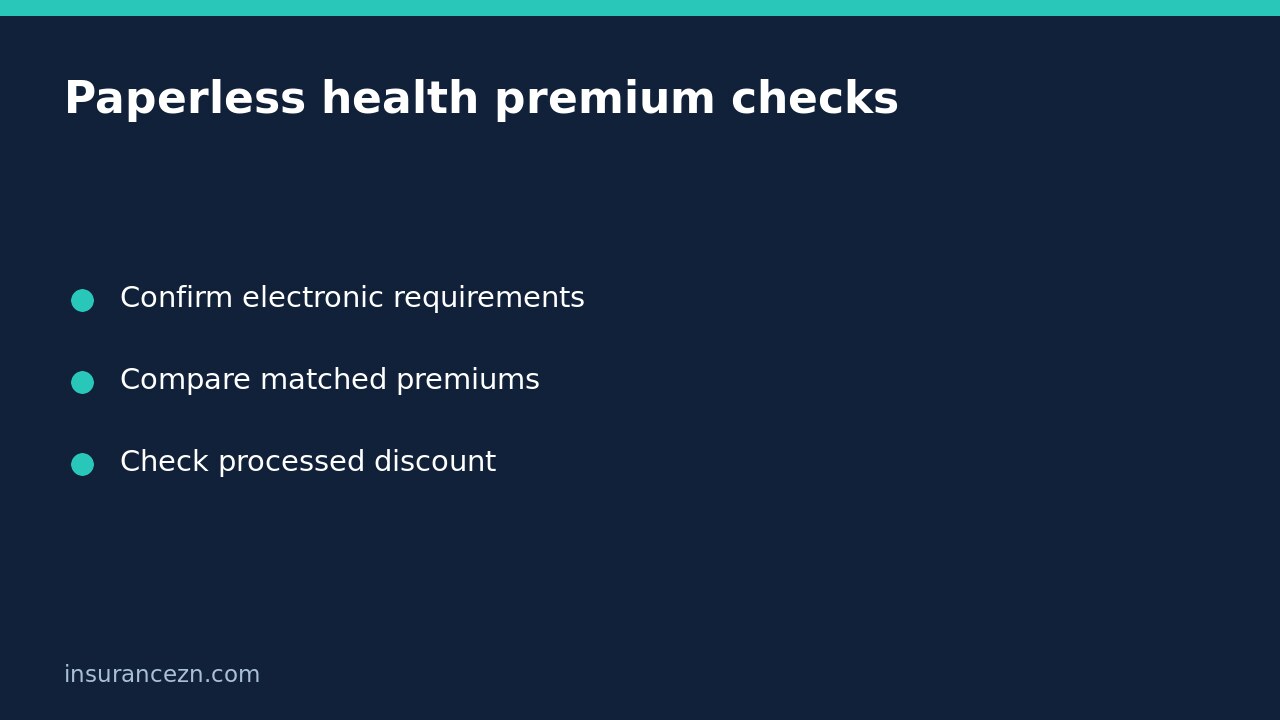

A paperless health insurance discount is worth checking, but do not assume that supplying an email address automatically reduces your premium. Ask whether your particular product offers a discount, which electronic communication and claiming conditions apply, and what you will actually pay after the change. Saving money is useful only if you can still receive important notices and manage claims reliably.
This is general information for Australian readers, not personal financial advice. Benefits, exclusions, waiting periods and discounts depend on the exact policy rules and applicable policy documents or PDS.
Establish whether the discount actually exists
The Australian Government’s PrivateHealth.gov.au guidance on managing your policy says health insurers may offer premium discounts to people who agree to communicate with the insurer and make claims electronically. It recommends checking eligibility with the insurer. That is not a promise that every insurer, product or membership offers the same saving.
Start with your existing membership rather than cancelling it. Ask for the name of any electronic-service discount, the products to which it applies and the written conditions. Check whether your current premium already includes it. An advertised saving that is already included in your quote is not an additional reduction you can subtract again.
Read communication and claiming conditions separately
Ask what the agreement requires in practice. Does it involve receiving notices through a portal, using email, submitting particular claims electronically, or a combination? Request clarification about exceptions when a claim cannot be completed online. Do not assume that electronic correspondence, marketing consent and authority for someone else to discuss your membership are the same thing.
- Confirm which email address and mobile number will receive notifications.
- Check whether documents arrive as attachments or must be retrieved from an account.
- Ask what happens if an email bounces or you cannot access the portal.
- Establish the options for accessibility support or a temporary inability to claim electronically.
Only agree to arrangements you can use. You should not need to share your password with a family member merely to read a renewal notice. Ask about authorised access instead, and keep recovery details current.
Compare matched payable premiums, not discount labels
Request two written premium figures for the same people, product, state, payment period and commencement date: one with the eligible electronic arrangement and one without it. Ask the insurer to explain other adjustments included in each figure. Do not compare a combined hospital-and-extras price with an extras-only price and attribute the difference to paperless delivery.
Check whether the saving can operate alongside other discounts and whether it ends after an introductory period. If the comparison also changes payment method, use our guide to comparing the actual payable premium for direct-debit discounts. Treat each condition as a separate question; do not add advertised percentages unless the insurer confirms how they interact.
Consider a hypothetical member whose current product already includes an electronic-service reduction. A new quote highlights a paperless discount but removes a different concession. The headline sounds attractive, yet the useful comparison is the final payable amount for equivalent cover. The discount’s name alone does not establish a lower cost.
Do not trade away useful cover just to obtain the discount
PrivateHealth.gov.au cautions that the cheapest policy may not be right for you: exclusions, excesses, co-payments and benefit limits also affect your costs. If accessing an electronic discount requires moving products or insurers, compare those features before accepting.
Check treatment eligibility, waiting-period continuity and any accrued benefits that might not transfer. Do not assume switching resets annual limits or preserves every loyalty credit. Ask the proposed insurer for answers about your membership and planned treatment before arranging cancellation of existing cover.
Verify processing and retain a notice-access checklist
Save the written offer and your acceptance. Ask when the arrangement takes effect and which payment first reflects it. A submitted preference change is not proof that billing has been updated. Inspect the processed premium notice and the subsequent payment, and query differences without paying a second time unnecessarily.
Log in through the insurer’s official website and confirm you can open and save documents. Maintain your own secure copy of relevant terms, premium notices and policy changes. A successfully opened marketing email does not prove that all policy correspondence is reaching you.
Quick questions before accepting
Is the discount automatic? Not necessarily; ask whether it is available and already applied. Does paperless mean every claim must be online? Check the exact conditions and exceptions rather than assuming. Does a preference change guarantee cheaper cover? No. Confirm eligibility, the processed effective date and your final premium while checking that the policy still meets your needs.