
Your insurer has corrected a personal detail in a car claim, but a repairer still calls an old number or an assessment document still repeats the original entry. The useful next question is not simply whether the insurer changed its screen. Ask whether the corrected information needs to reach a separate organisation that previously received the inaccurate version.
This guide concerns personal-information handling during an Australian car claim. It does not establish who caused an accident, whether damage is covered or what settlement is payable. This is general information for Australian readers, not personal financial advice. Check the current PDS and policy documents, and contact your insurer about your individual cover.
Identify the corrected information precisely
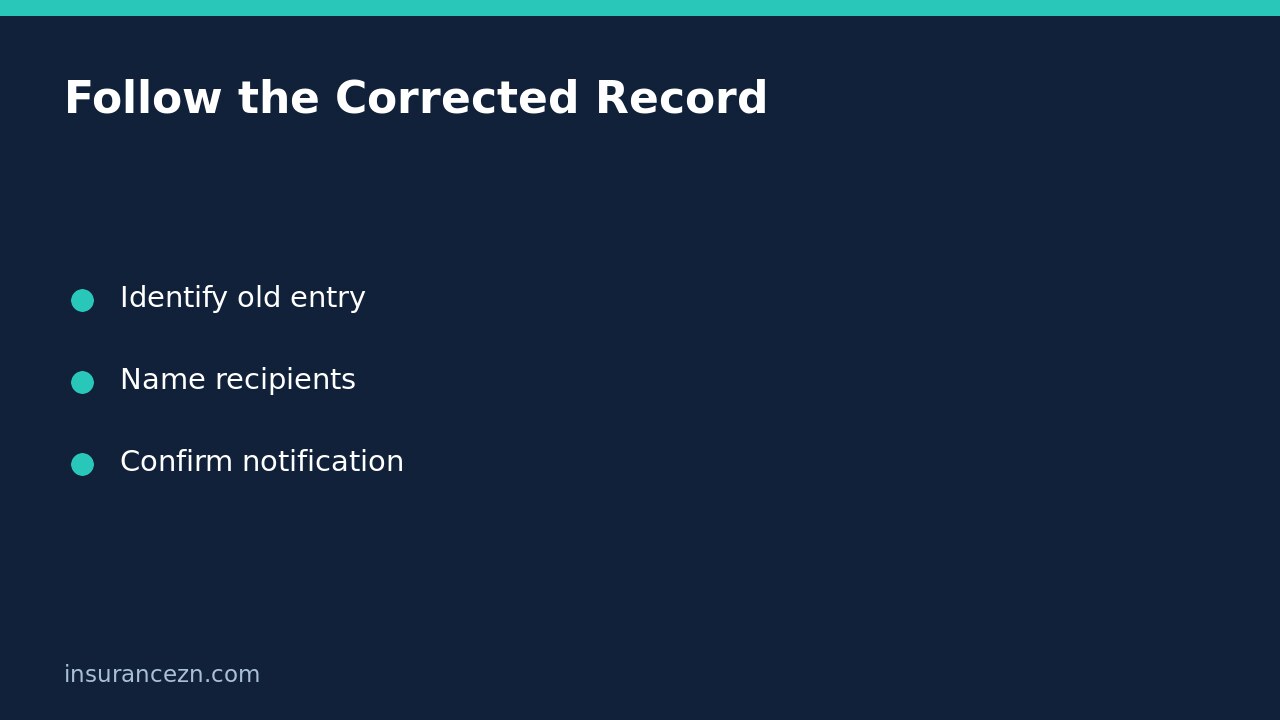
Start with the particular field, document and correction confirmation. For example, an old contact number on a claim referral is a clearer subject than a request to fix every record everywhere. Keep the original message and the insurer’s correction response, with their dates and claim reference.
If the underlying correction is still disputed, say so. Do not describe your proposed replacement as an accepted correction when the insurer has only acknowledged receiving it. Likewise, a disagreement about an assessor’s opinion is not necessarily the same as an incorrect personal detail. Identify what the record says, why you believe it is wrong and what stage the insurer has reached.
Understand the notification rule and its limits
For a concrete insurer example, section 12 of Chubb Insurance Australia Limited’s privacy policy says it will take reasonable steps to notify a third party of a correction when the individual requests this after a previous disclosure, unless notification is impracticable or unlawful. This is a privacy-policy example, not a statement about your car product’s cover.
Those qualifications matter. This is not an unlimited promise to locate every copy held by anyone. Do not assume every workshop or contractor is an APP entity, or that the insurer supplied information a repairer obtained independently. Ask which organisation received the information from the insurer, what information was sent and what notification process applies to that recipient under its current privacy policy.
Make a targeted downstream request
A practical message can separate the completed correction from the next action: ‘You confirmed the correction of my contact number on the identified claim record. Please confirm whether the previous number was disclosed to the repairer or another APP entity. Where applicable, I request notification of the correction to those recipients under your privacy correction process. Please tell me what has been notified and what remains outstanding.’
Use verified insurer contact details or the existing claim portal. Do not include full identity documents in a group email to every supplier. Ask what identity or authority evidence is needed through a secure channel. If someone is helping you, establish their authority rather than assuming that paying the premium permits them to amend another person’s information.
Track each recipient separately
Create a short table with the recipient’s name, the old information, the correction confirmed by the insurer, the notification requested and the response. Mark an unknown item as unknown. A request sent today is not a notification completed today, and a notification sent is not proof of every recipient system being updated.
Consider a hypothetical claim in which the insurer confirms a number change but a workshop’s next text still uses the old number. Retain that text and refer it back to the existing request. Ask whether the workshop received a correction, whether it has its own separate customer record and what verified contact route should be used to resolve the remaining mismatch.
Our car accident evidence register can help organise the original referral, correction confirmation and later correspondence without overwriting their history.
Ask for confirmation without confusing it with claim approval
Youi’s privacy policy separately explains that customers should advise it of amendments needed to keep information current and contact it to seek correction. Do not read a general correction channel as confirmation that a particular external recipient has been updated. Ask your insurer for a written summary naming the corrected item and recipients, rather than accepting an unexplained statement that everything is updated.
Keep operational questions separate. An accurate contact number does not authorise repairs, extend a hire-car allowance or accept liability. If a missed message affected an appointment, explain the specific consequence and ask the claims team what happens next. Do not assume a privacy correction automatically reverses a claim decision or reimburses an expense.
Follow up an unresolved mismatch proportionately
If the response does not identify what happened, reply against the existing reference with the missing question. For example, ask whether notification was considered impracticable, whether the recipient obtained the information elsewhere, or whether a separate recipient request is needed. A focused explanation is more useful than repeatedly lodging the same broad correction.
For a continuing privacy concern, use the insurer’s privacy complaint process and request the applicable escalation information. Keep cover or repair disputes identifiable as separate issues so the right team can address each one.
- Keep the original and corrected versions with dates.
- Identify which external recipient may hold the old information.
- Request notification explicitly rather than assuming automatic propagation.
- Record requested, sent and confirmed as different stages.
- Check the next relevant communication for the remaining error.
The goal is an auditable correction trail, not a guarantee that every historical document will be rewritten. A small, precise request makes the unresolved step visible while preserving the evidence needed if further review is necessary.