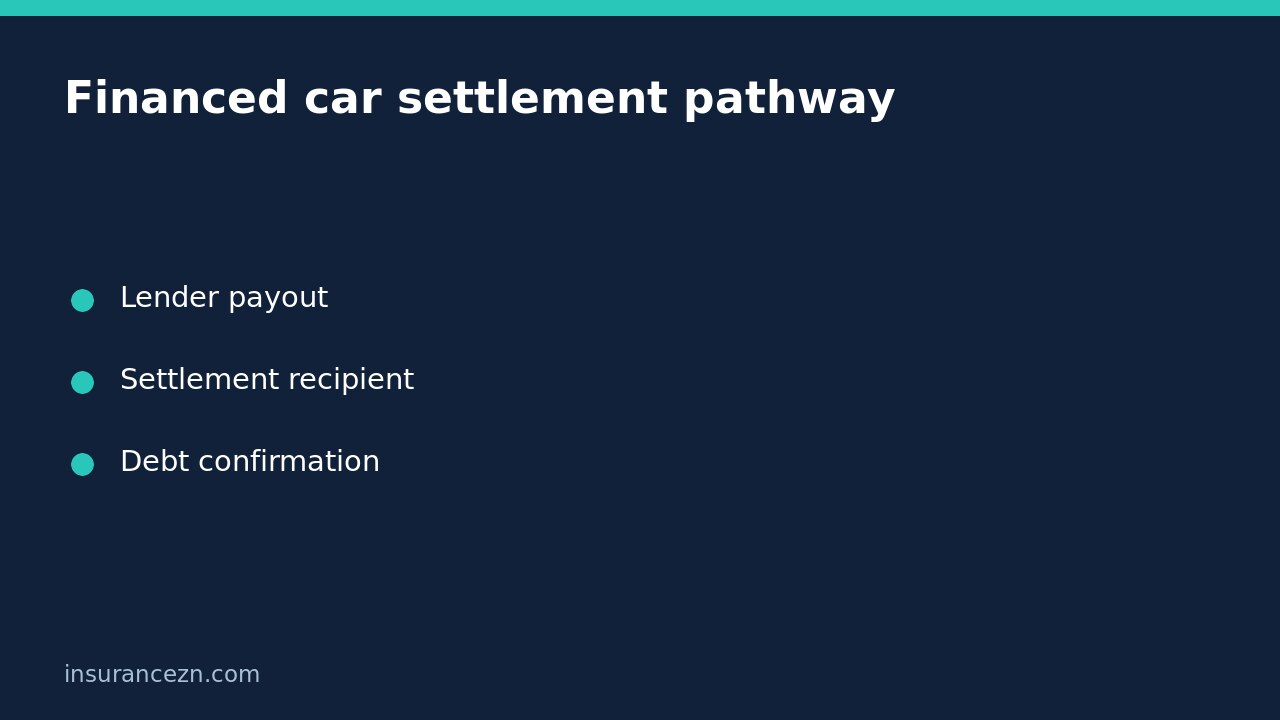

A car insurance total-loss amount and the money deposited into your bank account are not necessarily the same thing. If a lender has an interest in the vehicle, part or all of a settlement may go to that lender. Before comparing premiums for a financed car, compare the proposed payment pathway: who is paid, which debt evidence is needed and how any remaining balance is explained.
This is general information for Australian readers, not personal financial advice. Check the current PDS, policy schedule and loan documents, and contact the insurer about your individual cover. This comparison method does not establish that a claim will be accepted or that insurance will clear your loan.
Separate the insured vehicle from the loan account
Start with two document piles. The insurance pile contains the quoted product, vehicle details, insured value or valuation basis, excesses and applicable wording. The finance pile contains the lender’s legal name, account reference, loan type and current payout information. Do not use the original amount borrowed as a substitute for a current payout statement.
Next, identify whether the lender has a secured interest in this particular car. Describe the actual arrangement to the insurer rather than calling every debt a car loan. An unsecured personal loan used to buy a vehicle and finance secured against that vehicle should not be assumed to have identical settlement instructions. Ask the insurer what evidence it requires to establish the relevant interest.
Find the payment-recipient clause in each policy
AAMI’s write-off explanation distinguishes a financed vehicle from a purchase funded using a bank loan and explains that a payout can leave an outstanding amount. This is a reason to clarify your actual arrangement; it is not a universal promise to clear every debt or a legal opinion about your loan.
AAMI’s new-for-old replacement explanation separately lists written financier consent among its replacement conditions. That illustrates why a replacement vehicle involves a different decision from simply paying cash. Check the current PDS and the wording applying to your own quote rather than treating these explanatory pages as the contract.
In your comparison notes, record the recipient provision separately from the vehicle valuation. A policy offering an acceptable insured value can still require a payment process you have not budgeted around. If the clause is unclear, ask for a written explanation using your actual lender and loan arrangement.
Request a settlement sequence, not just a headline amount
Give each shortlisted insurer the same hypothetical total-loss situation and ask it to explain the stages without pretending a future claim is already approved. The useful question is: after the claim amount and applicable deductions are determined, how is the financier’s entitlement established and paid?
- Who requests the lender’s payout statement?
- Must that statement be valid on a particular proposed payment date?
- How are any excess, unpaid premium or other applicable adjustments shown?
- Who confirms the amount sent directly to the lender?
- How and when is any remaining settlement balance sent to you?
Keep answers as product-specific notes. Do not combine a favourable answer from one insurer with another insurer’s cheaper premium and treat the resulting imaginary product as an option you can buy.
Test a shortfall without assuming insurance fills it
Consider a hypothetical owner whose lender’s current payout request is greater than the net insurance settlement available. The key decision is not whether the advertised insured value sounds large. It is who remains responsible for the unresolved debt and what information the lender needs next. Ask the lender to explain that position under the loan agreement.
Do not describe agreed value as automatic loan protection. Likewise, do not assume a new-car replacement benefit and a cash payment can both be added together to repay finance and fund another vehicle. Ask how the specific settlement method interacts with the lender’s interest. If a product has a separate shortfall feature, obtain its actual eligibility, exclusions and limit instead of inferring it from comprehensive cover.
Our related article on comparing renewal quotes without losing agreed value covers the valuation choice. This guide addresses the different task of tracing who receives the resulting payment.
Keep the lender and insurer confirmations separate
An insurer saying that it has paid does not, by itself, establish that the loan account is closed. Ask for the payment reference and settlement breakdown, then obtain confirmation from the lender showing how it applied the money and whether anything remains outstanding. Match the vehicle and account references across those records.
If a payment is in transit, describe it as sent or pending rather than cleared. Continue following the lender’s instructions about scheduled repayments until the account position is confirmed; do not cancel payments merely because someone has estimated a future insurance settlement. Any refund or adjustment for overlapping payments needs to be reconciled with the lender.
A practical pre-purchase decision checklist
Before choosing, make sure you can locate the financier provision, identify the applicable valuation basis, understand the evidence request and describe the likely payment sequence in plain language. Mark unanswered issues as unresolved rather than filling them with assumptions. Retain the quote, PDS version, schedule and written clarification together.
Does a lender receiving payment mean the whole debt disappears? Not necessarily. Obtain the lender’s own account confirmation. Can the insurer send everything to me instead? Ask about your specific arrangement; do not assume the insurer can ignore another party’s interest. The useful comparison is a documented pathway you understand, not an unsupported expectation of cash arriving first.