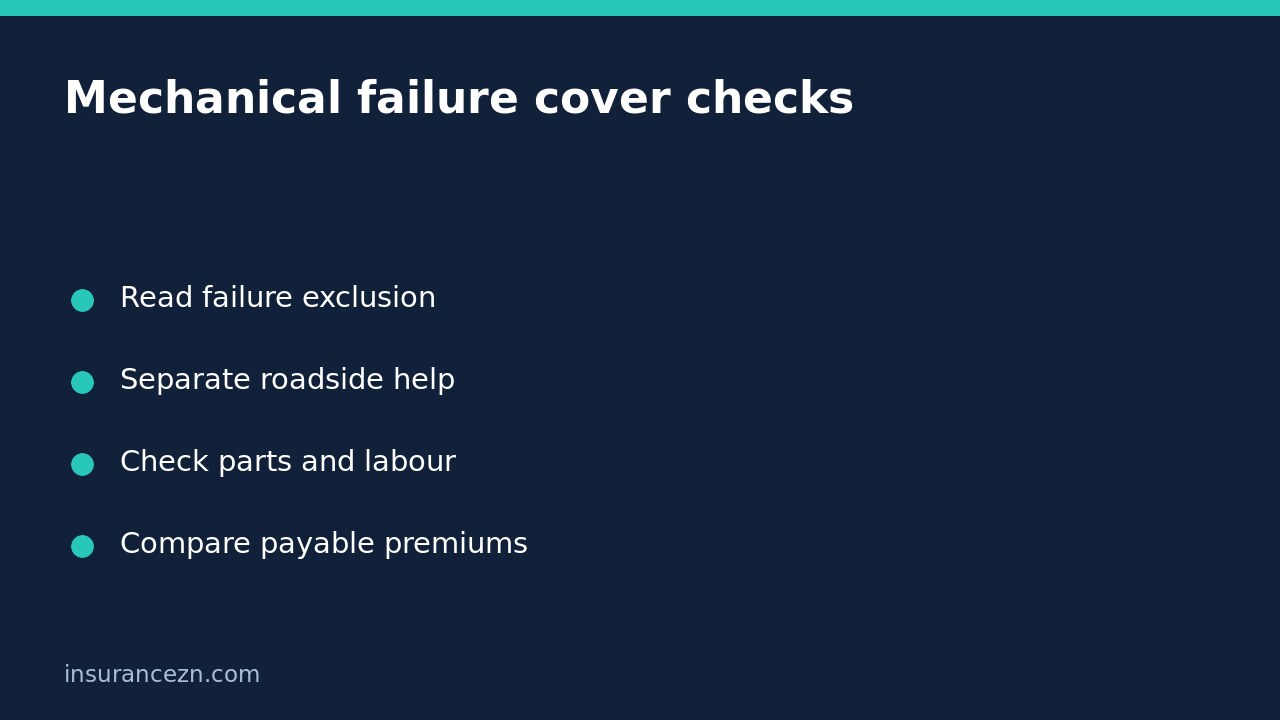

When comparing car insurance, do not treat comprehensive cover plus roadside assistance as a promise to pay mechanical repair bills. Check accidental damage cover, mechanical and electrical failure exclusions, and breakdown assistance separately. A service that sends someone to your stranded car may solve the immediate transport problem without funding the failed component or workshop labour.
This is general information for Australian readers, not personal financial advice. Cover depends on the relevant Product Disclosure Statement (PDS), schedule, endorsements and circumstances. Roadside service terms and any separate warranty have their own eligibility rules and exclusions.
Start with the failure, not the package name
Use one precise scenario for every quote: an internal mechanical component fails during ordinary driving, with no known collision or other external event. Ask each insurer what, if anything, the proposed product would pay. Do not substitute a different scenario merely because the brochure mentions accidental damage.
AAMI’s comprehensive car insurance summary provides a useful first-party example. It describes accidental damage cover but lists mechanical and electrical breakdown under what is not covered, referring separately to specific benefits available with optional Roadside Assist. It also identifies wear, tear and gradual deterioration as exclusions and explains the owner’s maintenance responsibility.
That is AAMI’s summary, not a decision about every product or a diagnosis of your car. Read the applicable contract and ask for the exact clause supporting the answer. The word comprehensive does not, by itself, resolve a breakdown question.
Divide the potential bill into separate services
A comparison becomes more useful when you record what each provider actually supplies. Create a worksheet with these rows rather than one box marked breakdown cover:
- Immediate assistance: attendance, fault checks or an attempt to get the vehicle moving, subject to the service terms.
- Transport: towing arrangements, destination restrictions and any charges outside the included service.
- Diagnosis: workshop investigation and any requirement to obtain approval before testing or dismantling.
- Repair: replacement components, labour and consumables.
- Other costs: storage, alternative transport or expenses you might need to pay yourself.
These are questions to investigate, not benefits that every roadside package includes. Mark an unanswered row as unknown. An assistance dispatch confirms a service arrangement; it is not automatically acceptance of a repair claim. For a concrete parts-cost comparison, see our guide to who pays for a replacement battery under roadside assistance.
Compare two quotes without inventing savings
Suppose Quote A includes comprehensive insurance and optional roadside assistance, while Quote B covers the car but offers no roadside service. Use identical vehicle, driver, usage and valuation details, and align the policy period and excess where possible. Record the actual total payable premium for each quote and any separately priced add-on.
Next, ask both providers to answer the same internal-failure scenario. If neither policy funds the component repair, Quote A should not be labelled mechanical-repair insurance simply because help can attend. You may value its assistance service, but compare that service against its additional cost and any existing assistance entitlement.
Check manufacturer, dealer or separate warranty arrangements independently if relevant. Do not assume an active warranty covers the component, diagnosis or towing, or that insurance and warranty administrators share approvals. Ask which organisation authorises each cost before committing to non-urgent work.
Keep accident damage and breakdown questions distinct
A failed component after an impact raises a different question from a component that stops working without a known incident. Timing alone does not prove cause. Give the insurer and repairer an accurate description rather than choosing the label you think will produce cover.
Before buying, ask how the insurer assesses a suspected connection between an insured incident and a mechanical symptom. Request the relevant wording, not a blanket assurance that everything after an accident is covered. This comparison is about understanding the contract in advance; it cannot predict a later assessment or make an unsafe car fit to drive.
Final questions before paying
Does roadside assistance remove the breakdown exclusion? Do not assume so. Ask whether it supplies services, pays repair costs or changes any insurance terms, and retain the written explanation.
Will a higher premium guarantee better breakdown protection? No. Compare the specific purchased benefits and exclusions, not price alone.
What should I save? Keep the matched quotes, PDS version, roadside terms and provider responses. Confirm accepted cover and service commencement dates separately. If the car is already stranded or unsafe, prioritise appropriate assistance rather than delaying help to finish a comparison.