
When a standard auto or homeowners insurance policy reaches its limit, an umbrella policy acts as a critical financial safety net. However, navigating a claim with excess liability coverage is distinct from filing a standard property or collision claim. The process involves strict procedural requirements, specific documentation standards, and a rigorous review of the underlying policy’s adequacy. Understanding these nuances is essential for ensuring that your umbrella provider honors the coverage when it matters most.
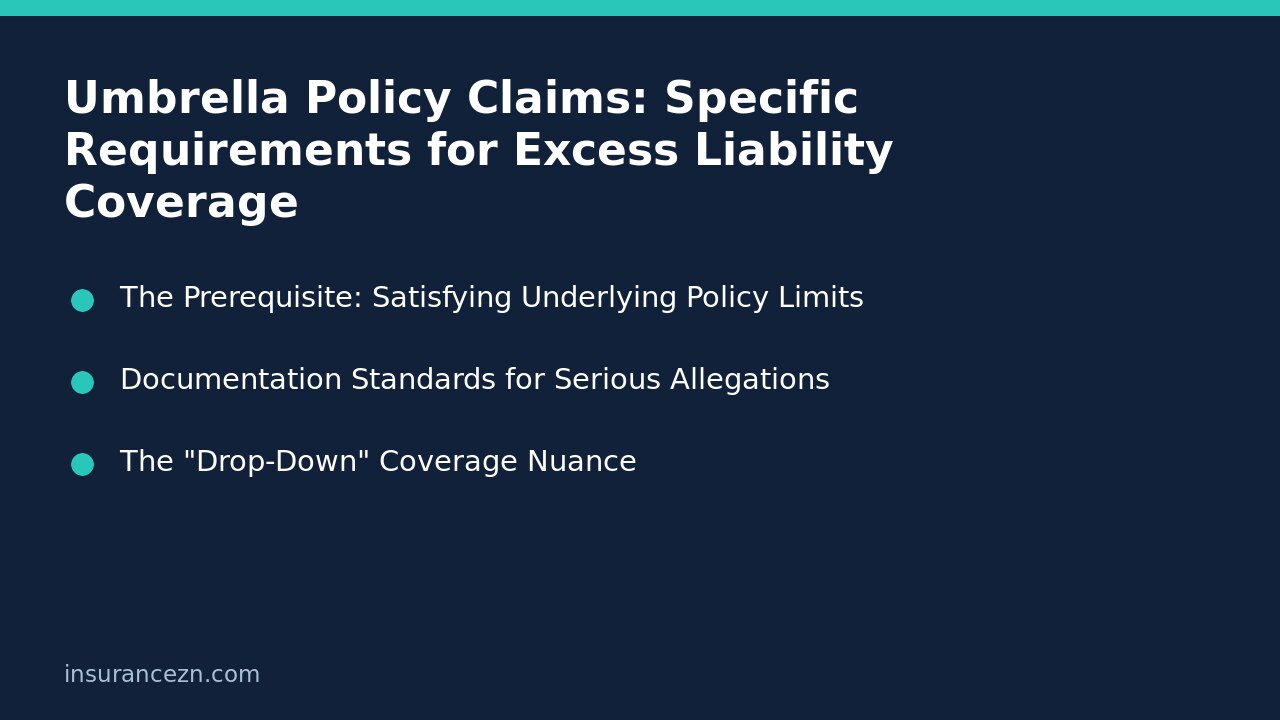
The Prerequisite: Satisfying Underlying Policy Limits
The most fundamental requirement for an umbrella claim is that you must first exhaust the limits of all applicable underlying policies. Insurers operate on a “primary and excess” basis; they will not pay out until your standard auto, homeowners, or renters insurance has paid its full benefit amount. This means if you have a $500,000 liability limit on your car insurance and an umbrella policy kicking in at $1 million, the insurer must see proof that the underlying policy was triggered and fully depleted before releasing funds for the excess portion.
To satisfy this requirement, you must provide the claims adjuster with the settlement statements or payment advices from your primary insurers showing that their limits have been reached. In many jurisdictions, there are also mandatory insurance laws regarding bodily injury and property damage. If your primary insurer refuses to pay a claim due to an exclusion (such as driving under the influence), your umbrella policy typically will not cover it either, unless you purchased a specific “drop-down” or “gap” coverage rider. It is vital to review your declarations page annually to ensure your underlying limits meet the threshold required by your umbrella contract, often $250,000 or $500,000 per occurrence.
Documentation Standards for Serious Allegations
Umbrella claims almost exclusively involve serious allegations such as severe bodily injury, sexual assault, defamation, libel, or massive property damage. Consequently, the documentation required is significantly more rigorous than for a minor fender-bender. You must expect to provide comprehensive medical records detailing the extent of injuries, police reports documenting the incident scene, and witness statements.
For non-physical claims like advertising injury or privacy violations, you will need legal correspondence, cease-and-desist letters, and court filings. The claims department will scrutinize these documents to determine if the event falls within the scope of “personal liability,” which is the core of umbrella coverage. They may also request proof that the incident occurred within the policy period and that you were not engaged in a professional capacity at the time (unless you have a specific commercial umbrella rider). Providing incomplete or vague documentation early in the process can lead to immediate denial, as it prevents the insurer from accurately assessing the severity of the loss.
The “Drop-Down” Coverage Nuance
One of the most confusing aspects of umbrella policies is the concept of “drop-down” coverage. Most standard umbrella policies do not cover claims that would be denied by your primary insurance due to exclusions like criminal acts, intentional misconduct, or auto racing. However, many policies offer a drop-down feature that allows them to pay for these specific types of claims up to a certain amount (e.g., $500,000) even if the underlying policy denies the claim entirely.
When filing a claim involving potential criminal activity or intentional harm, you must explicitly confirm with your agent whether your policy includes this drop-down endorsement and what the specific monetary cap is. If you attempt to file a claim without this coverage in place, the insurer will likely deny the request immediately upon realizing the primary policy has an exclusion that matches the incident type. Always disclose the full nature of the incident during the initial report; hiding details to get a payout can be construed as fraud and void the entire contract.
The Role of Self-Insured Retentions (SIR)
While traditional umbrella policies have deductibles, some commercial or high-net-worth personal policies utilize Self-Insured Retentions (SIR) instead of standard deductibles. An SIR is a specific amount you must pay out of pocket before the insurance coverage begins to respond. This is common in general liability and auto physical damage sections of an umbrella policy.
For example, if your policy has a $250,000 SIR for auto physical damage, and you suffer a loss that your primary insurance covers but exceeds its limits, the insurer will only pay the amount exceeding both the primary limit AND the SIR. It is crucial to distinguish between a deductible (which applies per occurrence) and an SIR (which may apply as a retention across multiple claims within a period). When filing a claim, you must calculate whether the loss amount triggers the SIR requirement. Failure to account for the SIR can result in unexpected out-of-pocket expenses that significantly reduce the net recovery from your excess coverage.
The Claims Process: Notification and Investigation Timelines
Time is of the essence when dealing with excess liability. Most umbrella policies require immediate notification of any claim, regardless of whether it has been filed in court or if a settlement demand has been made. Waiting until a lawsuit is served can violate the “notice” clause of your policy, leading to a denial. You must contact your insurance carrier as soon as you become aware of an incident that could potentially lead to a claim.
The investigation phase for umbrella claims is often longer and more invasive than standard claims. The insurer may hire independent forensic investigators to reconstruct accident scenes or review digital footprints for social media posts related to the incident. They will also verify your driving record, employment history, and past claims history to ensure you do not have a pattern of negligence or prior exclusions that would invalidate the coverage. During this time, you should avoid discussing the details of the claim on social media and refrain from making settlement offers to third parties without legal counsel, as these actions can be used against you during the investigation.
Real-World Scenario: The Pool Party Incident
Consider a homeowner who hosts a pool party where a guest slips and suffers a broken leg. The guest’s medical bills and pain-and-suffering claims total $800,000. The homeowner’s standard homeowners policy has a liability limit of $300,000.
1. Primary Exhaustion: The homeowners insurer pays the first $300,000 and denies further payment because their limit is reached. They provide a “limit exhaustion” letter to the plaintiff’s attorney.
2. Umbrella Activation: The homeowner’s umbrella policy has a $1 million limit with a $250,000 SIR for this specific type of claim.
3. Calculation: The total loss is $800,000. The primary paid $300,000. That leaves $500,000 in excess liability. However, the policy has a $250,000 SIR. Therefore, the umbrella insurer pays $250,000 (the SIR amount) and stops there, leaving the homeowner responsible for the remaining $250,000 of the loss, unless the policy allows the SIR to be waived once the primary is exhausted (a less common but possible structure).
4. Documentation: The homeowner must submit the denied claim letter from the primary insurer, medical records totaling the $800,000, and proof that no other insurance exists to cover the gap.
This example highlights why understanding SIRs and limit exhaustion is critical. Without these specific requirements met, the excess coverage might not pay the full amount expected by the victim or their legal team.
Conclusion and Final Checklist
Filing a claim with an umbrella policy requires meticulous attention to detail. The core requirements boil down to exhausting underlying limits, providing exhaustive documentation of serious allegations, verifying drop-down coverage for excluded acts, accounting for SIRs, and adhering to strict notification timelines. Because terms, availability, eligibility, laws, and prices depend on the specific insurer, policy wording, and jurisdiction, you should never assume a claim will be handled automatically.
Umbrella Claim Filing Checklist:
* [ ] Confirm all underlying policies (auto, home) have reached their maximum limits.
* [ ] Obtain official “limit exhaustion” letters from primary insurers.
* [ ] Gather all medical records, police reports, and legal filings.
* [ ] Verify if the incident involves an exclusion (e.g., criminal act) and confirm drop-down coverage exists.
* [ ] Calculate potential Self-Insured Retention (SIR) obligations.
* [ ] Notify the carrier immediately upon awareness of the incident, not just when sued.
* [ ] Consult with a qualified attorney before accepting any settlement or admitting liability.
By following these steps and understanding the specific mechanics of excess liability, policyholders can ensure they are prepared to handle the complexities that arise when high-stakes claims occur.