
When a small business faces an unexpected liability claim—whether it involves a customer slip-and-fall, a data breach, or a professional negligence lawsuit—the priority is securing funds to cover legal defense and settlements. However, the path from filing a claim to receiving a payout is often obstructed not by the severity of the incident, but by preventable administrative oversights. Even with excellent coverage terms, insurers frequently deny or delay payments due to procedural failures that suggest the policy was mismanaged rather than abused. Understanding these specific pitfalls allows business owners to navigate the claims process more effectively and avoid unnecessary financial strain during a crisis.
The most critical factor in a swift resolution is the accuracy of the initial notification. Insurers rely on the information provided by the claimant to assess risk and verify coverage. Failing to report an incident within the timeframe specified in the policy, often 24 to 72 hours for accidents or immediately upon discovery for cyber incidents, can trigger a denial based on the “duty to notify” clause. Furthermore, providing incomplete details at this stage creates a paper trail that contradicts later statements. If a business owner admits fault in an initial email but later contests liability during negotiations, the insurer may view this as bad faith or an attempt to inflate the claim amount.
Another frequent error involves the mishandling of documentation and third-party communications. Many small business owners instinctively try to “handle it themselves” before contacting their broker or carrier. This often leads to the accidental release of privileged information or admission of liability to opposing counsel, investigators, or social media platforms. Insurance policies typically require the insured to cooperate fully with the insurer’s defense team; however, independent communications that contradict the official position can jeopardize coverage. Additionally, failing to forward all relevant correspondence—including police reports, medical records, and witness statements—to the claims adjuster immediately can result in missing critical evidence needed to validate the claim.
Misunderstanding policy limits and exclusions is a subtle but devastating administrative mistake. Business owners often assume their general liability policy covers every type of injury or property damage, only to discover later that specific perils were excluded or that the incident occurred outside the defined “occurrence” period. For instance, professional liability (E&O) claims arising from acts performed two years prior might fall outside a standard one-year retroactive date limit if not carefully managed. Neglecting to review the specific endorsements attached to the policy can also lead to gaps in coverage that are only apparent after a claim is filed.
Finally, administrative delays often stem from internal disorganization regarding the claims file. Keeping all documents scattered across personal devices, home offices, or physical files makes it difficult for adjusters to reconstruct the timeline of events. A lack of a centralized, secure record of interactions with the insurance carrier can lead to confusion over what has already been discussed, agreed upon, or denied. This friction slows down the investigation and increases the likelihood of errors that require rework, extending the time before any settlement check is issued.
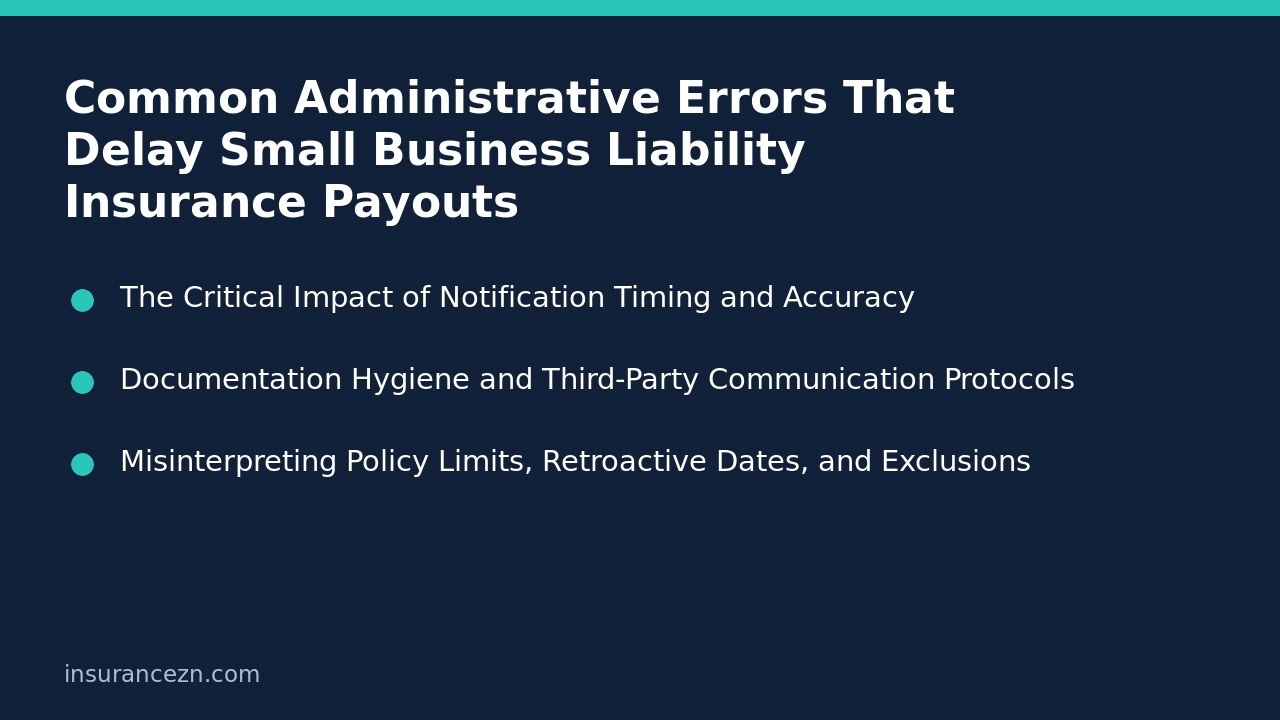
The Critical Impact of Notification Timing and Accuracy
The clock starts ticking the moment an incident occurs. Most commercial liability policies contain a strict condition requiring prompt notice of any claim or circumstance that could lead to a claim. While “prompt” can be subjective, insurers interpret this as immediately upon discovery or within the specific window outlined in the policy declarations page. Delaying notification allows the opposing party to gather evidence, hire experts, and prepare a defense while memories fade and physical evidence degrades.
Accuracy in the initial report is equally vital. When filing the notice of claim, business owners must be precise about the date, time, location, and nature of the incident. Vague descriptions like “an accident happened at our warehouse” are insufficient. The report must specify that a forklift struck a stack of pallets, causing damage to inventory and potentially injuring an employee. Inaccuracies here can lead the insurer to categorize the claim under the wrong coverage form or miss critical exclusions. For example, if a fire occurs due to electrical malfunction, describing it solely as “arson” versus “accidental fire” changes the entire legal landscape of the claim.
Documentation Hygiene and Third-Party Communication Protocols
Once a claim is filed, the volume of information required explodes. The administrative burden includes collecting police reports, medical bills, repair estimates, and witness statements. A common mistake is waiting until the adjuster asks for these documents rather than proactively organizing them. This reactive approach often leads to missed deadlines or incomplete packets that force the insurer to reopen the file, causing weeks of delay.
Equally important is controlling external communications. Small business owners must avoid discussing the details of a claim on social media, with friends, family, or even unrelated employees. Posts admitting fault (“We are so sorry our customer slipped”) can be used by defense attorneys to argue against the insurer’s offer. Furthermore, answering calls from opposing counsel without routing them through the insurance carrier is a major risk. Insurance policies almost universally require that all communications regarding a claim be directed through the assigned adjuster. Direct contact with the other party can result in statements that contradict the policyholder’s position or reveal information that should have been withheld during the investigation phase.
Misinterpreting Policy Limits, Retroactive Dates, and Exclusions
Administrative delays often occur because business owners operate under false assumptions about their coverage scope. General liability policies do not cover professional errors; they require a separate Professional Liability (Errors and Omissions) policy. If a claim arises from a consulting error and the business only holds general liability, the administrative task of seeking alternative coverage or understanding why the claim is denied becomes a nightmare before it has even begun.
Similarly, the concept of “occurrence” and “retroactive dates” in claims-made policies (common in professional liability and cyber insurance) is frequently misunderstood. An incident that happened last year but was discovered this month may not be covered if the policy was renewed without extending the retroactive date or if the reporting period has expired. Administrators must meticulously track renewal dates and ensure that any gaps in coverage are bridged before a claim materializes. Ignoring these technicalities until a lawsuit is served leaves no time to correct the administrative record.
Internal Organization of Claims Files and Correspondence
The physical or digital disarray of a claims file is a silent killer of efficiency. When an adjuster requests specific documents, they expect them to be ready for immediate review. If a business owner has emails scattered across different accounts, receipts stored in personal cloud folders, and paper logs left at a home office, the retrieval process takes days or weeks. This delay frustrates the insurer, who may perceive the lack of organization as a sign of poor risk management, potentially influencing their willingness to settle quickly.
Best practice involves maintaining a dedicated claims folder (digital or physical) that is updated in real-time. Every interaction with the adjuster, every document received, and every internal decision should be logged. This creates an audit trail that protects the business owner if disputes arise regarding what was agreed upon during negotiations. It also ensures that no critical piece of evidence is lost when staff turnover occurs or when the urgency of the situation causes panic-driven disorganization.
Real-World Scenario: The Delayed Settlement Due to a Missed Reporting Window
Consider the case of “TechFix Solutions,” a local IT repair company. A client’s laptop was damaged during a service visit, and the client filed a lawsuit alleging negligence in handling data. TechFix immediately contacted their insurer but failed to provide the full scope of the damage initially, citing only hardware failure. During the investigation, it was revealed that client data had also been corrupted. Because TechFix had not disclosed the potential for data loss during the initial report, the insurer flagged the claim as a material misrepresentation regarding the nature of the risk. The administrative error of incomplete initial disclosure caused the claim to be placed on hold for three months while underwriting reviewed whether the policy exclusions applied. Had TechFix reported the full extent of the incident immediately, the adjuster could have determined coverage applicability sooner, likely resulting in a faster resolution and a settlement that covered the data restoration costs included in their cyber liability endorsement.
Checklist for Preventing Administrative Delays
To minimize the risk of delays, small business owners should adhere to this essential checklist when a liability claim arises:
* Notify Immediately: Contact your insurance broker or carrier within the timeframe specified in your policy, usually within 24 hours of knowing about the incident.
* Be Comprehensive: Provide a detailed account of the incident, including dates, times, locations, people involved, and potential damages. Do not minimize the issue.
* Secure Evidence: Photograph the scene, preserve damaged property, and secure digital logs before they are altered or deleted.
* Control Communications: Do not discuss the claim on social media or with anyone other than your insurer’s assigned representatives. Route all calls from opposing counsel to your adjuster.
* Gather Documents: Collect police reports, medical records, witness statements, and internal incident logs immediately.
* Review Policy Terms: Quickly verify that the specific type of loss falls under your current policy limits and endorsements.
* Maintain a Log: Keep a running record of all phone calls, emails, and document submissions related to the claim.
Conclusion
The speed and success of a liability insurance payout depend heavily on administrative diligence rather than just the merit of the underlying claim. By adhering to strict notification protocols, maintaining rigorous documentation standards, understanding policy nuances, and controlling external communications, small business owners can protect themselves from avoidable delays. These practices ensure that when an incident occurs, the insurance mechanism functions as intended, providing the financial safety net designed to support the business through challenging times.