
Maintaining a clean driving history is one of the most effective ways to lower your auto insurance premiums, yet many drivers with perfect records still overpay by failing to shop strategically. A spotless record does not automatically guarantee the lowest rate; it simply qualifies you for discounts that risky drivers do not receive. To truly capitalize on this advantage, you must understand how insurers weigh driving behavior against other risk factors and where to look for savings beyond just your driving record.
When comparing quotes, the primary goal is to ensure you are leveraging your clean history while avoiding unnecessary coverage gaps or inflated prices caused by poor data entry. Insurers use complex algorithms that analyze not only accidents and tickets but also claims frequency, credit-based insurance scores (where legal), telematics data, and even vehicle safety ratings. A driver with no violations might still see high rates if they live in a high-theft area or drive an expensive sports car. Therefore, the comparison process must be holistic, treating your clean record as a strong asset that needs to be presented correctly across multiple carriers.
The following guide provides actionable steps to maximize your savings, identify potential errors in your profile, and select a policy that balances comprehensive protection with affordability.
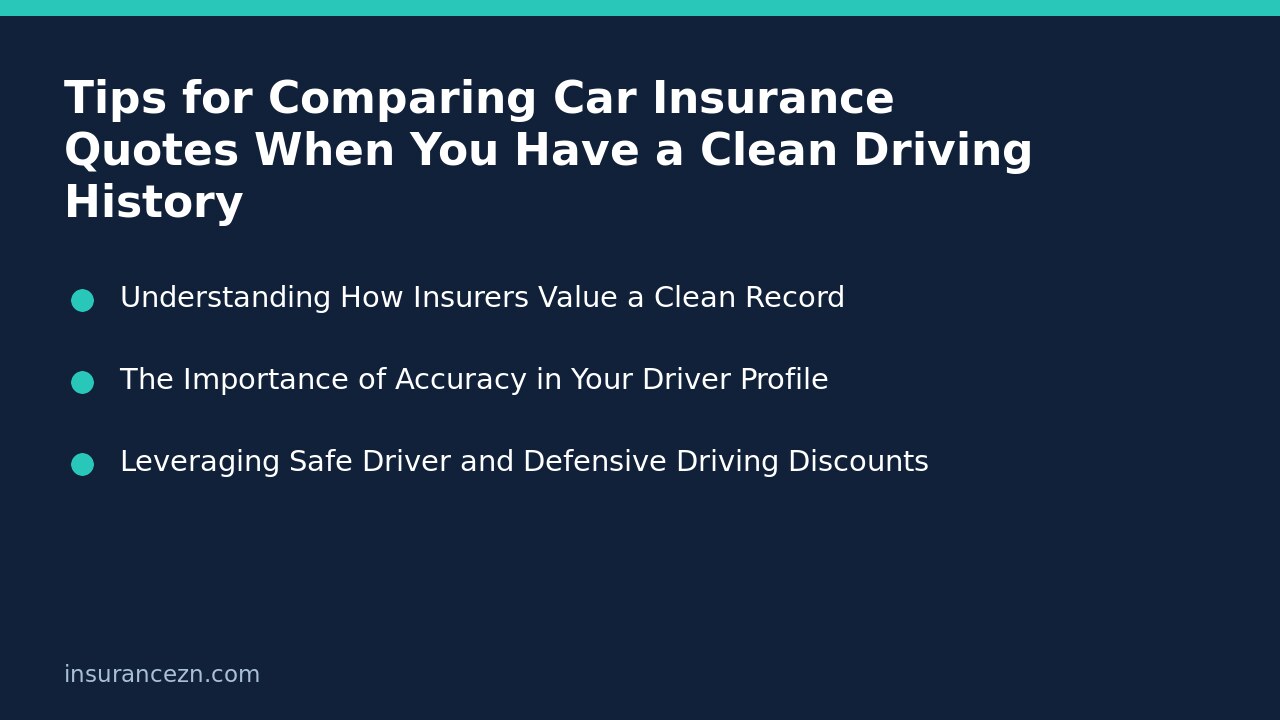
Understanding How Insurers Value a Clean Record
Insurance companies categorize drivers based on risk profiles. A clean driving history typically places you in the “preferred” or “elite” tier. However, the magnitude of the discount varies significantly between carriers. Some insurers offer substantial reductions for accident-free years, while others may only provide a modest bonus.
It is crucial to recognize that different companies define a “clean record” slightly differently. For instance, one carrier might consider you clean if you have had no accidents in the last five years, while another may look at a ten-year window. Additionally, some insurers weigh recent driving history more heavily than older incidents, meaning that clearing your record of minor infractions from several years ago can yield different results depending on the company’s policy. When comparing quotes, always verify how far back each insurer looks at your driving file and whether they penalize specific types of violations differently.
The Importance of Accuracy in Your Driver Profile
Even with a perfect driving history, administrative errors can inflate your premium. Insurers rely on data feeds from state motor vehicle departments and third-party reporting agencies. Sometimes, these systems lag or contain mistakes, such as a ticket that was paid but not updated in the insurer’s database, or a minor fender-bender that was settled privately and never reported to the police.
Before comparing quotes, you must audit your own driving record. Log into your state’s DMV portal or contact your local department of motor vehicles to request an official copy of your driving history. Review it meticulously for any inaccuracies. If you find errors, dispute them immediately before submitting insurance applications. Applying for coverage with incorrect data can lead to a quote that reflects a higher risk profile than your actual behavior, negating the benefits of your clean record.
Leveraging Safe Driver and Defensive Driving Discounts
A clean driving history often unlocks specific discounts that go beyond the base rate reduction. Many insurers offer “Safe Driver” discounts for those who have gone several years without an at-fault accident. Furthermore, completing an accredited defensive driving course can sometimes result in additional percentage reductions, even if you haven’t had a recent violation.
Some carriers also offer usage-based insurance (UBI) programs or telematics discounts for drivers who demonstrate safe habits through their driving data. If you have a clean history but are unsure about your current standing, consider enrolling in a telematics program that tracks mileage and braking patterns. This can provide empirical evidence of your safe driving style, potentially lowering rates further. When comparing quotes, ask agents specifically which discounts apply to your profile and ensure they are applied correctly during the final quote generation.
Comparing Coverage Limits and Deductibles Wisely
Your clean driving record is valuable, but it should not lead you to skimp on essential coverage. Low premiums often come with high deductibles or limited liability limits, which can be dangerous in the event of a serious accident. When comparing quotes, focus on balancing your deductible amount with your financial ability to pay out-of-pocket if an incident occurs.
For example, raising your comprehensive and collision deductible from $500 to $1,000 might save you a few hundred dollars annually, but it increases the risk of financial strain after a claim. Conversely, lowering your liability limits to the bare minimum required by state law could expose your assets to lawsuits if you cause significant damage. Use your clean record as leverage to negotiate better terms rather than simply accepting the cheapest option. Ensure that every quote you receive includes the same coverage types and limits so that you are comparing apples to apples.
Checking for Data Entry Errors Across Multiple Carriers
One of the most common pitfalls when comparing quotes is assuming that all carriers are pulling your data accurately. Sometimes, one insurer may have an outdated record showing a past violation that has since been expunged or corrected, while another carrier correctly reflects your clean status. This discrepancy can result in wildly different quotes for the same driver.
To avoid this, obtain quotes from at least three to five different insurers. If you notice a significant variance where one quote is much higher than the rest despite having the same coverage details, investigate further. Request that the agent manually review your driving record with the specific carrier’s underwriting team. It is better to spend time resolving a data discrepancy than to pay an inflated premium for months or years based on incorrect information.
Real-World Example: Maximizing Savings with a Perfect Record
Consider the case of Sarah, a 30-year-old female who has driven without any accidents or tickets for six years. She currently pays $1,200 annually with her current insurer. By following these tips, she takes the following steps:
1. Audit: She pulls her driving record and confirms it is error-free.
2. Discounts: She completes a defensive driving course to unlock an additional 5% discount.
3. Comparison: She requests quotes from five carriers, specifying $1,000 deductibles and standard liability limits.
4. Verification: She notices one carrier quoted her higher due to a lingering error in their system; she corrects it with proof of clean history.
5. Result: After switching to the most competitive offer that included all applicable discounts, Sarah reduces her premium to $850 annually while maintaining robust coverage.
This example illustrates how a systematic approach can yield significant savings without sacrificing protection.
Final Checklist for Comparing Quotes
To ensure you get the best deal, use this checklist before finalizing your policy:
– [ ] Have I verified my driving record for errors?
– [ ] Am I applying for quotes from at least three different carriers?
– [ ] Have I asked about all available safe driver and usage-based discounts?
– [ ] Are the coverage limits and deductibles identical across all compared quotes?
– [ ] Did I confirm that my clean driving history is being recognized by each insurer?
– [ ] Is the chosen insurer financially stable and reputable in my region?
By diligently following these steps, you can transform your clean driving history into a powerful tool for financial savings. Remember that insurance terms, availability, eligibility, laws, and prices vary by insurer, policy, and jurisdiction. Always review the specific details of any policy before signing, as what constitutes a “clean record” or qualifies for a discount can depend heavily on local regulations and individual underwriting guidelines.