
Understanding the difference between liability, collision, and comprehensive coverage is the first step toward securing a policy that protects your finances without overpaying. Most drivers mistakenly believe that standard auto insurance covers everything, but these three pillars represent distinct layers of protection with specific triggers and limitations. Before you compare rates or select a provider, it is crucial to grasp exactly what each type pays for and when they apply. This guide breaks down the mechanics of these coverages so you can make informed decisions based on your vehicle’s value, your financial situation, and local laws.
Why Liability Coverage Is Often Mandatory but Limited
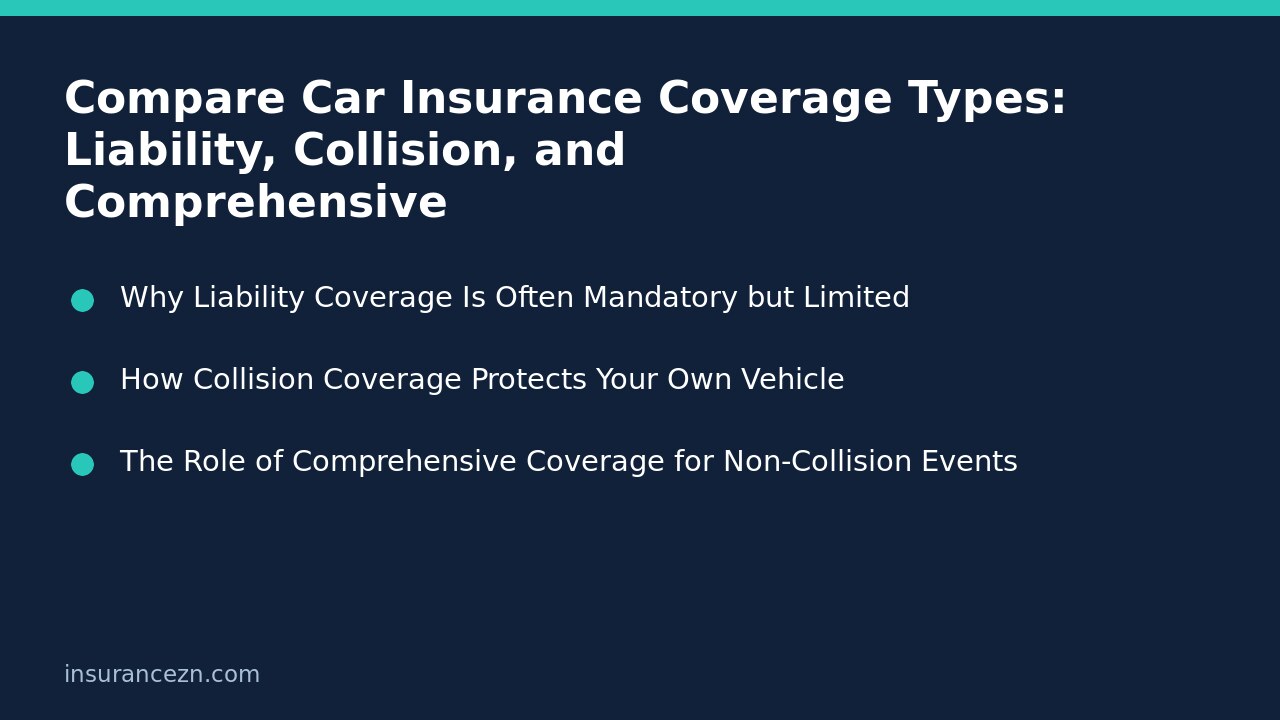
Liability insurance is the foundation of almost every auto policy in the United States and many other jurisdictions. It is frequently required by state law because it protects others from the financial fallout if you cause an accident. This coverage splits into two main components: bodily injury liability and property damage liability. Bodily injury liability pays for medical expenses, lost wages, and legal fees if you are found responsible for injuring someone else. Property damage liability covers the cost of repairing or replacing another person’s vehicle or other structures damaged by your car.
However, liability coverage has a critical flaw: it does not protect you from your own costs. If you cause an accident where you are at fault, your liability insurance pays for the other driver’s repairs and medical bills up to your policy limits. Any amount exceeding those limits becomes your personal debt. Furthermore, if the other party is injured and sues you for more than your liability limit covers, your personal assets—such as your home or savings—could be at risk. When comparing policies, always look for high enough liability limits to protect your net worth, often recommended in the 100/300/100 format ($100,000 per person, $300,000 per accident for bodily injury, and $100,000 for property damage).
How Collision Coverage Protects Your Own Vehicle
Collision coverage is an optional add-on that specifically addresses damage to your own vehicle resulting from a collision with another car or object. This includes accidents involving trees, guardrails, or other stationary objects. The key distinction here is that it applies regardless of who is at fault in the accident. If you hit another driver who has no insurance, collision coverage ensures your car gets repaired without waiting for their claim to be processed.
When evaluating collision options, consider your vehicle’s actual cash value (ACV). Insurance companies will not pay more than what your car is worth at the time of the crash. For example, if you have a five-year-old sedan worth $8,000 and it is totaled in an accident, your insurer will pay up to $8,000 minus your deductible. If the repair cost exceeds the ACV, the vehicle is declared a total loss. Many financial experts suggest dropping collision coverage once the annual premium for that coverage exceeds 1% of the car’s value or when the deductible would require more than one year of savings to pay out-of-pocket.
The Role of Comprehensive Coverage for Non-Collision Events
Comprehensive coverage, often called “other than collision” insurance, handles damage to your vehicle caused by events other than a crash with another car. This includes theft, vandalism, fire, hail, falling objects, and contact with animals, such as hitting a deer. Like collision coverage, comprehensive does not apply if you are at fault in a crash; that falls under liability or collision. However, it is essential for vehicles parked in areas prone to severe weather or high theft rates.
A common misconception is that comprehensive covers everything related to the car’s condition. It does not cover normal wear and tear, mechanical failures, or damage from your own negligence (like leaving keys in the ignition while the engine runs). When comparing quotes, be aware that comprehensive rates can fluctuate significantly based on where you park and local crime statistics. If you have a classic car or a vehicle with sentimental value beyond its market price, comprehensive coverage is often necessary to ensure full restitution.
Determining Your Deductible Strategy
The deductible is the amount you agree to pay out of pocket before your insurance kicks in for a covered claim. This figure directly impacts your premium; a higher deductible usually lowers your monthly cost, while a lower deductible increases it. The choice between a $500 and a $1,000 deductible, for instance, can save hundreds of dollars annually but requires you to have that cash readily available if an accident occurs.
Consider your emergency fund when setting this limit. If choosing a $1,000 deductible saves you $600 a year, calculate how many months it would take to recover that savings versus the risk of needing to pay $1,000 in a single incident. A practical rule of thumb is to ensure you have at least one year’s worth of deductibles saved in an accessible account before selecting a higher limit. This strategy allows you to lower premiums without risking financial instability during a claim.
Real-World Scenario: Comparing Coverage Needs
To illustrate how these coverages interact, imagine two drivers: Alex and Jordan. Alex drives a brand-new electric vehicle purchased last week, while Jordan drives a ten-year-old compact car that they plan to keep until it runs out of gas.
In this scenario, Alex likely needs both collision and comprehensive coverage at maximum limits because the car’s high value makes the risk of a total loss significant. If Alex gets into an accident with no fault, their liability covers the other party, but collision covers their own new car. Comprehensive protects against hail storms that could destroy the battery or roof. Conversely, Jordan might be able to drop collision and comprehensive coverage entirely. Since the car’s value is low, the cost of these premiums would likely exceed the potential payout from an insurer. If Jordan gets into an accident, they can simply pay for repairs out of pocket or rely on their savings, knowing that liability insurance will still handle any injuries to others. This comparison highlights why “one size fits all” policies often lead to wasted spending.
Common Mistakes to Avoid When Comparing Policies
When shopping for car insurance, several pitfalls can lead to underinsurance or expensive surprises. First, do not let agents lower your coverage limits just to secure a cheaper rate. While it feels like a bargain now, it leaves you vulnerable if a serious accident occurs. Second, avoid assuming that comprehensive covers all natural disasters; verify exactly what perils are included in your specific policy language, as definitions can vary by state and carrier. Third, never forget to check for bundling discounts or multi-car discounts, which can lower the overall cost of liability, collision, and comprehensive combined. Finally, ensure you understand the difference between “actual cash value” and “agreed value” coverage, especially if you own a classic car or a customized vehicle where market value does not reflect the true cost to restore it.
Conclusion: Building a Balanced Insurance Portfolio
Selecting the right mix of liability, collision, and comprehensive coverage requires balancing legal requirements, financial assets, and the value of your vehicle. Liability is non-negotiable in most places, but raising your limits is an investment in your personal security. Collision and comprehensive are optional but highly recommended for newer or expensive cars. By understanding the specific triggers for each type of coverage and calculating the impact of deductibles on your budget, you can construct a policy that offers robust protection without unnecessary expense. Always review your policy details before signing, ensuring that the terms align with your real-world driving habits and financial goals.