
Securing affordable business liability insurance is often more about strategic communication than simply shopping around for the lowest quote online. Many business owners believe that once they receive a premium from an insurer, that number is fixed and unchangeable. However, experienced commercial brokers and risk managers know that premiums are rarely set in stone at the moment of issuance. There is significant room to negotiate your rate down by presenting data-driven arguments, adjusting coverage parameters, and leveraging market competition. This guide outlines the specific tactics you can use to lower your monthly or annual premium without sacrificing essential protection.
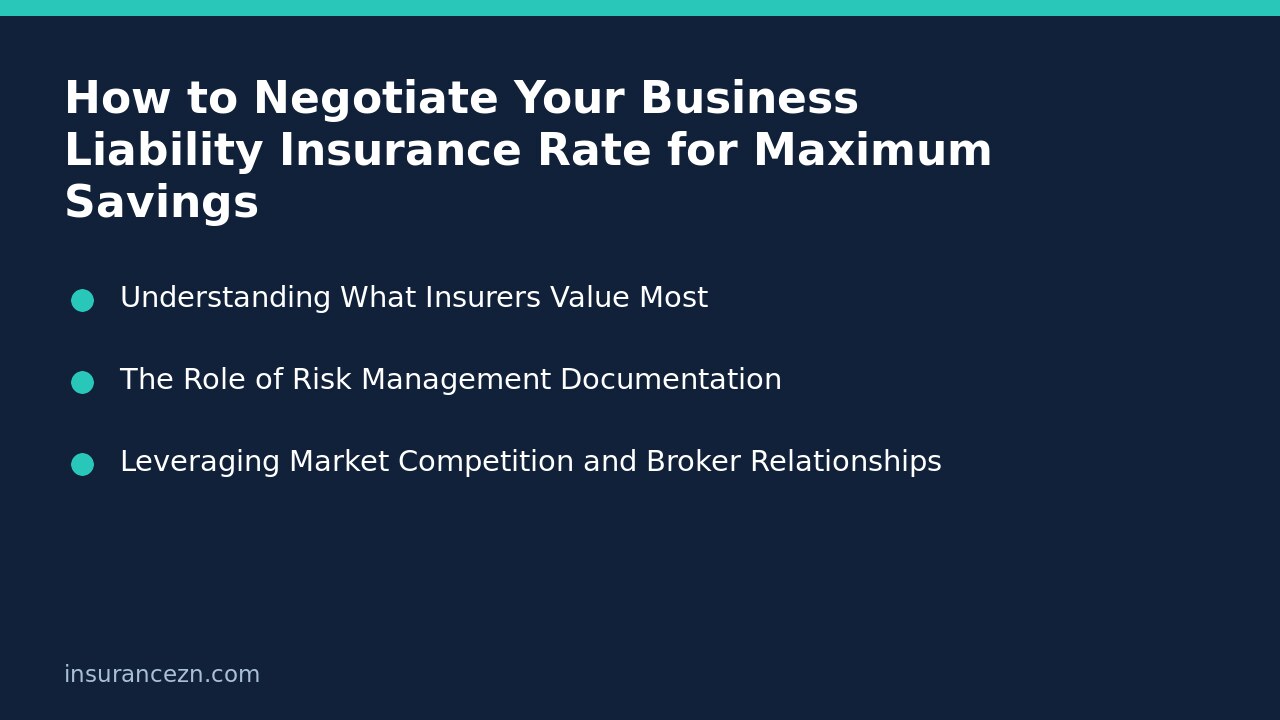
Understanding What Insurers Value Most
Before walking into a negotiation, you must understand what factors drive up premiums in the eyes of an underwriter. Insurance companies price policies based on risk exposure. If you can demonstrate that you actively manage these risks better than the average business in your industry, you become a more attractive candidate for lower rates. Insurers look closely at your claims history, your loss control measures, and your operational safety protocols.
A common misconception is that a clean claims record over five years guarantees a low rate forever. While helpful, it does not automatically lock in a price if the insurer believes your current risk profile has increased. Conversely, if you have implemented new safety training or upgraded equipment since your last policy renewal, you have a legitimate case for a discount. Negotiation starts with gathering evidence of these improvements. You need to compile a dossier that proves your business is safer today than it was when the quote was originally generated.
The Role of Risk Management Documentation
One of the most effective ways to negotiate is by submitting formal risk management documentation. This does not mean writing a novel; it means providing concrete proof of safety initiatives. For example, if you recently installed fire suppression systems, upgraded your security cameras, or completed a certified safety training course for all employees, document this.
When presenting these details to your broker or insurer, frame them as value-adds that reduce their potential payout risk. Ask the underwriter specifically how these measures impact their rating algorithms. In many jurisdictions, businesses with robust loss prevention programs qualify for “safety discounts” that may not be automatically applied. By bringing this up explicitly, you prompt the insurer to review your file against their internal guidelines for risk mitigation. If they do not offer the discount immediately, it is often because they missed the data or are unaware of the specific criteria. Politely requesting a re-evaluation based on this new information can yield immediate savings.
Leveraging Market Competition and Broker Relationships
If you have received quotes from multiple carriers, use those offers as leverage during negotiations, but do so strategically. Do not simply say, “Company X offered me 20% less.” Instead, present the situation as a matter of market alignment. Tell your current insurer, “We are reviewing our options to ensure we are getting fair market value for the coverage limits and deductibles we selected. Given our long history with you and our improved risk profile, what steps can we take to match or approach the competitive pricing we are seeing in the market?”
This approach signals that you are serious about finding a sustainable rate but are not yet ready to leave if a solution can be found. It is crucial to work closely with your commercial insurance broker. A good broker acts as an advocate for your business, not just a middleman. They have relationships with multiple carriers and understand which ones are most likely to adjust rates downward based on specific arguments. Ask your broker to speak directly to the underwriting team on your behalf. Often, a broker can access “special” rate adjustments or temporary promotions that a business owner cannot see when logging into a public portal.
Adjusting Coverage Limits and Deductibles
Another primary lever for negotiation lies in the structure of your policy itself. The premium you pay is directly correlated to your chosen deductible and coverage limits. If you have been paying premiums based on high-limit protection but rarely utilize it, consider increasing your deductible. A higher deductible shifts more financial risk onto your business, which immediately lowers the premium cost.
However, this must be done carefully. You must ensure that your business has sufficient cash reserves to cover a claim should it occur. If you cannot afford a $5,000 deductible in the event of a lawsuit, moving from a $1,000 to a $2,500 deductible might save money now but could cause financial distress later. Negotiate a tiered approach: perhaps keep general liability limits high for major events but accept a higher deductible for minor incidents if your policy structure allows. Additionally, review whether you are paying for coverage you do not need. For instance, if your business operates solely online and does not interact with the public physically, you might not need broad premises liability coverage. Removing unnecessary endorsements can significantly trim the cost while maintaining core protection.
Real-World Example: The Manufacturing Shop Scenario
Consider a hypothetical manufacturing shop that has operated for ten years. Their current liability premium is $12,000 annually. Upon renewal, they receive a standard quote without changes. The business owner decides to negotiate by taking three steps. First, they gather documentation showing they installed new ventilation systems and updated all employee safety manuals six months ago. Second, they contact their broker to find out if any of their competitors in the same region are getting lower rates due to similar risk profiles. Third, they propose increasing their deductible from $2,000 to $3,500 to offset some of the cost.
Armed with this information, the owner meets with the insurer’s underwriter. They present the safety documentation and express willingness to accept a higher deductible if it results in a premium reduction. The insurer reviews the new risk data, acknowledges the improved safety protocols, and agrees that the shop qualifies for a “safety discount” they previously missed. Combined with the higher deductible, the insurer offers a revised rate of $9,800. This represents a saving of $2,200 annually, or roughly 18%, achieved through negotiation rather than switching carriers entirely. The business retains its loyal relationship with an insurer that knows their operations well while securing a better financial outcome.
Common Mistakes to Avoid During Negotiation
Even with the best intentions, businesses often stumble during the negotiation process. One major mistake is being inflexible about coverage terms. Insurers are not adversaries; they want good customers who will stay for years. If you demand drastic changes that compromise your protection, you may push them away before a deal can be struck. Always prioritize maintaining adequate coverage over squeezing out every last dollar of premium.
Another error is failing to follow up. Negotiations often stall because the business owner assumes silence means rejection. After sending your risk documentation or proposing adjustments, wait a few days and then politely follow up with your broker or underwriter. Ask for a timeline on when they can review the new data and provide an updated quote. Persistence, backed by facts, usually pays off. Finally, avoid comparing apples to oranges. Ensure that any competitor quotes you use for leverage are for identical coverage limits, deductibles, and endorsements. Comparing a $1 million limit policy to a $500,000 limit policy is not a valid negotiation tactic and can damage your credibility with the underwriter.
Conclusion: Securing Value Through Communication
Negotiating your business liability insurance rate is a proactive process that requires preparation, documentation, and clear communication. By demonstrating improved risk management practices, leveraging market data through your broker, and thoughtfully adjusting policy structures like deductibles, you can achieve significant savings. Remember that the goal is to find a sustainable partnership with an insurer who understands your unique business needs while keeping costs reasonable. Start gathering your safety records today, engage your broker in these conversations, and approach your renewal date with a strategy ready to implement. With the right approach, maximum savings are within reach without compromising the security of your business assets.