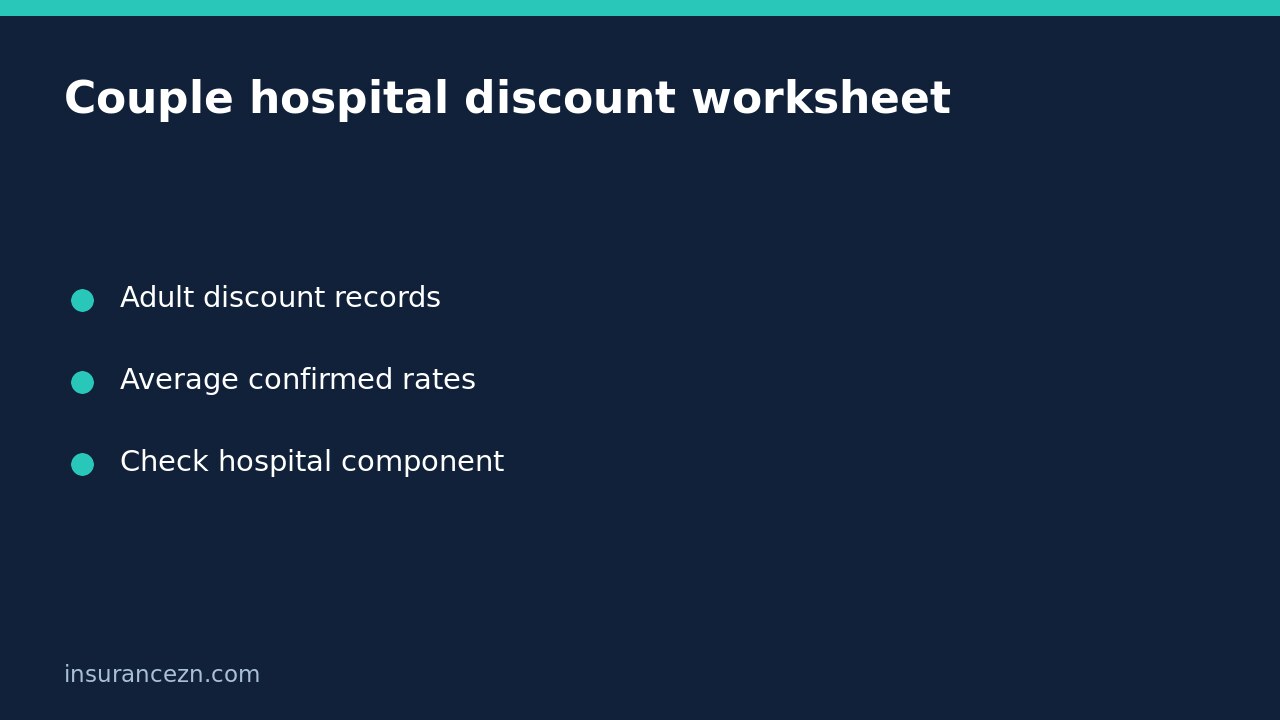

When two adults share a couple or family hospital policy offering age-based discounts, the household discount is calculated as an average of the two adults’ individual discounts. It is not automatically the larger partner’s rate. Before combining memberships or comparing a quote, ask the fund to show the two individual records and the resulting hospital-premium discount.
This is general information for Australian readers, not personal financial advice. Product availability, membership rules, applicable policy documents and any PDS limitations matter. A discount calculation is not a recommendation to combine policies, change benefits or cancel existing insurance.
Confirm that the product offers the discount
The official age-based discount guidance says insurers can offer eligible younger adults discounts on hospital insurance premiums. Offering a discount is not universal. The page sets out allowable rates and explains that individual membership history and the product’s introduction of discounts can matter.
Do not calculate eligibility from today’s birthday alone. Ask the fund for each adult’s recognised individual percentage and the reason for that percentage. If a person already holds a discount, request confirmation of what will happen on the proposed product. Insurers can choose whether to honour existing discounts on transfers between discounted products or insurers.
Also distinguish an adult policyholder from a dependent. The government guidance says someone covered as a dependent on a family or single-parent policy cannot simultaneously receive the age-based discount in that capacity. Obtain the proposed membership classification rather than assuming every adult named on a family policy contributes a discounted rate.
Average the adult rates, not the final bills
For a couple or family policy, the official guidance describes the discount as an average between the two adults’ individual discounts. Start with fund-confirmed percentages. Do not average the partners’ previous dollar payments: those amounts may reflect different products, excesses, rebate settings or other adjustments.
Here is a fictional calculation, not a real quote. Suppose the fund confirms that one adult has a 10% individual discount and the other has 0%. The average is 5%. If the relevant annual hospital premium base in this simplified example is $2,400, a 5% discount is $120, leaving $2,280 before any adjustments not included in the illustration.
This example deliberately isolates one calculation. It does not establish the actual order in which your insurer applies rebate, loadings or other adjustments, nor does it compare the household’s previous cover. Ask the fund to identify the eligible premium base and show its actual calculation in dollars.
Keep hospital and extras components separate
The age-based discount described by the government applies to hospital premiums. A combined hospital-and-extras bill can obscure that distinction. Applying the percentage to the full combined bill may overstate the saving.
Request a quote that identifies the hospital component, extras component, recognised adult discount rates, averaged percentage and final amount payable. If the quote does not expose every calculation line, ask for a written explanation of how the age-based discount affects it. Do not infer that an unchanged total means no discount was applied: other pricing or membership changes may have occurred.
The PHIS guidance warns that statement premiums are comparison figures rather than personalised prices. Match the actual product and household circumstances instead of using an old statement amount as a guaranteed quote.
Ask for a before-and-after membership comparison
Send an information request before authorising changes: Please quote the proposed couple membership without changing our existing cover. Confirm each adult’s recognised age-based discount, the averaged rate, the hospital premium component and the final payable amount. Explain any discount transfer conditions and the proposed effective date.
Then compare benefits and costs over the same period. Check excesses, co-payments, hospital categories and other relevant product differences independently of the discount. A cheaper premium created by reducing cover is not a like-for-like discount saving. For help separating an excess from other admission costs, read why a hospital excess is not the total hospital bill.
Save the written quote, its expiry date if stated and the fund’s conditions. A reference number or confirmation that an enquiry was received does not establish that a membership change has been processed. If you proceed, reconcile the issued membership record and first bill against the accepted instructions.
Frequently asked questions
Can we simply use the younger partner’s rate? Not for the household calculation described in the government guidance. Obtain both recognised individual rates and the fund’s averaged result.
Does a shared policy always cost less than separate policies? The discount formula alone cannot answer that. Compare actual quotes, cover and household circumstances without assuming the largest advertised percentage produces the smallest suitable bill.
Does the percentage guarantee the premium cannot rise? No. A percentage discount and the underlying premium are different things. Check both the calculation and the final amount whenever membership or pricing changes.