
Hospital accident cover does not mean that every urgent hospital visit is covered. An Australian health policy may use a particular definition of accident, apply additional conditions and treat emergency department charges separately from an admitted hospital stay. The useful question is not simply whether the situation felt like an emergency, but which benefits apply to the actual event and services.
This is general information for Australian readers, not personal financial advice. Read the policy wording, applicable PDS where provided, membership rules and exclusions. Only your insurer can confirm how its product applies to your circumstances. Never delay emergency treatment while checking insurance.
Start with the contract definition, not the hospital label
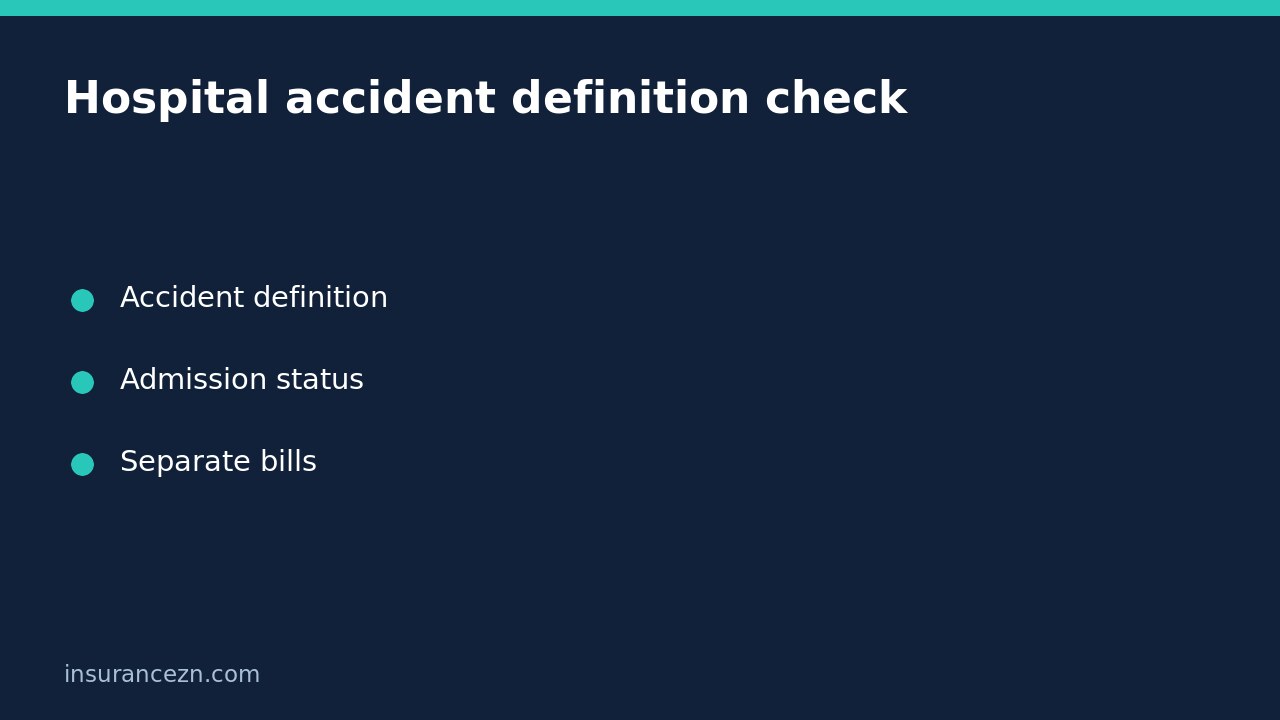
The official private health insurance glossary describes an accident as commonly involving an unintentional or unexpected injury requiring treatment by a registered medical practitioner at a hospital. It expressly warns that other conditions may apply and that accident cover differs between insurers.
That description is a starting point, not a substitute for your policy. Obtain the exact accident clause and any connected definitions. Ask whether it changes benefits for particular clinical categories or provides a separate benefit, and request the conditions that govern that change. Do not assume that a policy heading removes an exclusion everywhere else in the contract.
Record the event date, what happened and the treatment actually proposed. Be accurate about uncertainty: a tentative diagnosis should not become a confirmed diagnosis in an insurance enquiry. The treating clinician determines medical care; the insurer explains contractual benefits.
Separate emergency attendance from admission
The same official glossary explains that emergency room treatment is not considered hospital admission. A patient may attend an emergency department, receive treatment and leave without becoming an admitted patient. Another patient may subsequently be formally admitted. Those pathways need different billing questions.
Ask the hospital whether you were, or will be, admitted and which services sit before or outside that admission. Request an itemised estimate when practical, with the department fee, diagnostic services, doctors and admitted hospital charges identified separately. An accident-related injury does not by itself answer who pays each line.
Likewise, do not infer ambulance benefits from hospital cover. The glossary says accident benefits may include particular ambulance or private emergency department services, not that every product includes them. Ask about the actual transport and attendance arrangements relevant to your policy.
Use one event to test three separate questions
Consider a fictional example: an adult falls from a bicycle, attends a private emergency department and is later admitted for treatment. This illustration does not establish eligibility under any real policy.
- Definition: Does the insurer regard the reported injury as an accident under the applicable wording? What supporting information is required?
- Benefit pathway: Which benefits apply to the proposed admitted treatment, and which separate emergency or transport benefits, if any, apply?
- Personal costs: What excess, co-payment, medical gaps or non-covered charges remain?
A positive answer to the first question does not automatically answer the other two. An insurer may need clinical details before assessing benefits; an enquiry reference or automated receipt is not a processed coverage decision.
Send a precise written confirmation request
Use a short message such as: Please identify the accident definition and conditions applying to my product, and explain separately the benefits for emergency attendance, any admission and ambulance services. Here are the event details, proposed hospital and available treatment information. Please list information still required and any charges you cannot confirm.
Include the membership and product identifiers using the insurer’s secure channel. Save the answer with the wording version and enquiry date. If the response says only that accidents are covered, ask which actual services that statement addresses and whether assessment is still outstanding.
The government PHIS guide explains that a Private Health Information Statement is only a summary and terminology can differ from insurer wording. Use it to locate questions, then obtain the complete product details. For the separate hospital-billing issue, see why an agreement hospital does not automatically mean no gap.
Quick questions before relying on the benefit
- Do I have the actual accident clause and linked conditions?
- Have emergency attendance and formal admission been distinguished?
- Has each separate provider or transport charge been considered?
- Is the insurer confirming an outcome, or only acknowledging my enquiry?
- Have I kept the response and outstanding requirements?
Does an urgent illness automatically qualify? No such conclusion follows from urgency alone. Ask which ordinary illness benefits apply; do not describe an illness as an accident to obtain a different benefit.
Should I choose treatment based on this checklist? No. Obtain necessary care and follow clinical advice. This checklist helps organise insurance questions; it neither establishes treatment suitability nor guarantees payment.