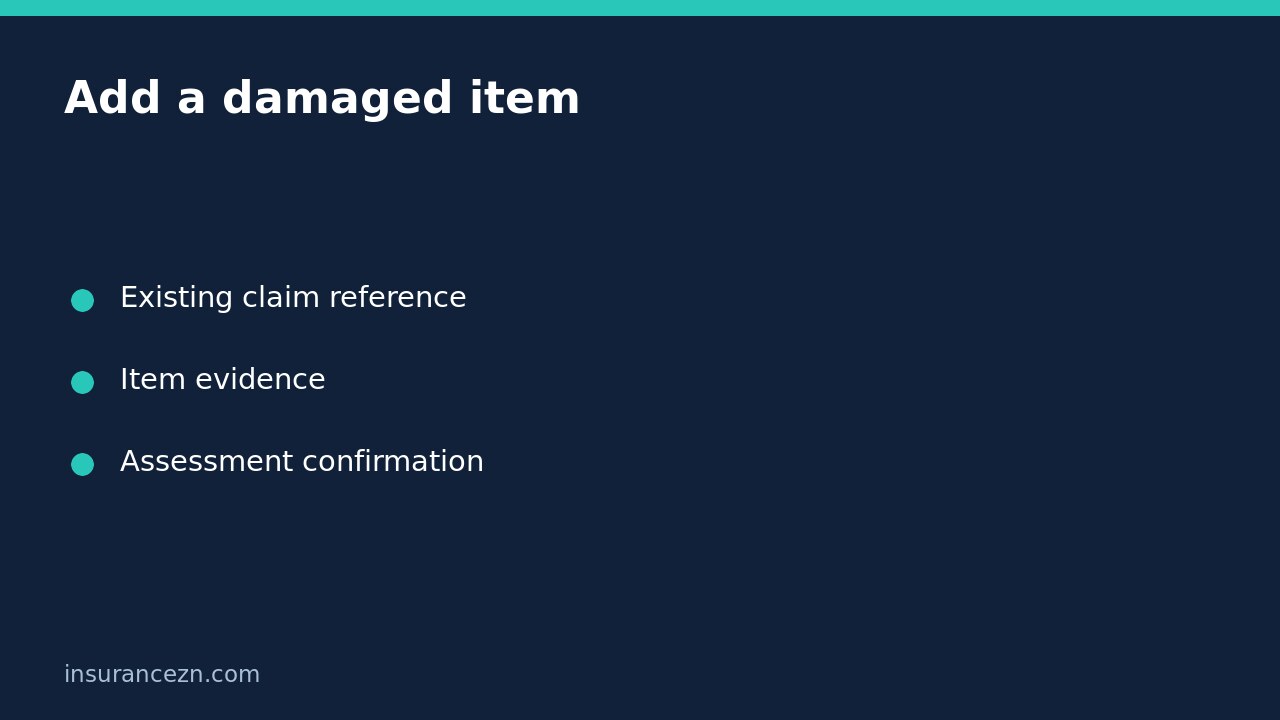

If you discover another damaged belonging after lodging a home or contents claim, contact the insurer using the existing claim reference and ask how to add it. Describe what you found and when, provide available evidence, and confirm whether the item has actually been added for assessment. Do not assume that sending a photograph creates an accepted addition or that a second claim is the right way to update the first.
This is general information for Australian readers, not personal financial advice. Your policy, Product Disclosure Statement (PDS), certificate, exclusions and claims assessment determine any entitlement. Provider examples describe that provider’s published process, not a universal Australian rule.
Check the existing claim before starting again
Find your claim reference and the contents list you already supplied. Check whether the newly discovered item is genuinely missing, recorded under another description, or included in a grouped entry. If an assessor has already listed a bedroom furniture set, for example, ask whether the damaged bedside table forms part of that entry before adding another line.
AAMI’s home-claim preparation information says it is helpful to have incident details and details of damaged contents, but that customers can lodge and add details later without having everything ready. That supports asking about an update; it does not promise acceptance of every later item or unrestricted reopening of a completed settlement.
Create a small evidence packet for the addition
Make the item easy to identify without rewriting the entire claim history. Use a stable label, such as ‘Additional item A — study desk lamp’, and retain copies of whatever you send. Collect information safely; do not handle unsafe electrical items, enter damaged rooms or delay urgent assistance to obtain photographs.
- State the existing claim reference and the incident already reported.
- Describe the item, room, make or model if known, and observed damage.
- Explain when you noticed the damage and why the item was absent from the earlier list.
- Include available photographs and ownership or purchase evidence, identifying missing information honestly.
- Ask what further inspection, evidence or instructions are required before repair or disposal.
Keep observation separate from cause. ‘The lamp would not operate when checked after the incident’ is different from a technical conclusion about why it failed. Do not guess a purchase date, invent a serial number, or present an unverified replacement price as an agreed settlement amount.
Send an explicit update request
A hypothetical message might read: ‘For claim X concerning the reported water event, I have found damage to a study desk lamp not included in my original contents list. I noticed it while checking the room on Tuesday. Please attach the photographs and item details to that claim, confirm whether it is already included elsewhere, and advise what is required for assessment.’
AAMI’s claims overview describes online photo and document management and claim tracking or updates for eligible products. Use the channel the insurer specifies for your product. An online function available for one policy type must not be assumed available for all others. If you cannot tell whether the update reached the existing claim, ask for reconciliation before submitting a duplicate claim.
Track three separate outcomes
First, confirm receipt: the insurer has received your files. Second, confirm recording: the specific item appears on the correct claim or assessment list. Third, confirm the decision: the insurer has assessed the item and explained whether and how it is included. An automated acknowledgement proves neither the second nor the third outcome.
Keep a short log with the item label, submission date, response and next action. If the insurer requests more evidence, connect each new attachment to that label rather than sending an unexplained batch of images. If the item is declined, ask for the reason and applicable policy wording in writing so you can understand the decision.
Pause before accepting an incomplete settlement
If a settlement offer is already open, tell the insurer about the outstanding addition and ask whether the offer includes it. Do not assume acceptance leaves every unresolved item available for later consideration. Request an updated itemised position or a clear written explanation of what remains unresolved before making a decision.
For damage uncovered in the building repair scope rather than an overlooked belonging, use the separate workflow for requesting a repair variation. A contents-list addition and a change to authorised building work are different administrative tasks.
Final checklist
Have you used the original claim reference, checked for an existing entry, described the evidence accurately, and confirmed the item was recorded? Have you obtained an assessment response rather than relying on an upload receipt? These checks improve the accuracy of the claim record; they do not establish coverage, authorise a purchase or guarantee payment.