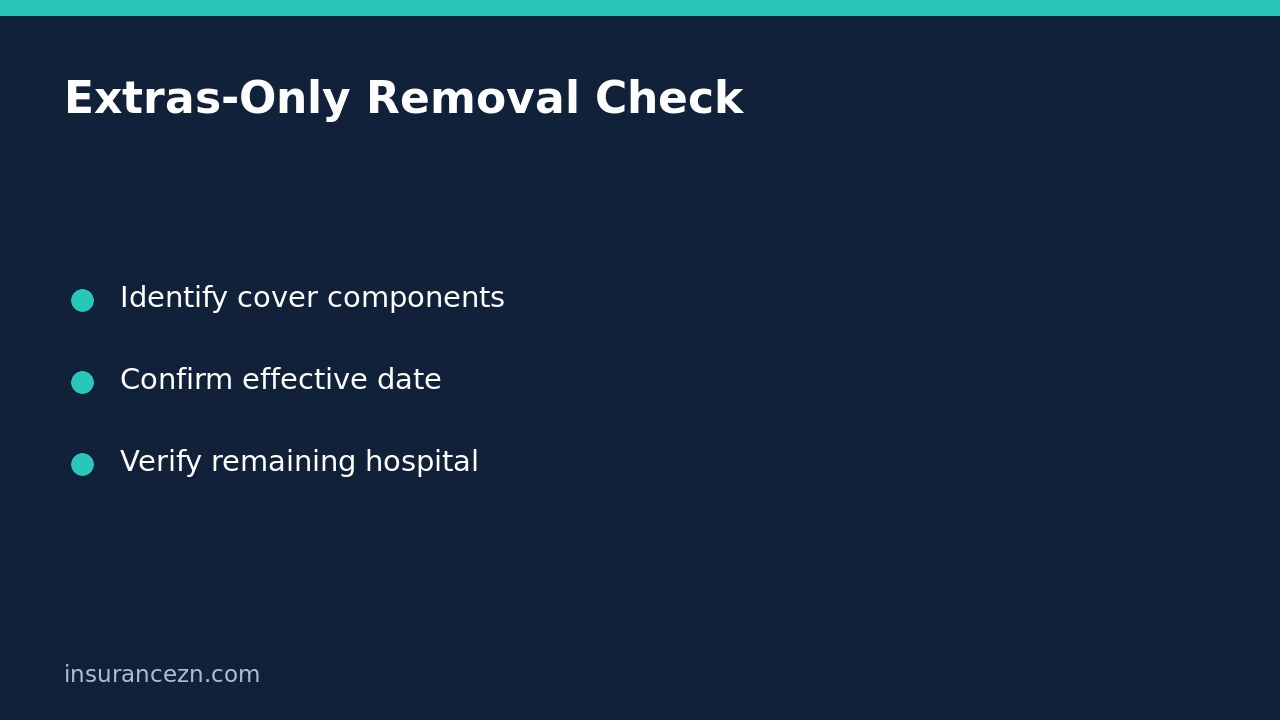

If you want to remove extras but retain hospital cover, give the health fund a component-specific instruction and ask it to confirm the processed result. Saying ‘cancel my health insurance’ risks describing a broader change than you intend. Obtain the remaining hospital product, covered members, effective date and payable premium in writing before treating the change as complete.
This is general information for Australian readers, not personal financial advice. Your fund rules, policy documents and Product Disclosure Statement (PDS), where applicable, determine available arrangements and benefits. Removing a component is not a guarantee of lower overall costs or continuing eligibility for a particular treatment.
Identify what you actually hold
The Australian Government’s Private Health Insurance Basics distinguishes hospital, general treatment or extras, and ambulance policies. It explains that funds offer combined policies and that hospital and extras can also be bought separately. Start with your membership statement rather than assuming that one direct debit means one indivisible type of cover.
List the product names, membership number, insured people and whether hospital and extras are packaged together. Ask the fund whether extras can be removed while retaining the existing hospital product, or whether it proposes moving you to a different hospital product. Those are materially different instructions.
Also ask where any ambulance benefits sit. Do not infer that ambulance protection remains merely because hospital cover continues, or that all ambulance entitlements disappear when extras ends. Your residence, entitlement and actual product arrangements need separate checking.
Get a before-and-after statement, not just a saving
Request a written comparison of the current arrangement and the proposed result. It should show the hospital product, people covered, excess, co-payments, exclusions, restrictions, premiums and relevant discounts. Record the last day extras applies and the date the new arrangement takes effect, including any time-of-day distinction the fund uses.
The government’s managing-your-policy guide recommends considering benefits, excesses and co-payments alongside premiums. It also explains that discount eligibility depends on circumstances and insurer rules. Accordingly, ask for the actual revised premium instead of subtracting an assumed extras price from your current bundled payment.
For example, a family might want to stop paying for routine dental benefits while leaving its hospital arrangements unchanged. A quote for a cheaper hospital product is not confirmation that the original hospital cover will be retained. Ask the fund to resolve that difference before authorising the proposal.
Check treatment and pending claims separately
List upcoming extras appointments and any receipts not yet assessed. Ask how the proposed removal affects services provided before and after the effective date, submission requirements and outstanding claims. A remaining annual limit is not money available for withdrawal, and an appointment booked before removal is not proof of eligibility after removal.
For a treatment course, identify appointment dates and the exact services involved. Ask for the effect of removal on those services rather than assuming an earlier quote promises benefits for the whole course. Do not prepay treatment simply to try to preserve benefits without checking the fund’s rules.
Keep hospital questions separate. Retaining a hospital membership does not itself establish that a planned admission, doctor or hospital charge is covered. Check the relevant clinical category, restrictions, waiting periods and provider estimates for that episode.
Use an instruction that cannot be mistaken for full cancellation
A practical message is: ‘I am requesting removal of the extras component only, subject to confirmation of the resulting arrangement. I want hospital cover retained for the listed members. Please confirm the exact products, effective dates, premium and any hospital changes before processing any broader cancellation.’
Ask whether the fund needs a specific form or authority. Keep a copy of the final instruction and distinguish a request for information from authorisation to act. Do not cancel the entire direct debit yourself as a substitute for changing the policy; payment collection and insured components are different records.
If you are also considering buying extras elsewhere, that is a separate comparison with its own commencement and benefit questions. Our guide to checking a clearance certificate when switching funds explains a useful continuity record. It is not proof that all credits or benefits transfer.
Verify the processed membership
- Obtain the updated membership statement and effective dates.
- Check hospital product and covered people against your instruction.
- Confirm extras removal rather than cancellation of all cover.
- Reconcile the next premium, adjustment and payment record.
- Keep unresolved claims and scheduled treatment questions on a separate list.
Can I add extras back later? Ask about the available product and waiting periods at that time. Do not assume removal freezes your old terms for future reinstatement.
Is a confirmation email enough? Read what it confirms. An automated receipt establishes submission, not the completed membership change. If the updated statement differs from your instruction, contact the fund promptly and request an evidence-backed correction without assuming retrospective benefits are guaranteed.