
When you sit down to purchase or renew an insurance policy, one of the first numbers you will encounter is your deductible. While often overlooked in the initial comparison of quotes, this figure is a critical component of your financial protection strategy. Many consumers mistakenly believe that lowering their deductible is always the best move because it reduces their monthly premium. However, the relationship between your deductible and your premium is not linear; it is an inverse correlation that demands careful consideration of your risk tolerance and financial liquidity. Understanding how adjusting this amount impacts your overall cost of insurance allows you to make a strategic decision that balances immediate cash flow with long-term security.
At its core, a deductible is the specific amount of money you agree to pay out-of-pocket before your insurance company begins to cover the costs of a covered loss. Whether you are dealing with an auto accident, a home fire, or medical expenses, this threshold applies to every claim you file. For example, if you have a $500 deductible and suffer damage costing $2,000 to repair, you pay the first $500, and your insurer pays the remaining $1,500. The insurance premium is essentially the price you pay for transferring the risk of large losses to the insurer. By agreeing to absorb a larger portion of small-to-medium losses yourself (a higher deductible), you signal to the insurer that you are willing to take on more risk, which allows them to lower their administrative burden and your monthly premium.
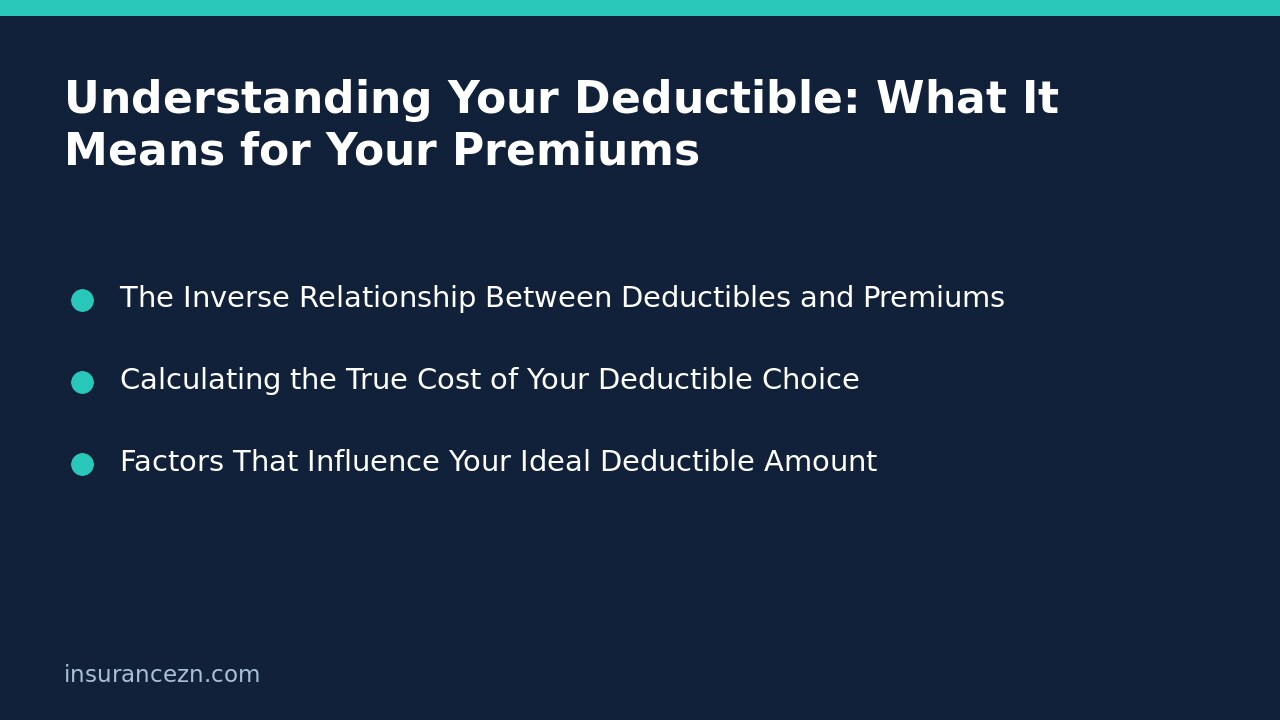
The Inverse Relationship Between Deductibles and Premiums
The most direct impact of changing your deductible is on your monthly premium. Insurance companies use complex actuarial models to determine rates, but the principle remains consistent across almost all property and casualty insurance lines: higher deductibles result in lower premiums, while lower deductibles result in higher premiums. This happens because a higher deductible reduces the insurer’s exposure to frequent, minor claims. When you choose a high deductible, you are effectively acting as your own insurer for smaller incidents, which saves the insurance company money on claim processing and payouts.
Conversely, selecting a low deductible means the insurer assumes more risk from the very first dollar of a loss. To compensate for this increased liability, they charge you a higher premium to offset the potential cost of frequent claims. For instance, switching your auto insurance deductible from $500 to $1,000 might lower your monthly premium by 10% to 20%. While this sounds like an easy win, it is crucial to understand that this savings is often negligible compared to the total amount you would need to pay in a major accident. If you choose the lowest possible deductible to save money today, you must be prepared to pay that full amount immediately if a disaster strikes.
Calculating the True Cost of Your Deductible Choice
To make an informed decision, you must look beyond the monthly savings and calculate the “true cost” of your deductible choice. This involves comparing the annual premium savings against the worst-case scenario payout required from you. Consider a homeowner with two options: a $500 deductible costing $1,200 annually, or a $1,000 deductible costing $1,000 annually. The difference in premium is $240 per year. However, if a fire causes $20,000 in damage, the homeowner with the $500 deductible pays $500 out of pocket, while the homeowner with the $1,000 deductible pays $1,000.
The “break-even” point occurs when the total savings from the lower premium equals the extra amount paid at the time of a claim. In the example above, it would take more than one year to simply break even on that single claim difference. If you never file a claim during your policy period, you keep the entire $240 in savings. However, if you file a claim and the repair costs exceed your deductible by only a small margin (e.g., a $600 repair), the higher deductible option becomes financially disadvantageous because the premium savings are wiped out instantly by the claim payout. You must honestly assess whether you have the liquid savings to cover a high deductible without forcing you to skip other essential bills like rent, groceries, or mortgage payments.
Factors That Influence Your Ideal Deductible Amount
Determining the right deductible for your specific situation requires evaluating several personal and financial factors. The most significant factor is your emergency fund liquidity. If you have six months of living expenses saved in a liquid account, opting for a higher deductible may be a safe strategy. If your finances are tight or you rely heavily on credit to survive emergencies, a lower deductible provides a necessary safety net against catastrophic cash flow disruption.
Another critical factor is the likelihood of filing a claim. High-deductible policies make sense if you live in an area with low risk of frequent small claims, such as a region without severe hailstorms or in a neighborhood with excellent crime prevention measures that reduces auto theft risks. Conversely, if you live in an area prone to wildfires, hurricanes, or frequent minor fender-benders, the probability of hitting your deductible increases. Additionally, consider the type of insurance. Medical insurance often has high deductibles due to the nature of healthcare costs, whereas liability-only policies might function differently depending on local laws and coverage limits. Always review your policy declarations page to see if you are eligible to change these amounts; some insurers allow this at renewal, while others lock it in for the term.
Common Mistakes When Selecting a Deductible
One of the most common mistakes consumers make is choosing the lowest available deductible solely because it appears cheaper on the quote sheet. This approach ignores the reality that insurance premiums are based on projected claim frequency. If you choose a low deductible, you are paying a premium to cover yourself against small losses, which defeats the purpose of having an emergency fund for those exact scenarios. Another mistake is failing to understand that adjusting your deductible does not change what is covered; it only changes when coverage kicks in. You might think lowering your deductible protects you from everything, but if a claim exceeds your policy limits, you are still personally liable for the excess amount regardless of your deductible choice.
Furthermore, many people forget to update their deductibles when they change jobs or receive a significant raise. A financial windfall should be an opportunity to increase your deductible and lock in lower rates, rather than maintaining a low deductible that you can no longer afford in terms of risk exposure. Finally, avoid the temptation to switch deductibles just because a neighbor or friend did so. Insurance is highly personalized; what works for someone with a massive retirement portfolio may leave another person financially vulnerable. Always base your decision on your own financial snapshot and risk profile.
Strategic Checklist for Reviewing Your Deductible
Before you finalize your policy or renew it, run through this quick checklist to ensure your deductible choice aligns with your current life stage:
1. Review your savings: Do you have at least $1,000 (or the amount of your proposed high deductible) in a liquid savings account that is not earmarked for other goals?
2. Analyze local risks: Does your area suffer from frequent natural disasters or high crime rates that increase the probability of small claims?
3. Calculate break-even: Multiply your annual premium difference by two to see how many years it would take to recover the extra cost of a claim if you switched deductibles.
4. Check policy terms: Confirm with your agent if you can change deductibles mid-term or only at renewal, and understand any administrative fees associated with the change.
5. Assess cash flow: If a major loss occurred tomorrow, could you pay the deductible without taking on high-interest debt?
Conclusion
Your deductible is not just a number on a form; it is a strategic financial lever that controls the balance between your monthly expenses and your out-of-pocket risk. While lowering your deductible reduces your premium, it also lowers the threshold for when you must pay significant amounts yourself. By understanding the inverse relationship between these two costs and honestly assessing your financial resilience, you can choose a deductible that offers the best value for your specific circumstances. Remember that insurance is designed to protect against catastrophic losses, not to cover minor wear and tear or frequent small accidents. Making a calculated decision about your deductible ensures that you are not just buying insurance, but building a robust financial defense system tailored to your reality. Always consult with a licensed insurance professional to review your specific policy terms, as availability, eligibility, laws, and pricing vary by insurer and jurisdiction.