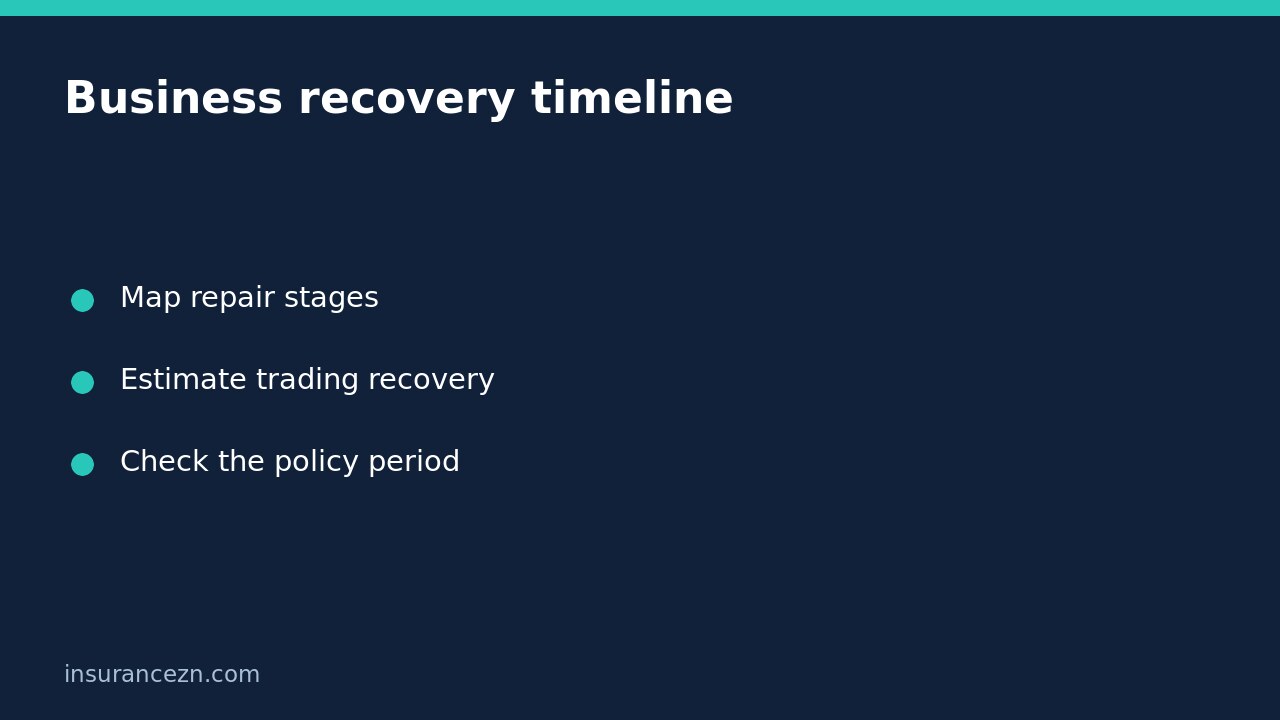

When comparing business interruption insurance, do not choose an indemnity period using only a builder’s estimate of repair time. Map the time needed to investigate the damage, arrange approvals, repair premises, replace essential equipment and rebuild trading. Then ask a broker or insurer how the policy’s actual indemnity-period wording responds to that timeline.
This is general information for Australian readers, not personal financial advice. Cover depends on the policy, its product disclosure statement (PDS) where applicable, schedule, definitions, exclusions and endorsements. An illustration of recovery time is not a forecast or a promise that an insurer will pay.
What the indemnity period is for
Business Queensland’s insurance overview explains that business interruption insurance can cover costs when a business is out of action because of certain events or risks. It notes that a business may need to select an indemnity period for loss of gross profit. Its example involves a restaurant closing after a kitchen fire.
The practical question is how long an insured interruption could affect the business financially. The maximum period is not automatically the period for which every loss will be paid. The event must meet the policy’s cover requirements, and the claim remains subject to its calculation rules, limits and conditions. Ask how the period starts and ends under the specific wording rather than assuming all policies use identical triggers.
Draw the recovery sequence, not just one repair estimate
Create a timeline with one row for each dependency. A building may be structurally ready before the business has the equipment, approvals or staff needed to trade. Conversely, some work can proceed in parallel, so adding every estimate together can exaggerate the total.
- Immediate response: safe access, damage assessment and securing the premises.
- Planning: investigation, repair design, quotations and required approvals.
- Physical recovery: building work, specialist equipment delivery and installation.
- Operational restart: testing, replenishing stock and organising staff or suppliers.
- Trading recovery: rebuilding bookings, customer demand and normal turnover after reopening.
Record who supplied each assumption and whether it is a firm lead time or an estimate. Ask suppliers about essential imported components or custom machinery. Do not present an optimistic delivery date as a contractual guarantee.
Use a clearly labelled scenario
Consider a fictional suburban bakery. The owner initially thinks a short closure is manageable because the building repair looks straightforward. The timeline exercise reveals another dependency: a replacement specialist oven cannot be installed until the floor and electrical work are ready. After reopening, standing wholesale orders may take time to rebuild.
The owner makes two versions of the timeline: an ordinary recovery and a slower but plausible recovery with a supplier delay. Neither version establishes insurance cover. They provide concrete questions for the broker: which stages can produce an insured loss, what documentation would support them, and when would the policy stop responding even if turnover remained below normal?
Keep the amount of cover separate from the duration. A longer indemnity period does not correct an inadequate insured amount, and a large amount does not extend the maximum time allowed. Ask an accountant and broker to help interpret policy-defined gross profit; do not assume it equals a familiar line in the annual accounts.
Check the trigger before debating the duration
A strong timeline is useless if the event is outside the purchased cover. Ask which insured damage or other specified circumstances must occur before interruption benefits apply. Then ask about the actual risks that concern you, such as equipment failure or damage affecting access, without assuming every interruption is included.
For machinery-related concerns, read the related explanation of equipment breakdown versus maintenance costs. Paying to repair a machine and paying for the resulting trading loss are separate coverage questions. A breakdown section does not, by itself, establish interruption cover.
Questions to take to a broker
- What event starts the indemnity period, and what wording determines its end?
- How is reduced trading after reopening assessed, if it is covered?
- What waiting periods, time deductibles, sublimits or special endorsements apply?
- How should seasonal turnover, growth and continuing expenses be reflected in the insured amount?
- What happens if repairs or replacement equipment take longer than the selected period?
- Which reasonable temporary operating costs might be covered, and when is prior approval needed?
Request answers against the proposed wording and record unresolved assumptions. Do not authorise a policy change based solely on a verbal statement that the period ‘should be enough’.
Review when the business changes
Revisit the timeline when adding specialist equipment, changing premises, entering a new supply chain or becoming more dependent on a few customers. Keep quotations and supplier lead-time notes with the review. The goal is not to predict every delay: it is to make the selected period and amount a considered decision rather than an accidental carry-over from last year’s schedule.