
If your own stock is damaged, do not assume that a public liability policy will replace it. For an Australian small business, the first useful distinction is between a loss to your property and a claim that your business injured another person or damaged someone else’s property. One incident can raise both questions, but they require separate checks against the insurance actually purchased.
Start with whose loss you are describing
On its public liability insurance overview, AAMI describes public and products liability in relation to business activities or products accidentally injuring someone other than an employee, or damaging their property. It separately lists contents and stock protection for damage at business premises resulting from insured events.
That is a provider-specific summary, not a promise that every insurer uses identical wording. However, it illustrates why a liability certificate is not evidence that your own merchandise is insured. Check the selected sections, policy schedule and wording rather than relying on the broad label ‘business insurance’.
Split one incident into separate questions
Imagine a shop display falls. Some of the shop’s sale stock breaks, a visitor alleges an injury, and the visitor’s bag is damaged. This is an illustrative scenario, not a confirmed insurance outcome. List the broken business stock separately from the visitor’s injury and property allegations.
For the stock, ask whether the business has an applicable property section, whether the cause is insured, where cover applies and what limits or exclusions matter. For the visitor’s allegations, ask the liability insurer how to notify the incident and what information is needed. Neither side is established just because the other side is being assessed.
There may also be goods belonging to a customer but held by the business for repair or storage. Tell the insurer about that custody arrangement explicitly. Do not assume that the phrase ‘someone else’s property’ removes every exclusion or condition affecting property you hold or work on.
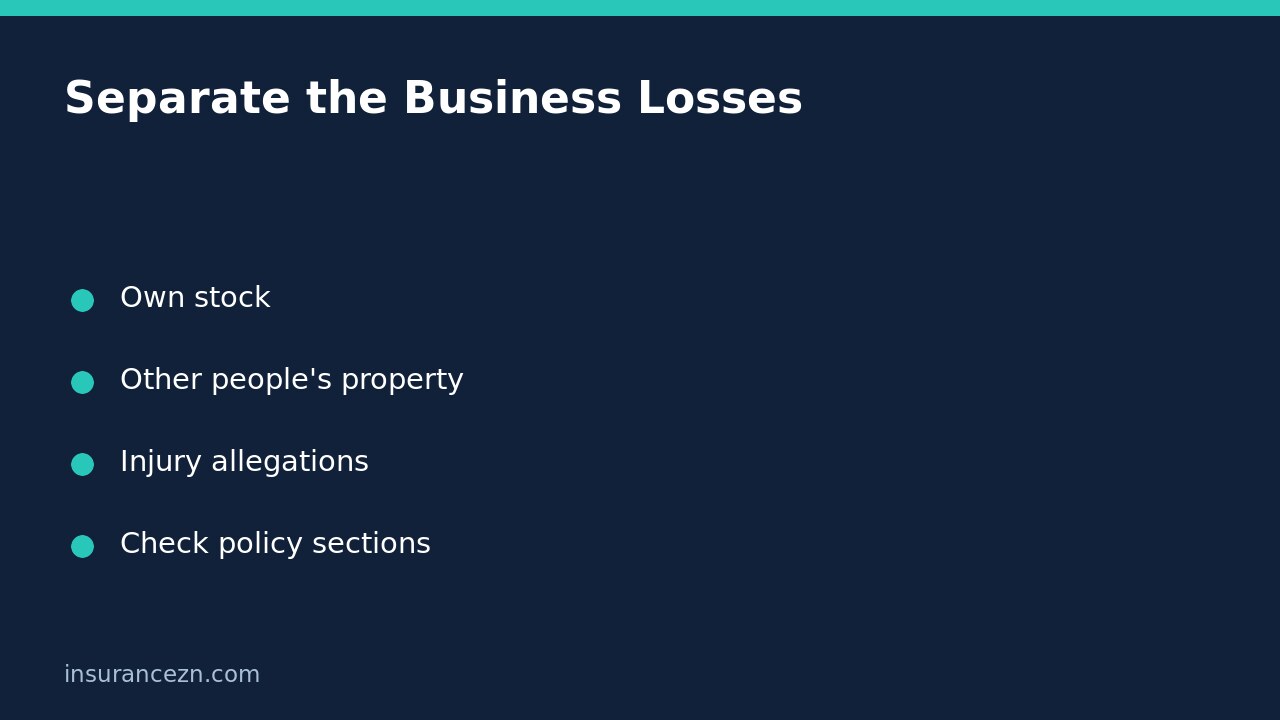
Make a section-by-section cover map
- Business-owned stock: record ownership, location, approximate value and the damage cause you want checked.
- Business equipment: distinguish fixed equipment from items carried away from the premises.
- Another person’s property: describe who owns it, why your business had access to it and what allegedly happened.
- Personal injury: record the incident facts and distinguish a visitor from an employee; do not treat liability insurance as a substitute for checking workers compensation obligations.
- Lost trading income: ask separately whether there is a relevant business interruption section and what triggers its benefits.
AAMI’s overview lists theft, portable items and business interruption among separate additional covers. Their appearance on a website does not mean they are included in your contract. Ask your insurer or broker to identify the actual selected section for each concern, with its limit, excess, conditions and exclusions.
Ask focused questions before buying or renewing
Send a plain-language description of your activities rather than just a job title. Include whether you sell products, keep customer goods, deliver orders or carry stock elsewhere. Ask: ‘Which selected section would respond to damage to my own stock at this address, and which causes would not be insured?’
Follow with: ‘How should I notify a customer allegation arising from the same incident, and are there relevant restrictions for property in my care?’ Request written answers tied to the proposed policy. If the response is only a general brochure, ask for the policy wording reference and schedule entry.
For equipment that travels with you, use our business tools away from the premises checklist. A premises-based answer may not resolve the journey or destination.
Keep the incident record factual
After an incident, prioritize safety and appropriate assistance. When safe, retain photographs, purchase records, relevant communications and a list separating your losses from other people’s allegations. Follow the insurer’s notification and evidence instructions. Ask before authorizing non-urgent replacement or disposal where it could affect assessment, while still taking necessary safety steps.
Does notifying both sections mean two payments are approved? No. Notification starts assessment; it does not establish coverage or payment entitlement.
Does a certificate prove my stock is covered? Not by itself. Read the selected cover and detailed terms.
What if the insurer acknowledges my amendment request? Confirm whether the change was actually accepted and recorded, its effective date and any outstanding requirements. An acknowledgement alone is not amended cover.
This is general information for Australian readers, not personal financial advice. Read the applicable PDS, policy wording and schedule; benefits depend on selected cover, insured events, limits, excesses, exclusions and conditions. The AAMI example is not an endorsement or a guarantee of cover or claim payment.