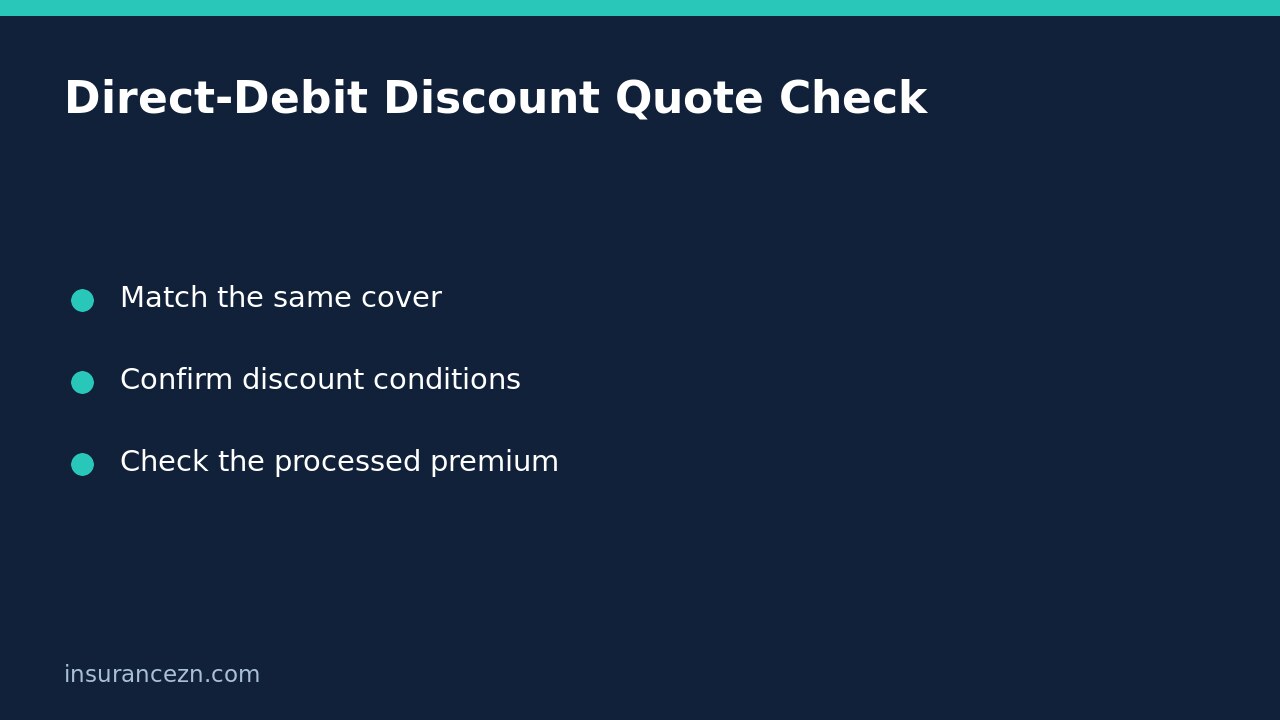

A direct-debit discount can reduce an Australian health-insurance premium, but a discount headline does not establish the amount you will actually pay. Compare written quotes for the same cover, confirm the fund’s payment-method conditions and check the processed premium after the arrangement starts. Do not cancel suitable cover just because another quote displays a percentage saving.
This is general information for Australian readers, not personal financial advice. Benefits, discounts and changes depend on the fund’s rules, policy documents and any applicable PDS. A payment arrangement is not confirmation of treatment eligibility or a claim-payment entitlement.
Establish whether a discount is available to you
The Australian Government’s Managing your policy guide says insurers may offer discounts for pre-arranged direct debit, electronic communication and claims, advance payment or certain contribution groups. It tells readers to check eligibility with their own insurer. The word ‘may’ matters: there is no basis here to assume every fund offers the same discount or accepts every payment method.
Ask whether the quoted saving requires a particular account type, payment frequency or communication preference. If several discounts appear in an advertisement, ask which ones apply to this membership and whether they can be combined. Do not simply add their advertised percentages together.
Request two matching quotes, not two different products
For an existing membership, request the payable premium with your current payment method and with the proposed direct-debit arrangement. Keep the product, people covered, location and quoted period unchanged. Ask the fund to identify any other assumptions affecting the price, including the rebate setting or loading where relevant.
If comparing another insurer, also match hospital inclusions and restrictions, excesses, co-payments, extras benefits and limits. The government guide emphasises that the cheapest policy is not necessarily right for your needs. A cheaper quote achieved by removing a service is not evidence that direct debit alone delivered the saving.
- Write down the full product name and membership type.
- Record the premium period and the quote’s validity date.
- List each confirmed discount and its conditions.
- Note whether the amount is introductory or ongoing.
- Record any change in cover separately from the payment-method saving.
Compare amounts over the same period
Ask for a total over a common comparison period rather than comparing one monthly amount with one fortnightly amount. Have the fund explain the first deduction, regular ongoing deductions and any transition adjustment. A smaller first payment might reflect a shorter initial period rather than a permanently lower price.
For example, an existing member could ask: ‘Please quote my current cover for the same twelve-month period using my present payment method and the proposed direct debit. Identify any assumed premium changes and tell me whether the quoted discount lasts for the whole period.’ This is a comparison request, not a guarantee that future premiums will stay unchanged.
If the alternative requires paying well in advance, affordability and access to that cash also matter. Our explanation of advance payments and rate protection covers why prepayment should not automatically be treated as a protected rate.
Confirm acceptance and the first effective deduction
Submitting bank details or receiving an automated acknowledgement is not proof that the discounted premium has been applied. Obtain confirmation of the accepted payment arrangement, discount eligibility, effective date and next deduction. Check the membership statement and bank record after processing.
The government guide recommends checking statements to ensure direct-debit payments have actually been taken. If the amount differs from the accepted quote, ask for a reconciliation showing the covered period, discount and any adjustment. Before paying a second amount manually, confirm whether an earlier deduction is pending so you do not accidentally duplicate payment.
Keep payment savings separate from benefits
A payment-method discount does not itself increase a dental limit, remove a hospital exclusion or establish that a proposed treatment is covered. If the fund offers a different product while setting up direct debit, request a separate explanation of the benefit changes and any waiting periods before accepting it.
Also ask what happens to the discount if you later change accounts, payment frequency or communication preferences. Do not assume a changed payment method automatically cancels membership; equally, do not assume an unprocessed instruction has maintained payment continuity. Obtain the fund’s actual record and address discrepancies promptly.
Final decision checklist
- Are the two quotes for equivalent cover and the same period?
- Is the saving based on the amount payable, not just an advertised percentage?
- Are eligibility, ongoing conditions and the effective date confirmed?
- Does the first processed deduction match the explanation?
Can I rely on a quote alone? Use it as evidence of what was offered, then verify the accepted arrangement. Does a discounted premium mean cheaper treatment? Not necessarily. Treatment benefits and out-of-pocket costs need their own checks against the policy and provider estimates.