
A reciprocal health care agreement may help an eligible Australian traveller obtain certain necessary care overseas, but it does not replace travel insurance. Before relying on one, establish what the destination’s arrangement actually provides, what you may still pay and how your insurance handles expenses outside that arrangement.
This is general information for Australian readers, not personal financial advice. Cover depends on the policy, Product Disclosure Statement (PDS), exclusions, limits and individual circumstances. Seek urgent medical assistance when needed; do not postpone necessary care while checking benefit paperwork.
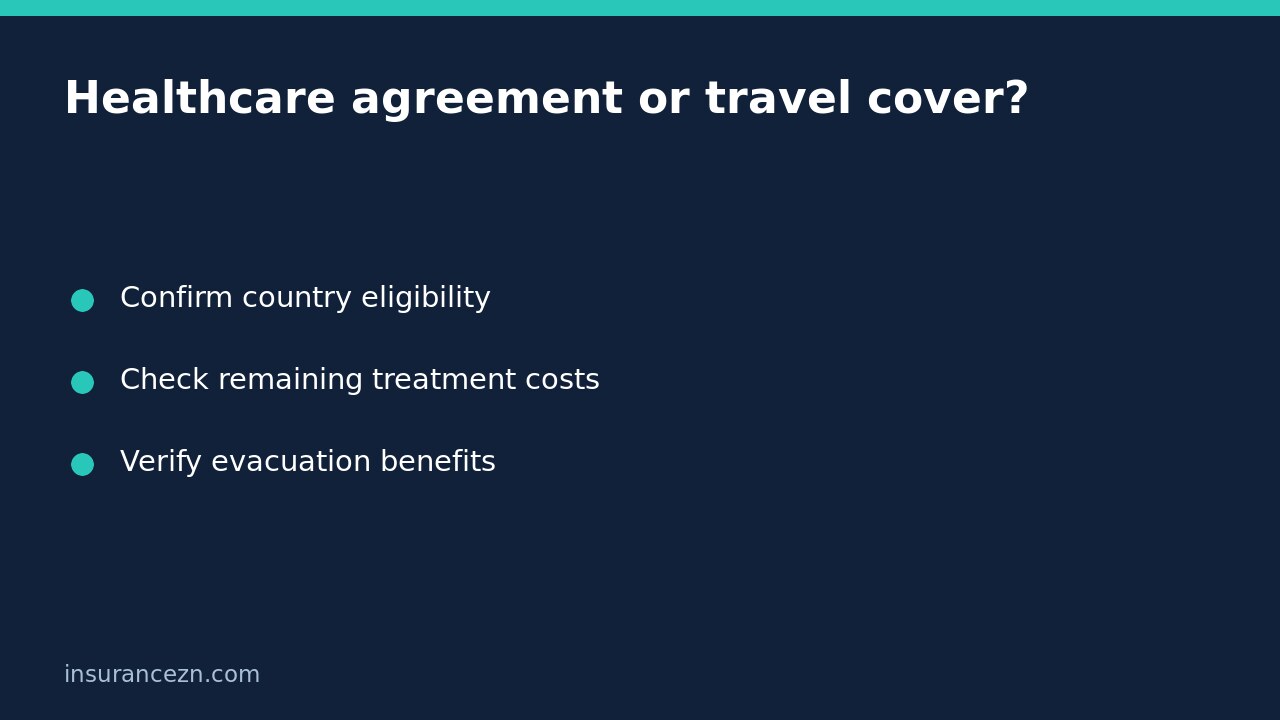
Check the agreement for each destination
Smartraveller’s healthcare agreement guidance explains that agreements can cover or subsidise some emergency medical costs, usually for urgent treatment that cannot wait until you return home. Each participating country decides what it covers or subsidises. Subsidised care is not necessarily free care.
Do not apply one country’s rules to the whole itinerary. Create a row for each destination, including a stopover where you may need treatment. Record whether an agreement exists, your eligibility, how to prove it and any application process. Use the destination-specific information linked through the official guidance rather than a general statement that Australians receive overseas healthcare.
Ask whether your circumstances affect eligibility, particularly if you have dual nationality or will be living, working or studying abroad. An Australian passport or Medicare card should not be treated as proof that every service at every provider will be funded.
Separate access to care from the amount payable
Eligibility is only the first question. You also need to know whether the particular service and provider fall within the arrangement. Smartraveller warns that agreements do not pay for private healthcare and do not cover every medical situation. Non-subsidised medicines and non-urgent care can leave costs payable, while some subsidised services involve a patient contribution.
Before a non-emergency appointment, where practicable, ask the provider how it will classify and bill the service. Record whether it is treating you through the agreement or as a private patient. Ask for the likely patient charge and required eligibility documents. A reception booking is not confirmation of subsidised treatment.
Keep clinical questions with clinicians. Smartraveller notes that the treating doctor determines medical necessity; travellers cannot establish eligibility for urgent benefits simply by describing an appointment as urgent.
Verify evacuation separately from hospital treatment
The official guidance explicitly states that reciprocal agreements do not cover medical evacuations. Do not confuse a subsidised hospital stay with funded transport home. Ask the travel insurer how its policy defines medical evacuation, repatriation and any related transport benefits, including who decides necessity and which approvals are required.
Do not assume a replacement ordinary flight, a medically escorted flight and a specialised evacuation are interchangeable benefits. Obtain the policy wording and ask about your circumstances. An assistance case number is not, by itself, approval for an independently booked transport service.
Likewise, ask about local medical transport under the destination’s arrangement rather than assuming it is always included or always excluded. Smartraveller says some agreements cover additional costs such as local transport, medicines or specialist services; the country-specific rules matter.
Build a two-column funding check
For a hypothetical trip, put the agreement on one side of your worksheet and travel insurance on the other. Use rows for necessary public treatment, private treatment, medicines, local transport, evacuation and non-medical losses. Write confirmed conditions beside each entry; leave unresolved entries marked as questions, not as assumed benefits.
For example, an agreement might help with eligible public treatment while leaving a contribution payable. Ask the insurer whether that contribution can be claimed, what evidence it requires and whether any excess applies. Do not assume the insurer automatically pays every amount the agreement leaves behind.
Smartraveller’s travel insurance overview also recommends choosing insurance for every country visited, including transit points. Use our transit-stop insurance checklist to make the insurance itinerary match your actual route.
Questions to settle before departure
- Have I checked the official arrangement for each country?
- What documents and application steps establish my eligibility?
- Which providers and services are included, and what remains payable?
- What does my insurer require before arranging transport or direct payment?
- Can I access the policy, assistance number and eligibility evidence offline?
Can consular assistance replace either funding pathway? No. Smartraveller states that the Australian Government cannot pay your medical bills or lend you money for them. Keep access to care, agreement eligibility and insurer payment approval as three separate matters.
Does accepting an insurance application settle future claims? No. The actual policy terms and circumstances still govern assessment. Save written answers to specific questions, and check any unresolved exclusions before relying on the cover.