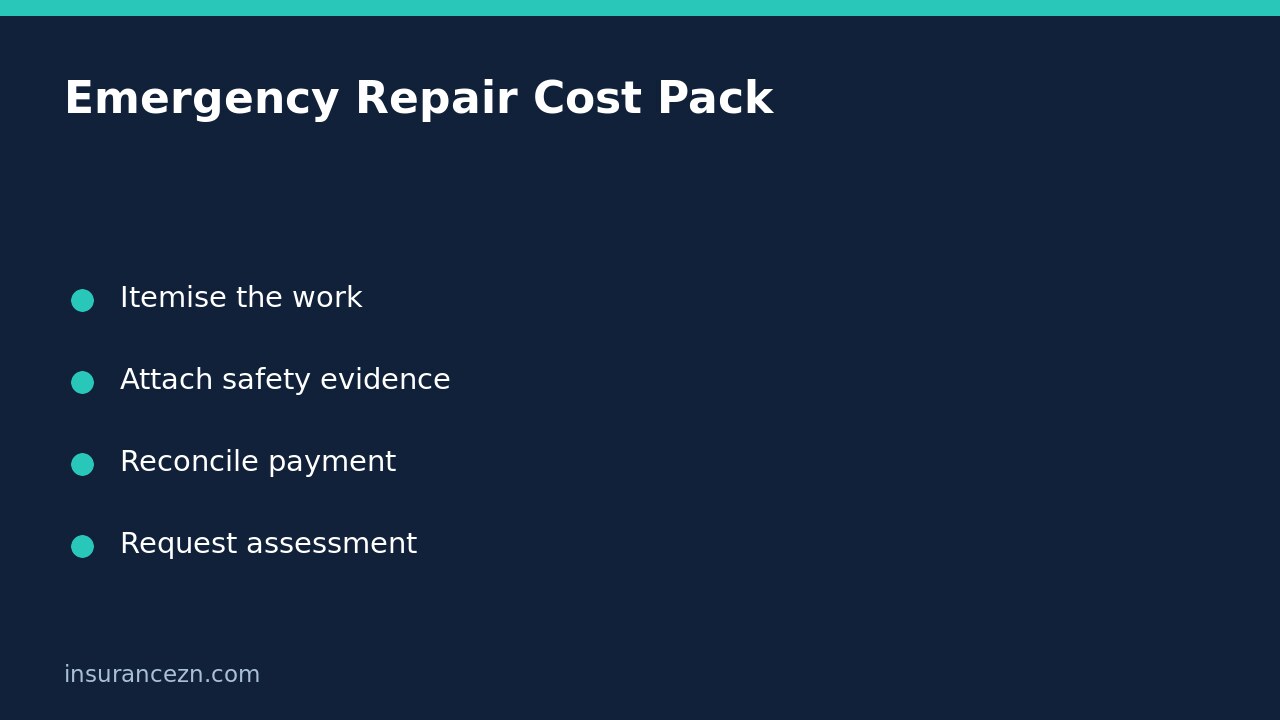

If you paid a tradesperson to make your home safe, prepare more than a bank receipt for your insurance claim. Build a cost pack connecting the itemised invoice to the emergency, the work performed and any insurer instructions. Paying a bill does not establish that the insurer authorised every task or will reimburse the full amount.
This checklist is for Australian homeowners organising an existing claim. It focuses on the bill and supporting records after urgent attendance, rather than deciding which permanent repairs to commission.
Start with the safety work and consent record
Do not delay necessary action to protect people while assembling paperwork. Suncorp’s published home-claim instructions say not to carry out repairs without its consent, except where contact is not possible and emergency repairs are needed to protect the home or contents, or for health and safety. That is a provider-specific explanation, not a universal reimbursement promise.
Record when you noticed the problem, what immediate risk existed, when you tried to contact the insurer and what instructions you received. Preserve messages and call notes. If you could not make contact, describe the attempts accurately instead of writing that approval was obtained.
Ask for an invoice that explains the actual work
Suncorp asks customers who arrange emergency repairs before its supplier or assessor attends to obtain an itemised invoice and send it for assessment. A total marked ‘storm repairs’ gives the reviewer little help distinguishing temporary protection from other work.
- Check the property address, supplier details, attendance date and invoice reference.
- Request descriptions of the work actually completed, not just the original quotation.
- Separate call-out, labour, materials and any other charges where the supplier can accurately do so.
- Identify temporary protection separately from permanent replacement or unrelated maintenance.
- Keep the original invoice and any corrected version, with the reason for the correction.
Do not ask a contractor to relabel maintenance as incident damage. Where a bundled charge cannot be separated, ask for an explanatory note rather than inventing a breakdown yourself.
Attach evidence that connects the charge to the incident
Match each substantial work description to available evidence: photographs, a short attendance report, the insurer’s instructions or a tradesperson’s explanation. Suncorp specifically asks for clear photos or videos of damage, including its source, when emergency work precedes the assessor’s attendance.
For example, an illustrative invoice might combine a temporary roof covering with replacement of an ageing fitting. Label the temporary covering, identify the safety reason for it and ask the insurer to assess each component. Neither the shared invoice nor the fact that both jobs happened on the same day establishes that both costs are covered.
If damage has already been concealed, explain what evidence remains. Do not recreate a scene or claim that a later photograph proves how it looked before the work. See our evidence and disposal checklist before disaster cleanup for the separate task of preserving damaged-item records safely.
Reconcile the invoice with what you paid
Keep the invoice, any receipt and a relevant payment record together. Mark whether the invoice is unpaid, partly paid or paid in full. An invoice describes a charge; a payment record shows a transfer. Neither by itself shows an insurer’s assessment.
If several transfers paid one invoice, list the references without counting the invoice again for each transfer. If a refund or corrected bill exists, include it. Redact unrelated banking information where appropriate while retaining the details needed to identify the transaction.
Upload once and request a recorded outcome
Send the pack under the existing claim reference through the insurer’s current document channel. Suncorp describes account or app uploads and an email route with the claim number in the subject. Check the current instructions before sending sensitive documents.
A useful covering message is: ‘Please assess the attached emergency-work invoice against claim [reference]. The temporary safety work and other charges are identified separately. Please confirm receipt, any further evidence required and the assessed amount with reasons for any difference.’
Retain your attachment list and submission confirmation. Receipt is not approval. Ask for the assessment before treating an expected reimbursement as money available for further repairs.
Quick questions before closing the file
Does an emergency automatically make every charge payable? No. The applicable policy, circumstances, consent requirements and assessment still matter.
Should I open another claim just to send the invoice? Use the existing incident reference unless the insurer directs otherwise. Clarify genuinely separate events rather than duplicating the same submission.
Source: Suncorp’s home, contents and landlord claims instructions, including its emergency-repair and document-submission FAQs.
This is general information for Australian readers, not personal financial advice. Read your policy, PDS and schedule; coverage, limits, exclusions and claim assessment depend on the applicable contract and circumstances.