
Do not add together every family member’s advertised extras allowance and assume one person can spend the total. Before comparing Australian family extras policies, ask the fund whether the relevant benefit is personal, shared across the membership, or subject to both limits. Any permission to share unused benefits needs to come from the exact product rules, not the word ‘family’ on the quote.
This is general information for Australian readers, not personal financial advice. Benefits depend on the policy, applicable policy booklet or PDS, waiting periods, service eligibility and claim assessment. This comparison method does not establish any particular fund’s sharing or transfer rules.
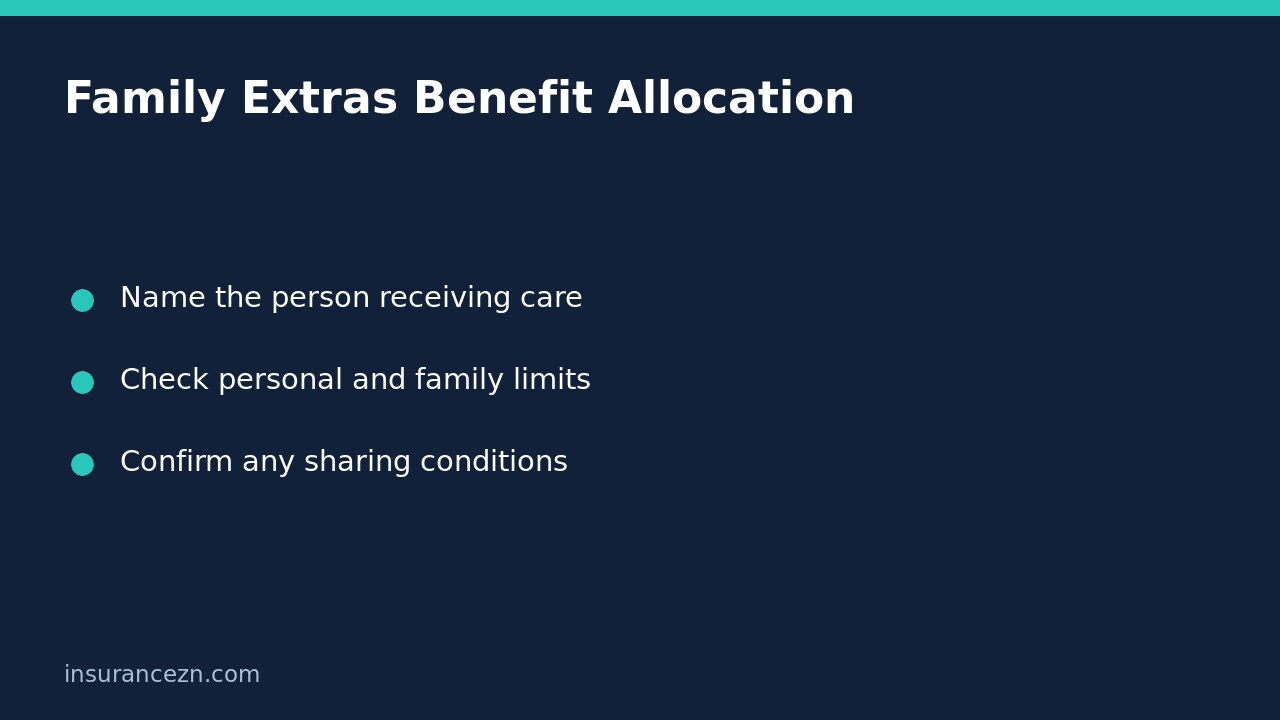
Allocate planned treatment to the actual person
Begin with a simple list of reasonably expected services. Put the family member’s name beside each appointment or item, along with the provider, expected service date and itemised price. Keep optional purchases separate from clinically recommended care. Do not book unnecessary treatment merely to use an allowance.
A useful worksheet has one row per service, not one row per family. For example, list a parent’s glasses, another adult’s dental appointment and a child’s physiotherapy separately. This makes it harder to assume that an unused optical allowance can fund dental care, or that one person’s unused benefit automatically belongs to another.
Where there is an existing treatment quote, preserve the exact service description. Our guide to comparing extras against an itemised dental quote explains why a broad category label is not enough to calculate a personal benefit.
Ask which limit controls each row
The Australian Government’s PrivateHealth.gov.au overview of private cover explains that general treatment benefits are limited and that per-service, annual and lifetime limits can apply. It recommends checking the Private Health Information Statement and obtaining details from the insurer. That general overview does not establish whether a particular family allowance is transferable.
For each shortlisted policy, ask the fund to identify the actual rules affecting each person and service:
- Is the displayed limit per person, per membership, or a combination?
- Is there also a smaller service-specific benefit or limit?
- Does the service share a limit with another treatment category?
- If sharing is offered, which people, services and amounts are eligible?
- Do waiting periods, prior claims or lifetime usage reduce the available amount?
Request the applicable wording and a written estimate for your planned services. A family total may be a ceiling rather than a pool that any member can freely use. Conversely, do not rule out sharing where a product expressly provides it: check the precise conditions rather than making either assumption.
Compare household costs without counting benefits twice
Place each fund’s estimated benefit next to the same itemised provider charge. Calculate the expected personal payment for that service from those matched figures, keeping unconfirmed estimates visibly marked. Then compare the household’s total expected personal payments and premiums over the same period.
If several services draw from one shared limit, ask the fund to model the sequence together. Separate estimates made as though every claim were the first claim can overstate what remains for later treatment. Do not count an allowance once for the adult and again for the child unless the product actually permits those separate amounts.
Check what happens if the clinical plan changes or one person does not use the expected service. An unused theoretical allowance is not cash returned to the household. Do not treat it as a saving unless it can actually reduce an eligible planned expense under the policy.
Verify records before switching or booking
Provide the fund with accurate prior usage and ask which benefit year and service date rules apply. If you are changing funds, obtain confirmation about waiting-period recognition and any effect of earlier claims. Do not assume a fresh membership number resets limits or creates transferable credits.
After a membership amendment, check the processed member list, product, effective date and payable premium. Submitting a request to add or remove someone is not proof that the record changed. Nor does a correctly updated membership guarantee payment for every treatment. Provider recognition, exact services and other policy conditions remain separate checks.
Can one child use another child’s unused allowance?
Only rely on that arrangement if the fund confirms that the exact product permits it for the relevant service and circumstances. Ask for an estimate naming the child receiving treatment and showing the applicable personal and family limits. Avoid sending more health information than is necessary for the enquiry.
Keep a short decision record
Save the quote, policy wording, written benefit estimates and your service-by-service worksheet together. Note unanswered sharing questions rather than filling them with assumptions. The useful comparison is what the household would actually pay for its expected care, not the largest combined number in an advertisement. A benefit estimate supports planning; final entitlement still depends on the claim and applicable rules.