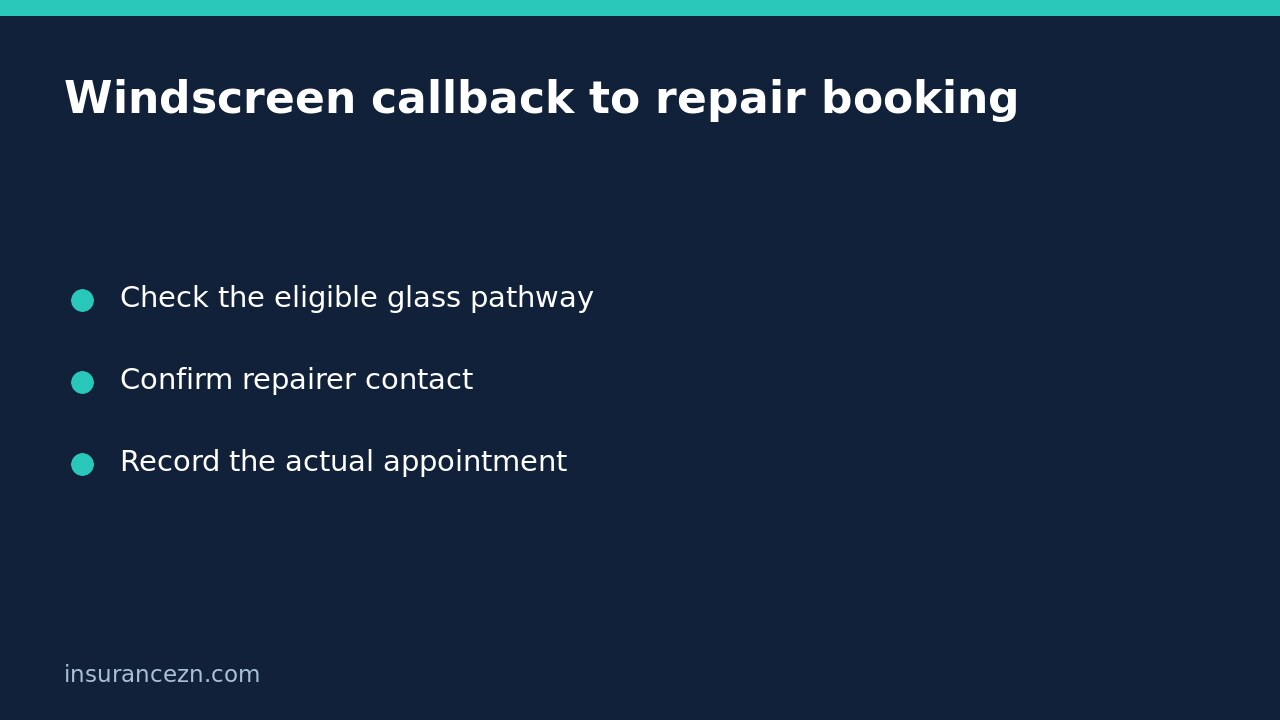

A promise that a glass repairer will call you is not a confirmed windscreen repair appointment. Before taking time off work or driving to a workshop, check whether your claim has reached the correct glass pathway, who should contact you and whether an actual appointment has been agreed.
This matters because a callback target can apply only to eligible policyholders and a particular lodgement channel. It does not automatically describe every motor claim, establish that all glass damage is covered or guarantee when the repair will finish.
Read what the callback promise actually says
As a provider-specific example, Suncorp’s comprehensive-car claims instructions say eligible policyholders lodging a glass or windscreen claim online receive a callback directly from the glass repairer within two hours. That wording describes contact following eligible online lodgement, not a two-hour repair service.
Do not transfer that statement to another insurer, a different product or a general body-repair claim. Check your provider’s current instructions and the message attached to your own claim. If a page does not explain a timing qualification, such as how an overnight submission is handled, ask rather than inventing an operating-hours rule.
Save the relevant confirmation and note the submission time, claim number and wording you relied on. A screenshot is useful context for an enquiry, but it does not independently establish eligibility or acceptance.
Establish whether a repairer handover happened
Use the insurer’s official website, app or a contact number checked against your policy documents. Explain that you are checking the glass-repairer callback, not asking to lodge the same incident again. Ask these specific questions:
- Is the existing claim recorded as a glass or windscreen claim?
- Does the advertised callback pathway apply to this policy and submission?
- Has the referral reached the repairer, and which business is receiving it?
- What action is needed if the expected contact has not occurred?
- Which claim reference should the repairer use when speaking with you?
Keep the original reference while resolving the handover. A delayed call does not prove the first submission failed. Starting another claim can make it harder to establish which record contains the current instructions. If the insurer confirms a different submission step is necessary, retain that instruction with your records.
Turn the conversation into a real appointment
When the repairer contacts you, distinguish preliminary questions from a confirmed booking. They may need vehicle details, photographs or information about the damaged glass before discussing a suitable service. Answer accurately and identify anything you cannot confirm.
Record the workshop address or mobile-service location, agreed date, appointment window, booking reference and work proposed. Ask whether the visit is an inspection, chip assessment or replacement appointment. Confirm whether any further insurer decision is outstanding and how any customer-payable charge will be explained.
For a vehicle with cameras or sensors near the windscreen, ask whether additional checks or calibration need consideration. Do not assume a call about glass establishes approval for every associated task. Likewise, do not treat a repairer’s preliminary cost discussion as the insurer’s final benefit decision.
Keep safety and transport separate from the callback
In a hypothetical example, an owner lodges online, expects a quick call and tells their employer the car will be repaired that afternoon. The repairer has not yet assessed the required work or offered a booking. The immediate correction is to obtain the actual appointment and clarify any outstanding approval, not to assume the callback promise guarantees same-day completion.
If the damage may make driving unsafe or unlawful, do not drive just to keep a tentative appointment. Seek appropriate safety guidance and discuss safe transport through verified channels. A glass callback does not itself establish towing or hire-car entitlement. Never delay emergency assistance while checking claim administration.
If a promised call was missed for a separate reason, our guide to checking the recorded car-claim contact number addresses that contact-record problem. Here the task is to reconcile the glass referral and actual booking.
Questions before you rearrange your day
Does an eligible callback mean my glass benefit has no excess? No. Check the applicable benefit, excess, exclusions and insurer decision separately.
Does a repairer calling mean every requested repair is authorised? No. Ask what work is approved, what remains conditional and who will confirm any additional costs.
What should I keep? Retain the claim confirmation, referral enquiry, repairer details and final appointment notice. Label a requested booking as requested until it is confirmed.
This is general information for Australian readers, not personal financial advice. Cover and services depend on your policy, Product Disclosure Statement (PDS), schedule, eligibility, exclusions and claim assessment. The Suncorp example describes its stated pathway, not a universal service promise or an endorsement.