
Managing the finances and paperwork for more than one vehicle can feel like a logistical nightmare. Between monthly payments, maintenance costs, and the ever-present worry of an accident, adding insurance premiums to the mix often leads homeowners to overlook potential savings. The most effective way to streamline this process is by bundling your coverage into a single multi-car policy. However, not all insurers offer the same discounts, nor are their pricing algorithms identical. This guide details how to compare car insurance for multiple vehicles in one policy, ensuring you secure the best rates without sacrificing necessary coverage levels.
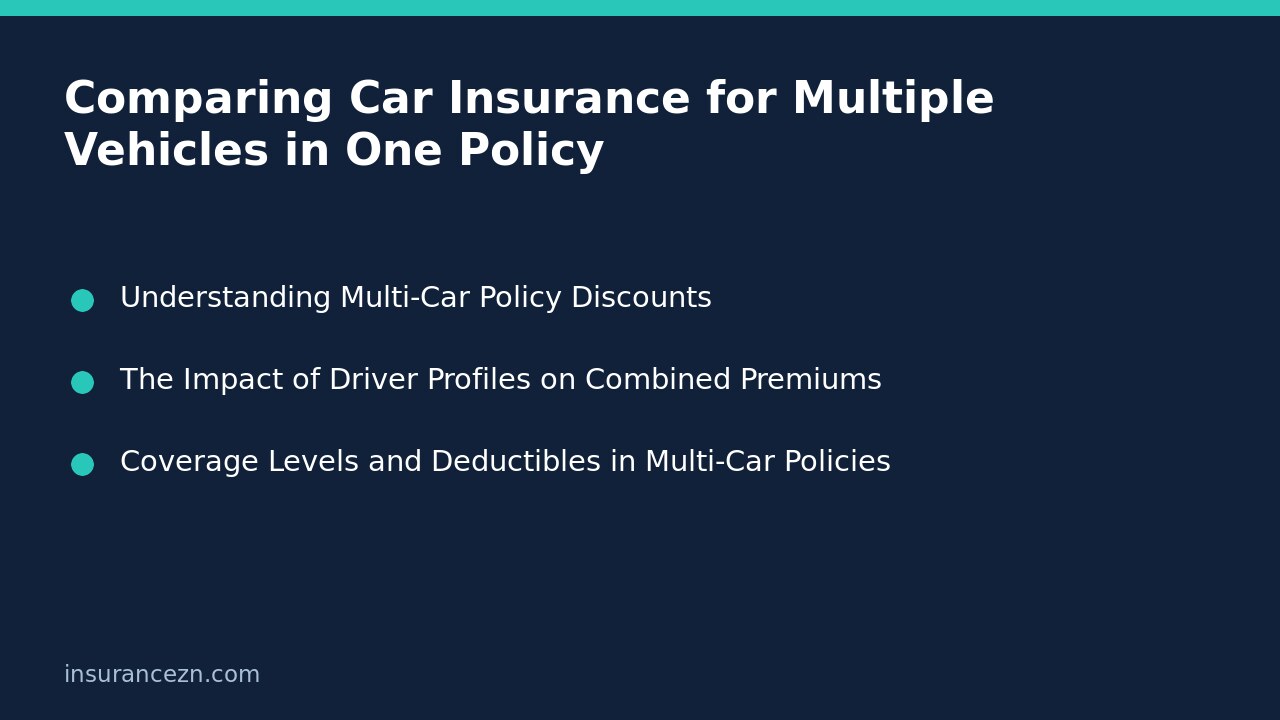
Understanding Multi-Car Policy Discounts
Insurers incentivize customers who insure multiple vehicles by offering multi-car discounts. These savings typically range from 5% to 25%, depending on the carrier and your specific profile. The logic is straightforward: insuring multiple cars often indicates a stable household with lower risk factors, such as a long-term residence and consistent payment history.
When comparing quotes, it is crucial to understand how these discounts are applied. Some insurers apply the discount only to the primary vehicle, while others prorate the savings across all vehicles on the policy. For example, if you have two cars and one qualifies for a “safe driver” discount while the other does not, some carriers might offer the multi-car discount on the total premium but exclude the non-qualifying car from other specific discounts. Always ask your agent or check the quote breakdown to see exactly where the savings are being applied.
The Impact of Driver Profiles on Combined Premiums
One common misconception is that adding a second vehicle automatically doubles your cost and then applies a small discount. In reality, the premium for a multi-car policy is calculated based on the highest-risk driver in each vehicle. If you own two cars but only one is driven by a high-risk driver (such as a teenager with limited experience), the insurer may price the entire policy closer to that higher risk level rather than averaging the two risks.
Conversely, if both vehicles are driven by low-risk adults with clean records, the multi-car discount can be substantial. However, if one vehicle is an expensive luxury car driven by someone with a recent at-fault accident, the insurer will likely rate the whole policy based on that high cost of liability and potential claim frequency. When comparing quotes, ensure you list all drivers for all vehicles accurately. Hiding a secondary driver to get a better quote is fraudulent and can lead to policy cancellation if discovered during a claim investigation.
Coverage Levels and Deductibles in Multi-Car Policies
When bundling cars, insurers often require that coverage levels be consistent across the fleet, though some flexibility exists. For instance, you might want comprehensive and collision coverage on your new SUV but only liability on your older sedan. While many carriers allow this, others default to applying the highest limit or deductible selected for any vehicle on the policy to every other vehicle.
Consider a scenario where you select a $500 deductible for your primary car and a $1,000 deductible for your secondary car. Some insurers will charge you the higher $1,000 rate for both vehicles in their calculation engine. To avoid this hidden cost increase, compare how different companies handle mixed deductibles. Additionally, be mindful of liability limits. If one car requires high bodily injury limits due to local laws or personal preference, the insurer may upgrade the entire policy’s umbrella coverage, potentially increasing your premium if you were previously paying for lower limits on the second car.
Common Mistakes to Avoid When Shopping Around
The process of comparing multi-car insurance is fraught with pitfalls that can lead to underestimating costs or overpaying. One frequent error is using online quote tools without entering complete information. Many consumers enter details for their primary vehicle but forget to add their spouse’s car or a child’s vehicle, resulting in a quote that is significantly lower than the final bill. Always ensure every driver and every VIN is included in the initial data entry.
Another mistake is assuming that switching carriers will result in an immediate price drop without a “free look” period review. When you switch insurers, your new policy starts with a clean slate, but your old insurer may also offer retention bonuses or final adjustments based on recent driving behavior. Furthermore, do not ignore the difference between “binding authority.” Some online aggregators provide estimates that are not guaranteed until fully underwritten by the specific carrier. Always request a formal, binding quote from the insurance company directly rather than relying solely on a third-party aggregator’s preliminary number.
Step-by-Step Guide to Comparing Multi-Car Quotes Effectively
To ensure you get the most accurate comparison, follow this structured approach:
- Gather Vehicle Data: Compile the VIN, make, model, year, and current mileage for every vehicle in your household.
- List All Drivers: Create a list of everyone who drives these cars, including their age, gender, license status, and any prior accidents or violations.
- Define Coverage Needs: Decide on the liability limits (e.g., 100/300/100), comprehensive/collision deductibles, and whether you need rental reimbursement or gap insurance for each car.
- Request Formal Quotes: Contact at least three major insurers and two local independent agents. Provide them with the identical data points gathered in steps one through three to ensure an apples-to-apples comparison.
- Analyze the Breakdown: Look beyond the bottom-line price. Examine where the savings come from (multi-car discount vs. safe driver discount) and verify how mixed deductibles are being priced.
- Check for Gaps: Ensure the policy explicitly states that all listed vehicles are covered under the same policy number and that the discounts are reflected in the final premium amount.
Real-World Example: The Miller Family Scenario
Consider the Miller family, who owns a 2018 Honda Civic driven by their daughter (a new driver) and a 2015 Toyota Camry driven by their son (an experienced driver). They currently pay separate policies for each car. When they decide to bundle with a national insurer, they input both vehicles. The insurer applies a 15% multi-car discount. However, because the daughter is a new driver, the base rate for her vehicle is high. If they had chosen a higher deductible for the father’s older Camry to save money, the insurer might have raised the deductible requirement for the daughter’s car as well, negating some savings. By comparing quotes, they found that one carrier allowed them to keep different deductibles per vehicle while still granting the multi-car discount, saving them an additional $120 annually compared to a competitor who forced uniform deductibles.
Conclusion and Final Checklist
Comparing car insurance for multiple vehicles requires more than just clicking a few buttons on a website; it demands a careful analysis of how insurers calculate risk across a fleet. By understanding the mechanics of multi-car discounts, driver profiling, and coverage consistency, you can navigate the market with confidence. Remember that terms, availability, eligibility, laws, and prices depend heavily on the specific insurer, your policy details, and your jurisdiction.
Before finalizing your decision, run through this quick checklist:
* [ ] Did I include every vehicle and driver in the quote?
* [ ] Does the quote explicitly show the multi-car discount applied?
* [ ] Are my preferred deductibles allowed for each specific vehicle, or does the insurer force uniformity?
* [ ] Have I verified that the liability limits meet my state’s minimum requirements and my personal risk tolerance?
* [ ] Is there a clear cancellation clause in case I need to switch back or add another car later?
Taking the time to compare these nuances ensures you are not just paying for insurance, but securing a smart financial strategy for your entire household.