
Navigating the landscape of health insurance can feel like deciphering a foreign language, especially when you first encounter terms like “premium,” “copay,” and “deductible.” Among these, the deductible often causes the most confusion. It is not merely a fee you pay once; it is a fundamental mechanic that determines how much you must spend out-of-pocket before your insurance company begins to share the cost of your medical care. Understanding this concept is crucial for managing your healthcare budget and avoiding financial surprises when illness or injury strikes. This guide breaks down exactly what a deductible is, how it functions within different plan types, and practical strategies to manage your expenses effectively.
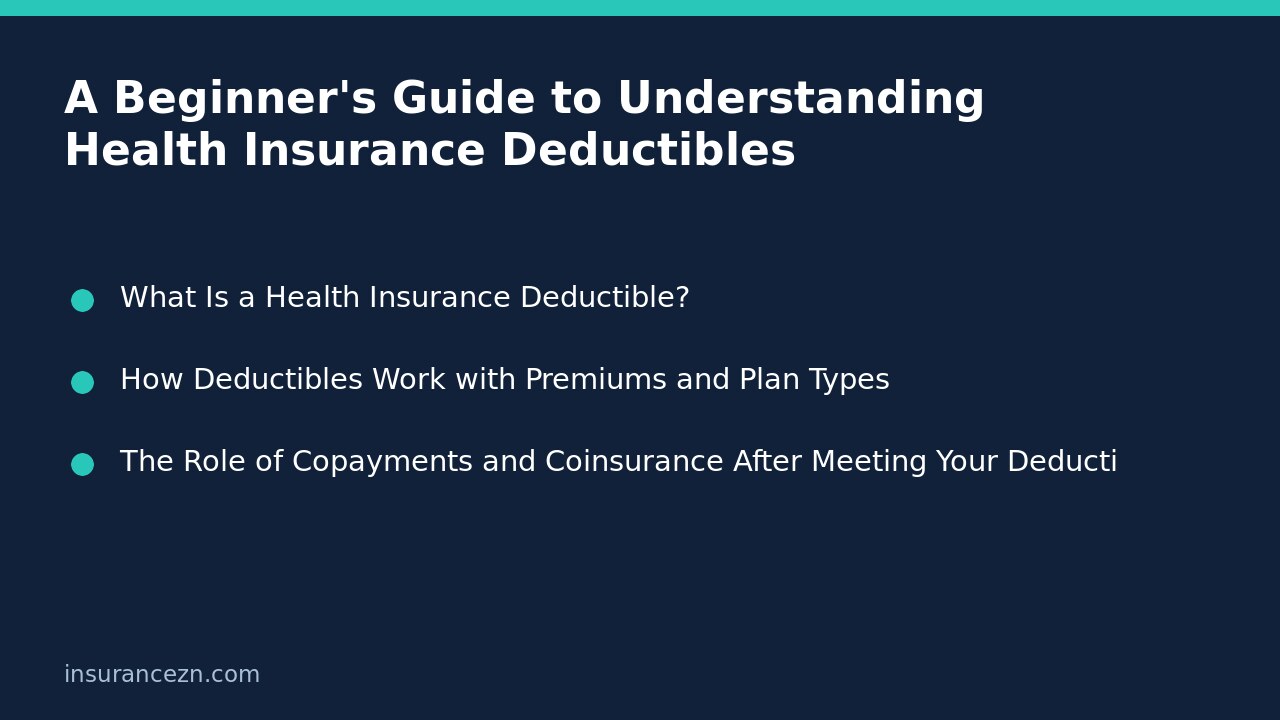
What Is a Health Insurance Deductible?
At its core, a health insurance deductible is the specific amount of money you are required to pay for covered healthcare services before your insurance plan starts to pay. Think of it as a threshold. Until you cross this financial line through out-of-pocket spending, you are responsible for 100% of the costs for eligible medical services. Once you meet your deductible, your insurance coverage kicks in, usually shifting the cost-sharing burden to copayments and coinsurance.
It is vital to distinguish between a “covered” service and an “eligible” one. Not every medical expense counts toward your deductible. For instance, if your plan covers preventive care under the Affordable Care Act (ACA), you typically pay $0 for these services regardless of whether you have met your deductible. However, expenses like doctor visits for illness, hospital stays, surgeries, and prescription drugs generally count toward meeting your annual deductible limit.
How Deductibles Work with Premiums and Plan Types
There is a direct relationship between your monthly premium and your annual deductible. Insurance operates on a risk-pooling model: plans with lower monthly premiums usually come with higher deductibles because you are taking on more of the financial risk yourself. Conversely, plans with high monthly premiums offer lower deductibles, providing more protection against large medical bills but costing more upfront every month.
Most health insurance plans fall into two categories regarding how they handle deductibles:
1. Individual Deductible: This is the amount you must pay before your plan starts paying. This applies to you and your family members individually. If you get sick and spend $500 on care, and your spouse gets sick and spends $600, you both contribute $500 each toward their respective deductibles.
2. Family Deductible: In some plans, the deductible is calculated for the entire family unit. Once the combined total of all family members’ medical spending hits this limit, the plan begins to pay for everyone’s covered services.
The Role of Copayments and Coinsurance After Meeting Your Deductible
Once you have met your deductible, you do not suddenly stop paying for healthcare. Instead, the structure of your payments changes. Most plans utilize a combination of copayments and coinsurance after the deductible is met.
- Copayment (Copay): This is a fixed amount you pay for a specific service, such as $20 for a primary care doctor visit or $10 for a generic prescription drug. In many plans, you pay the copay even after meeting your deductible, though some plans require you to meet the deductible first before any copays apply.
- Coinsurance: This is a percentage of the cost of a service that you pay. For example, if your plan has an 80/20 coinsplit after the deductible, you pay 20% of the bill, and the insurance company pays the remaining 80%.
Understanding this shift is essential for budgeting. If you have a minor cold, you might pay a small copay. If you require surgery, even with a met deductible, you will still owe coinsurance until you reach your plan’s “out-of-pocket maximum.”
Out-of-Pocket Maximum: Your Financial Safety Net
Every health insurance policy includes an out-of-pocket maximum (OOPM). This is the absolute most amount you will have to pay for covered services in a plan year. This limit includes your deductible, copayments, and coinsurance. It explicitly excludes premiums and costs for non-covered services.
Once you reach your out-of-pocket maximum, your insurance plan pays 100% of the cost of covered benefits for the rest of the year. This is a critical safety net that prevents catastrophic medical expenses from bankrupting a household. For example, if your OOPM is $6,500 and you have spent that much on deductibles and coinsurance during a severe illness, any further hospital stays or treatments will be fully covered by insurance until the policy resets the following year.
Real-World Example: Calculating Your Total Cost
To visualize how these concepts interact, let’s look at a concrete scenario involving Sarah, who has an HMO plan with the following terms:
* Annual Deductible: $1,500
* Coinsurance after deductible: 20% (Sarah pays) / 80% (Insurance pays)
* Out-of-Pocket Maximum: $6,500
Scenario: Sarah suffers a car accident requiring emergency room visits, surgery, and physical therapy. Her total billed charges for covered services are $12,000.
- Emergency Room Visit ($4,000): Sarah pays the full $4,000 because she hasn’t met her deductible yet. This brings her total spent to $4,000.
- Surgery and Hospital Stay ($8,000): She now has a $4,000 balance left on her deductible. The insurance company processes the bill. Sarah pays her share of the remaining deductible amount first. Let’s assume the negotiated rate is used. If the surgery costs $8,000, she must pay enough to reach the $1,500 deductible total.
- Remaining needed for deductible: $1,500 – $4,000 (already paid) = Deductible already met? No, wait. She paid $4,000 on the ER visit. That covers the entire $1,500 deductible requirement immediately.
- Now that the deductible is met, the 20/80 coinsurance applies to the remaining balance of the surgery and hospital stay.
- Assuming the total allowed charge for surgery/stay is $7,000 (after insurance adjustment): Sarah pays 20% of $7,000 = $1,400. Insurance pays $5,600.
Total Cost to Sarah: $4,000 (ER) + $1,400 (Surgery coinsurance) = $5,400.
Since she spent only $5,400 and her out-of-pocket max is $6,500, she has not hit the cap yet. Any subsequent physical therapy sessions would likely involve a copay or small percentage until she hits that $6,500 limit, at which point insurance covers everything else.
Common Mistakes to Avoid
Many policyholders make errors that lead to unexpected bills:
* Assuming All Costs Count: As mentioned earlier, preventive care, vision, and dental often do not count toward the medical deductible. Do not assume every dollar spent reduces your deductible balance.
* Ignoring In-Network Status: Services received out-of-network rarely count toward your in-network deductible. Always verify that your providers are in-network to ensure expenses apply to your plan’s limits.
* Confusing Premiums with Deductibles: Remember that paying your monthly premium does not mean you have “paid” for medical care. The premium buys the right to insurance; the deductible is the cost of utilizing that right.
Conclusion and Final Checklist
Understanding health insurance deductibles empowers you to make informed decisions about your healthcare spending. By recognizing when you are approaching your deductible, you can plan financially for the upcoming year. Before signing up for a new policy or reviewing your current one, consider this quick checklist:
1. Identify your annual deductible amount.
2. Determine if it is an individual or family deductible.
3. Check which services count toward the deductible (usually medical, not preventive).
4. Note your out-of-pocket maximum to know your worst-case scenario cost.
5. Calculate whether a higher premium with a lower deductible makes sense for your risk tolerance and cash flow.
Remember that insurance terms, availability, eligibility, laws, and prices depend heavily on the specific insurer, the policy details, and your jurisdiction. This guide provides general educational information and is not individualized financial or legal advice. Always consult your specific policy documents or contact your insurance provider for details regarding your unique situation.